Islamists seize Somali town near Ethiopia
September 30 2006 at 02:30PM
Baidoa - Somalia's Islamic fighters have seized control of a strategic village near the Ethiopian border, the group said on Saturday.Fighters loyal to the radical Union of Islamic Courts group routed pro-government militia from the village of Jawill, some 15km from the Ethiopian border. The only roads between Ethiopia and central Somalia pass through the village."The militiamen who controlled this village had a good relationship with Ethiopia so we decided they were an obstacle to our control in the region," said Hassan Abdirahman, whose Islamic fighters carried out the operation. "Some 200 fighters carried out the attack, he said.Local resident Abdi Risaq told The Associated Press by telephone that three pro-government militiamen and one fighter with the Union of Islamic Courts were killed during Friday's gunbattle for the village.
The militia loyal to the virtually powerless government fled across the Ethiopian border, according to eyewitnesses and the Islamic forces who captured the village.On Friday, the US State Department said it was worried by a surge of Muslim fundamentalism in Somalia."Some of their behavior is a source of concern," department spokesperson Sean McCormack said of reports that fundamentalist militia had seized control of much of the African country.Kenya has already also put its troops on high alert because of the deteriorating security in neighboring Somalia.Somalia has not had an effective national government since 1991, when warlords overthrew dictator Mohamed Siad Barre and then turned on one another, throwing the country into anarchy.The government has struggled to assert authority, while the Islamic movement seized Mogadishu after fierce battles with secular warlords in June and now controls much of the south. Ethiopia has been accused of deploying troops to prop up the government, which it denies.Analysts fear a regional conflict if Islamic militias and Ethiopian forces clash.The Islamic group's strict and often severe interpretation of Islam raises memories of Afghanistan's Taliban, which was ousted by a US-led campaign for harbouring Osama bin Laden and his al-Qaida fighters.Washington has accused Somalia's Islamic group of sheltering suspects in the 1998 al-Qaida bombings of US embassies in Kenya and Tanzania. Bin Laden has said Somalia is a battleground in his war on the West.Meanwhile militia loyal to the country's defense minister, Colonel Barre "Hirale" Aden Shire, have begun fortifying their positions, fearing an attack from the Islamic courts, local journalist Mohamed Ali Siyad told the AP.Colonel Shire, whose forces had controlled the strategic seaport of Kismayu until its capture by Islamic fighters on Sunday, reassembled his militia in the town of Baardheere, 200km southwest of Baidoa, where Somalia's weak government is based.Islamic forces who chased him out of Kismayo on Sunday have left the seaport and are now at Bu'aale, 150km south of Baardheere, a traditional elder, Sheik Salah Mayow, who lives in Bu'aale, said.
Sapa-AP
September 30, 2006
OLF says anything can happen anytime in Ethiopia
ADDA BILISUMMAA OROMOO
OROMO LIBERATION FRONT
Resolutions of the OLF Executive Committee
September 29, 2006 — The Oromo Liberation Front (OLF) Executive Committee has successfully conducted its regular meeting from September 25 to 29, 2006. After listening to the reports of the different departments, thoroughly analysing and deliberating on the overall condition and performance of the organization, the struggle of the Oromo people, the Oromo society, the Tigray Peoples Liberation Front (TPLF)-led government of Ethiopia, the political condition of the Horn of Africa and the global situation at large, the committee has issued the following statement.
The committee observed that the organization’s overall activities have been fruitful with creative responses and approaches to challenges of the time. Tangible achievements have been registered during this period. The organization’s efforts in expanding the horizon and coordinating of the different liberation and democratic forces on the Ethiopian arena have been consummated by the formation of the Alliance for Freedom and Democracy (AFD). Plans to build on the successes and overcome the shortcomings have been laid down in order to further intensify the struggle and bring it to the next stage.
The committee concluded that the human rights abuses, economic disenfranchisement, social disintegration and political repressions of the Oromo and other peoples under the current regime of Ethiopia have not shown any improvement. Despite all these repressive and heinous deeds of the regime, the Oromo people have continued to challenge the repression. The open resistance to this oppressive regime has gone beyond the student protests with the core of the regime’s mainstay, the military, including highest ranking officers, quitting the regime in protest and joining the Oromo liberation camp. In response the regime is resorting to further repression, isolating itself and inviting further chaos.
The Executive Committee expresses its appreciation for the Oromo people’s organized peaceful resistance headed by the gallant students of all levels of education and categorically condemns the violent repressive deeds of the TPLF regime. The committee also expresses its highest appreciation for the heroic actions of the courageous Oromo nationals serving in the military institution of the regime led by top ranking officers who joined the people’s struggle. The committee calls upon the Oromo people in general and those serving in the different sectors of the system in particular to stop serving this dying regime and take immediate action to further accelerate its imminent downfall.
The TPLF-led government of Ethiopia has never demonstrated any change in its policy of handling political problems of the country or in its dealings with political organizations and parties. The formation of AFD has introduced a new paradigm in Ethiopia’s political arena where polarization, confrontation and unhealthy competition between differing political questions and opinions had been the norm all along. The urgency for an all-inclusive conference is more real now than any other time before. Hence, the Committee calls upon all members of the Alliance to heighten their activities in all aspects to implement its stated program and objectives. We also call upon all other political forces to rally to play their roles in the achievement of the overall objective of the Alliance. The Committee also calls upon the general population to stand behind the AFD so that it meets the demand of the time.
On the regional level, the Executive Committee has observed that the TPLF-led Ethiopian government has continued its destabilizing activities in Somalia defying the UN imposed embargo of arms and military intervention. The committee calls upon all the stakeholders of the stability in the region to support dialogue among the parties concerned to find a lasting solution without any direct external intervention.
In conclusion the Executive Committee sees that the situation in Ethiopia is daily deteriorating. Peaceful political expression, both popular and organised, is increasingly stifled. With the regime’s continued intransigence to all proposals to peacefully resolve outstanding political issues impatience, desperation, frustration and hopelessness is mounting. Defections and resistance is tremendously escalating in all sectors to the extent that anything can happen anytime. We therefore call upon all concerned parties to embark on facilitating a process that will lead to a comprehensive solution to all outstanding problems.
Victory to the Oromo People!
The Executive Committee
Oromo Liberation Front
OROMO LIBERATION FRONT
Resolutions of the OLF Executive Committee
September 29, 2006 — The Oromo Liberation Front (OLF) Executive Committee has successfully conducted its regular meeting from September 25 to 29, 2006. After listening to the reports of the different departments, thoroughly analysing and deliberating on the overall condition and performance of the organization, the struggle of the Oromo people, the Oromo society, the Tigray Peoples Liberation Front (TPLF)-led government of Ethiopia, the political condition of the Horn of Africa and the global situation at large, the committee has issued the following statement.
The committee observed that the organization’s overall activities have been fruitful with creative responses and approaches to challenges of the time. Tangible achievements have been registered during this period. The organization’s efforts in expanding the horizon and coordinating of the different liberation and democratic forces on the Ethiopian arena have been consummated by the formation of the Alliance for Freedom and Democracy (AFD). Plans to build on the successes and overcome the shortcomings have been laid down in order to further intensify the struggle and bring it to the next stage.
The committee concluded that the human rights abuses, economic disenfranchisement, social disintegration and political repressions of the Oromo and other peoples under the current regime of Ethiopia have not shown any improvement. Despite all these repressive and heinous deeds of the regime, the Oromo people have continued to challenge the repression. The open resistance to this oppressive regime has gone beyond the student protests with the core of the regime’s mainstay, the military, including highest ranking officers, quitting the regime in protest and joining the Oromo liberation camp. In response the regime is resorting to further repression, isolating itself and inviting further chaos.
The Executive Committee expresses its appreciation for the Oromo people’s organized peaceful resistance headed by the gallant students of all levels of education and categorically condemns the violent repressive deeds of the TPLF regime. The committee also expresses its highest appreciation for the heroic actions of the courageous Oromo nationals serving in the military institution of the regime led by top ranking officers who joined the people’s struggle. The committee calls upon the Oromo people in general and those serving in the different sectors of the system in particular to stop serving this dying regime and take immediate action to further accelerate its imminent downfall.
The TPLF-led government of Ethiopia has never demonstrated any change in its policy of handling political problems of the country or in its dealings with political organizations and parties. The formation of AFD has introduced a new paradigm in Ethiopia’s political arena where polarization, confrontation and unhealthy competition between differing political questions and opinions had been the norm all along. The urgency for an all-inclusive conference is more real now than any other time before. Hence, the Committee calls upon all members of the Alliance to heighten their activities in all aspects to implement its stated program and objectives. We also call upon all other political forces to rally to play their roles in the achievement of the overall objective of the Alliance. The Committee also calls upon the general population to stand behind the AFD so that it meets the demand of the time.
On the regional level, the Executive Committee has observed that the TPLF-led Ethiopian government has continued its destabilizing activities in Somalia defying the UN imposed embargo of arms and military intervention. The committee calls upon all the stakeholders of the stability in the region to support dialogue among the parties concerned to find a lasting solution without any direct external intervention.
In conclusion the Executive Committee sees that the situation in Ethiopia is daily deteriorating. Peaceful political expression, both popular and organised, is increasingly stifled. With the regime’s continued intransigence to all proposals to peacefully resolve outstanding political issues impatience, desperation, frustration and hopelessness is mounting. Defections and resistance is tremendously escalating in all sectors to the extent that anything can happen anytime. We therefore call upon all concerned parties to embark on facilitating a process that will lead to a comprehensive solution to all outstanding problems.
Victory to the Oromo People!
The Executive Committee
Oromo Liberation Front
September 28, 2006
Ten government journalists defected!
EMF (Sept. 28 ) - More than ten government journalists had defected to the US, Europe and Asia fearing persecution, subsequent to refusing orders to produce false stories about opposition parties, source said. According to sources, journalists of the government controlled media in Ethiopia, who refuse order from the authorities to misinform the public are threatened to death. Escaped journalists say, the general manger of the government Press Agency, Kefyalew Azeze, insists all government journalists to produce false news about the popular Coalition for Unity and Democracy (CUD) party. “You have no right to question any orders from the boss”, says one of the defected journalist, “our other option is incarceration with treason charges.”
Dereje Tedla, journalist at government news agency and the Amharic daily Addis Zemen, who defected from Ethiopia to Japan, is known for his bravely challenging the Meles Zenawi regime. In a letter written to EMF on Wednesday, 27 September, 2006, Dereje said the Federal Police Officers came to his home On 25 November 2005, midnight and warned him to stop any opposition against the government, otherwise they were ready to kill him and all his family. Exhausted with intimidation and harassment, Dereje Tedla, 29, said that when he is approached by a soldier who threatened him by saying, “I am ready to kill you unless you denounce CUD". He had to make his way to escape from the brutal regime and through sponsorship by IAAF; he entered Japan, where he applied for political asylum.According to the International Federation of Journalists (IFJ), the government of Meles Zenawi has incarcerated more journalists than any other country in the world. In its recent statement, the IFJ’s Baglo says, “The Ethiopian Free Press Journalists Association (EFJA) is completely disbanded; there is no independent media in Ethiopia, as most independents journalists have gone underground and about 100 journalists are in exile, including EFJA President Kifle Mulat.” Below are among defected government journalists over the last six months:
Fisha Tegegn - FM 97.1 Radio
Getaneh Tsige - Ethiopian Press Agency
Aregash Mokennen - Ethiopian Press Agency
Yohannies Ayalew - Ethiopian Television
Hailu Tsige - Ethiopian Press Agency
Andargachew Tamir - Radio Fanna
Fasika Girmay - Ethiopian Television
Yared Belayneh - Ethiopian Radio
Mohamed Ahmed - Ethiopian Television
Dereje Tedla Demissie- Ethiopian Press Agency
Dereje Tedla, journalist at government news agency and the Amharic daily Addis Zemen, who defected from Ethiopia to Japan, is known for his bravely challenging the Meles Zenawi regime. In a letter written to EMF on Wednesday, 27 September, 2006, Dereje said the Federal Police Officers came to his home On 25 November 2005, midnight and warned him to stop any opposition against the government, otherwise they were ready to kill him and all his family. Exhausted with intimidation and harassment, Dereje Tedla, 29, said that when he is approached by a soldier who threatened him by saying, “I am ready to kill you unless you denounce CUD". He had to make his way to escape from the brutal regime and through sponsorship by IAAF; he entered Japan, where he applied for political asylum.According to the International Federation of Journalists (IFJ), the government of Meles Zenawi has incarcerated more journalists than any other country in the world. In its recent statement, the IFJ’s Baglo says, “The Ethiopian Free Press Journalists Association (EFJA) is completely disbanded; there is no independent media in Ethiopia, as most independents journalists have gone underground and about 100 journalists are in exile, including EFJA President Kifle Mulat.” Below are among defected government journalists over the last six months:
Fisha Tegegn - FM 97.1 Radio
Getaneh Tsige - Ethiopian Press Agency
Aregash Mokennen - Ethiopian Press Agency
Yohannies Ayalew - Ethiopian Television
Hailu Tsige - Ethiopian Press Agency
Andargachew Tamir - Radio Fanna
Fasika Girmay - Ethiopian Television
Yared Belayneh - Ethiopian Radio
Mohamed Ahmed - Ethiopian Television
Dereje Tedla Demissie- Ethiopian Press Agency
September 26, 2006
Get Ethiopian troops out of Somalia
In early summer, at the request of the fledgling Somali government, neighboring Ethiopia moved troops into Somalia to halt the advance of the Union of Islamic Courts (UIC), which already controls much of the south, including Mogadishu, Somalia's capital.
Ethiopia's actions seem to be in the best interest of the United States, as a militant Islamic regime in Somalia would be a major complication in the war on terror. However, Ethiopia is neither suited to promoting peace in Somalia nor interested in pacifying the troubled land. In truth, no country stands to gain more than Ethiopia from a war against the Islamic militias in Somalia.
Ethiopian troops in Somalia are regarded as hated foreign interlopers whose sole purpose is to prop up an unpopular and powerless regime. Ethiopian soldiers on Somali soil strengthen the Islamic Courts by allowing them to claim the mantle of nationalist defenders, which garners them popular support and undermines the country's transitional government. Ethiopia's Prime Minister Meles Zenawi is not only aware that his actions have increased the possibility of conflict, but is counting on the outbreak of war to win him aid.
The past year has not been kind to the Ethiopian government. After fixed elections that allowed Mr. Zenawi to win a third term, the government began a crackdown on the opposition. In response, the US Congress passed a bill branding the government as undemocratic and an abuser of human rights. Additionally, international donors have stopped the flow of cash to the Ethiopian government, and have not been in contact with the regime for several months. The loss of aid has hurt, as Ethiopia is one of the most aid-dependent countries in the world.
But an anti-Islamist war in Somalia would enable Zenawi to position himself as a key ally in the war on terror. Zenawi reasons that if his country plays an essential role in supporting Somalia's transitional government against the UIC, the United States will provide economic and diplomatic support, despite other objections to Ethiopia's policies. All Zenawi has to do is wait for civil war in Somalia to reignite - an outcome made more likely by his deployment of troops.
Last week, Somalia's president, Abdullah Yusuf, escaped a suicide car bomb meant to take his life. The transitional government and its Ethiopian allies have been quick to link this attack to the UIC and Al Qaeda. However, even following this attack, war is not inevitable, and the US does not have to play the fool in this potential African tragedy. While both the UIC and Ethiopia would benefit from war, three groups critical to peace would lose in this equation: The struggling transitional government, which has no interest in a war that would lead to its own destruction, and the civil war-weary population and Mogadishu business community, without whose support the UIC cannot keep control of southern Somalia.
America can appeal to these factions within Somalia by offering economic incentives - such as lifting sanctions on certain Somali companies - as a reward for cooperation in seeking a peaceful solution. By assisting a regional peacekeeping mission and supporting the current peace talks in Khartoum between the UIC and the transitional government, the US can help prevent Somalia from becoming a new front in the war on terrorism.
Yet moderation will never triumph as long as Ethiopian troops are on Somali soil and remain a rallying cry for Islamic extremists. Since 2002, the US military has operated a task force in Djibouti to provide humanitarian assistance and military instruction to the horn of Africa. One of the key benefactors has been Ethiopia. America must call immediately for Ethiopia to remove all of its forces from Somali territory. And if Zenawi does not comply, the US should suspend all nonhumanitarian operations inside Ethiopia and all future assistance to the government until Ethiopian soldiers leave Somalia.
America is prepared to help governments in need of assistance, but this aid should not go to a leader eager to spark an unnecessary war. Only when Ethiopia proves itself to be a supporter of progress in the horn of Africa, and a true ally of America in its conduct of both its foreign and domestic affairs, should it enjoy the rewards of American friendship. Until then, the US must show Ethiopia and the world that America refuses to define its allies based solely on whom they battle against, and that fighting in the war on terror merely out of self-interest is not a quick way to curry favor.
• Gregory H. Winger is a senior research assistant at the National Defense Council Foundation in Alexandria, Va.
Source: Christian Science Monitor
September 25, 2006
Ethiopia- Meles’s rule coming to an end by attrition
24 September 2006
By Zerihun Tesfaye
September 24, 2006 — With the unleashing of terror in the urban centers and the rural communities of Ethiopia after the debacle of the May 2005 elections, what little legitimacy Meles & his clique might have claimed over the years were totally lost. Events unfolding in the past year have made this abundantly clear. The semi state of emergency Meles declared the day after the elections can only be seen as an admission of the loss of this legitimacy and, at the same time, as a declaration that from that time onwards, his rule is going to rest on the security apparatus and the military.
How difficult must it be then, when the institution on which he and the clique pinned their hopes for their future rule starts being eroded under their watchful eyes in such a short time. Such is indeed the case when you have two Generals (a decorated war veteran!) Colonels, other officers and soldiers defect en masse; and to make it worse, declare their intention of joining opponents of the regime and declaring their intent to fight for its overthrow.
What makes it more alarming and painful to the clique is the fact that some of these officers were ex-POWs of the previous regime, who grew in EPRDF’s bosom, being inculcated with its ‘ideology’ cum propaganda, and who had distinguished themselves with its own criteria. Indeed, it ought to be more than alarming to the clique as to what might be larking behind its seemingly stable armed forces if these officers cut their ties loose despite the obvious loss of rank and privilege that will come with their defection,.
As if the rank of the defecting officers and soldiers was not alarming enough, the loci, timing and number of people involved must have shocked the clique, for it was a definite failure of its much talked about security apparatus - especially that of its military intelligence - to not be aware when such plans were initiated, organized and implemented with apparent ease, even though it involved a large group, and was located in a supposedly sensitive and high alert area. The clique that was highly rankled by this event, having no other choice or rather not knowing any other method of looking inward, went back to its known method of witch-hunting under the guise of Gimgema throughout the armed forces a practice which it supposedly had abandoned a few years back. The result of this was apparently the dismissal of hundreds of soldiers deemed sympathetic to the officers that defected or to other political opposition groups, and the imprisonment of scores of officers.
If this was meant to intimidate and tighten the clique’s hold on the army, it seems to have backfired, for another General and Colonel later to be joined by a Major defected in a similar manner, yet again undermining the supposedly newly strengthened military intelligence - further proving that the erosion will continue unabated until the trickle becomes a flood.
It is clear that the biggest slap on the face of the clique that caused the greatest consternation was the defection of Brigadier General Kemal, and his group for it was the clique that rushed to announce the defection so as to minimize any publicity damage the defection might inflict on the already blemished image of the regime. This step of the regime, however, would not have been futile had this been the only defection from its ranks. It was not to be. Way before the clique ‘s next press release, defection by Brigadier General Hailu Gonfa and Colonel Gemechu Ayana made headlines only to be followed by another high ranking officer Major Tesfaye Yemane.
As if this evident crumbling from the inside was not crushing enough, deep from inside one of the regime’s dungeons comes out a book written by one of the principal leaders of the opposition, who is falsely accused and jailed on trumped up charges, that narrates in great detail of events prior to, during, and after the elections of May 2005 and the regime’s descent into the abyss. This again became an occasion for the regime to realize how porous its security apparatus had become leading it to apparently interrogate and jail its own police and security responsible for the maintenance of its dungeon. In addition to this, the regime’s jitteriness was evident in its arbitrary decision of curtailing visitation rights of non immediate family members.
In as much as the great majority of the population is convinced that the regime’s heydays are over and downward descent has started, and its eventual fall is gathering momentum it has now become clear that, from what we read in the news, even stalwart regime supporters and sympathizers are also sensing this and are situating themselves in favorable positions.
The defection of over seventy diplomatic personnel, Ambassadors and staff members of Embassies to date, including a diplomat who once had the trust of the Prime Minister to serve him as his personal assistant of protocol is yet another major evidence of this trend that pervades the section that the clique thought was safe territory.
In addition personalities (Woldemichael Meshesha, the Vice president of the Federal First Instance Court, and Firehiwot Samuel, the president of the Supreme Court of SNNP region) deemed loyal to the clique and were duly appointed to investigate if there was ‘excess’ during the June and November massacres, and who were thought to come out with reports supporting the clique decided to defect rather than acquiesce to such an expectation, causing a further blow. Add to this the recent defection of a senior prosecutor (Alemayehu Zemedkun) who claimed to have decided to do so rather than participate in the kangaroo trial of the opposition leaders and one could see definite outlines of the developing picture.
The cumulative effects of these events have made members of the clique so nervous, that they have abandoned all pretenses of running the country and have gone on all out campaign at home and abroad to recruit sympathizers using all methods of enticement including, true to form, tribal mobilization. The desperation to get any semblance of support from the Diaspora is so great, that the vice prime minister (who also happens to be the head of the Amhara branch of EPRDF,) abandoned his responsibility of co-coordinating efforts to rescue and rehabilitate flood victims back home, to tour the US and mobilize as many supporters or sympathizers as possible by offering urban-land in some instances, investment opportunities and possible appointments in others. Gleaming through reports of his US adventures, it becomes obvious that his deployment was a total failure and a further confirmation, if any was needed, that support for the clique is hard to come by and no amount of enticement could make the clique acceptable to the great majority in the Diaspora. In this regard one sees a resonance in the stand of Ethiopians at home and abroad.
As discouraging as the domestic reality is to the clique, it can not see much encouragement from its international sponsors either. Gone are the days when Meles and his rogue buddies in the region were hailed as the new breed of African leaders, renaissance men…or other accolades, and are now recognized for what they truly are, petty dictators and potentates. The problem with the West has always been, as a recent article by the Economist, “Coddling Monsters has a price” indicates, the danger their policy makers face when they befriend tyrants and how this later complicates things when they want to extricate themselves after the tyrants’ usefulness has ended. This truly is the case, despite occasional claim of strategic partnership…etc, between Meles and his sponsors. Even here, the fact that Meles’s biggest past promoter Tony Blair is being pushed out of the premiership and the coming end of term for Bush doesn’t bode well for the clique. The clique could be rest assured that the coming Labor leader would have no incentive in propping up a murderous tyrant who has shed all democratic trappings and is hanging on power by brute force alone. The US president from whichever party it hails can not be expected to continue the failed and unproductive foreign policy of George Bush with regards to Ethiopia and the region, especially after witnessing the result of the misguided policy in Somalia.
All this doesn’t seem to have been lost on the head of the clique who of late has been heard lamenting about the failure of his underlings in implementing the correct policy guidelines he laid down as being the main reason people are against EPRDF! This Prime Minister of Ethiopia who also happens to be the chief of TPLF who likes to speak with forked tongues said as much in his opening remarks at the recent TPLF congress. (Which by the way was apparently not attended by the brotherly leaders of ANDM and OPDO even though, all the heads of the affiliated groupies were there to extend their solidarity on yet another successful congress and pay homage to the head of the clique!! Should we read anything into this?)
The people of Ethiopia are totally convinced of the regimes tenuous hold on power and that its final demise could not be too far off. What seems to have caused panic, confusion and bewilderment in the camp of the clique is not this evident reality amongst the general populace – that has been well noted since the election -, but rather the doubt, uncertainty fear and defection that is creeping into its camp and the belief by this sector that indeed EPRDF’s rule is coming to an end sooner than later.
Members of the clique, on their part, seem to be preparing for such an eventuality by positioning some of their cronies as Ambassadors and others as Counselors in some western capitals; sending of their children to these same capitals under the guise of higher education; and the sending of their spouses and close relatives under the guise of medical treatment.
Along this, it is also useful to remember the report in the international media a short while back, that money transfer from Ethiopia to banks in Britain has shown a significant increase, as a sign that the clique is also preparing itself financially for such an event.
While all these maneuvers are being executed by the Meles clique the semi official newspaper Reporter’s public role appears to be to incessantly plea for the TPLF to close ranks and mend its ways (going as far as saying EPRDF’s enemy is EPRDF itself in one of its latest Editorials) - as if there is enough time left to do that - to mollify the fears harbored by the loyal foot soldiers - to make them think that nothing out of the ordinary is occurring - and to stop them from taking actions that are right, timely and independent.
All these taken together might be disconcerting to people who nonetheless are working within the regime, but who genuinely believe that they are doing all they can to better the lives of the masses of the Ethiopian people. These civil servants and cadres are now realizing that both they and their cause have been betrayed by this ruling clique. These people might believe and, are in fact encouraged by the members the clique to believe, that their lot is tied to that of the clique and must be committed to go all the way to the end - to the demise of the regime.
This, however, need not be so, and should definitely not be so. All of the opposition political parties and groupings with no exception, have consistently called on and encouraged the people who currently are serving the regime, those that have no blood in their hands, and are thus clean, to come and join the people’s ranks. It is never too late to do so.
* The author is a retired educator residing in California. He can be reached at senbete@hotmail.com
By Zerihun Tesfaye
September 24, 2006 — With the unleashing of terror in the urban centers and the rural communities of Ethiopia after the debacle of the May 2005 elections, what little legitimacy Meles & his clique might have claimed over the years were totally lost. Events unfolding in the past year have made this abundantly clear. The semi state of emergency Meles declared the day after the elections can only be seen as an admission of the loss of this legitimacy and, at the same time, as a declaration that from that time onwards, his rule is going to rest on the security apparatus and the military.
How difficult must it be then, when the institution on which he and the clique pinned their hopes for their future rule starts being eroded under their watchful eyes in such a short time. Such is indeed the case when you have two Generals (a decorated war veteran!) Colonels, other officers and soldiers defect en masse; and to make it worse, declare their intention of joining opponents of the regime and declaring their intent to fight for its overthrow.
What makes it more alarming and painful to the clique is the fact that some of these officers were ex-POWs of the previous regime, who grew in EPRDF’s bosom, being inculcated with its ‘ideology’ cum propaganda, and who had distinguished themselves with its own criteria. Indeed, it ought to be more than alarming to the clique as to what might be larking behind its seemingly stable armed forces if these officers cut their ties loose despite the obvious loss of rank and privilege that will come with their defection,.
As if the rank of the defecting officers and soldiers was not alarming enough, the loci, timing and number of people involved must have shocked the clique, for it was a definite failure of its much talked about security apparatus - especially that of its military intelligence - to not be aware when such plans were initiated, organized and implemented with apparent ease, even though it involved a large group, and was located in a supposedly sensitive and high alert area. The clique that was highly rankled by this event, having no other choice or rather not knowing any other method of looking inward, went back to its known method of witch-hunting under the guise of Gimgema throughout the armed forces a practice which it supposedly had abandoned a few years back. The result of this was apparently the dismissal of hundreds of soldiers deemed sympathetic to the officers that defected or to other political opposition groups, and the imprisonment of scores of officers.
If this was meant to intimidate and tighten the clique’s hold on the army, it seems to have backfired, for another General and Colonel later to be joined by a Major defected in a similar manner, yet again undermining the supposedly newly strengthened military intelligence - further proving that the erosion will continue unabated until the trickle becomes a flood.
It is clear that the biggest slap on the face of the clique that caused the greatest consternation was the defection of Brigadier General Kemal, and his group for it was the clique that rushed to announce the defection so as to minimize any publicity damage the defection might inflict on the already blemished image of the regime. This step of the regime, however, would not have been futile had this been the only defection from its ranks. It was not to be. Way before the clique ‘s next press release, defection by Brigadier General Hailu Gonfa and Colonel Gemechu Ayana made headlines only to be followed by another high ranking officer Major Tesfaye Yemane.
As if this evident crumbling from the inside was not crushing enough, deep from inside one of the regime’s dungeons comes out a book written by one of the principal leaders of the opposition, who is falsely accused and jailed on trumped up charges, that narrates in great detail of events prior to, during, and after the elections of May 2005 and the regime’s descent into the abyss. This again became an occasion for the regime to realize how porous its security apparatus had become leading it to apparently interrogate and jail its own police and security responsible for the maintenance of its dungeon. In addition to this, the regime’s jitteriness was evident in its arbitrary decision of curtailing visitation rights of non immediate family members.
In as much as the great majority of the population is convinced that the regime’s heydays are over and downward descent has started, and its eventual fall is gathering momentum it has now become clear that, from what we read in the news, even stalwart regime supporters and sympathizers are also sensing this and are situating themselves in favorable positions.
The defection of over seventy diplomatic personnel, Ambassadors and staff members of Embassies to date, including a diplomat who once had the trust of the Prime Minister to serve him as his personal assistant of protocol is yet another major evidence of this trend that pervades the section that the clique thought was safe territory.
In addition personalities (Woldemichael Meshesha, the Vice president of the Federal First Instance Court, and Firehiwot Samuel, the president of the Supreme Court of SNNP region) deemed loyal to the clique and were duly appointed to investigate if there was ‘excess’ during the June and November massacres, and who were thought to come out with reports supporting the clique decided to defect rather than acquiesce to such an expectation, causing a further blow. Add to this the recent defection of a senior prosecutor (Alemayehu Zemedkun) who claimed to have decided to do so rather than participate in the kangaroo trial of the opposition leaders and one could see definite outlines of the developing picture.
The cumulative effects of these events have made members of the clique so nervous, that they have abandoned all pretenses of running the country and have gone on all out campaign at home and abroad to recruit sympathizers using all methods of enticement including, true to form, tribal mobilization. The desperation to get any semblance of support from the Diaspora is so great, that the vice prime minister (who also happens to be the head of the Amhara branch of EPRDF,) abandoned his responsibility of co-coordinating efforts to rescue and rehabilitate flood victims back home, to tour the US and mobilize as many supporters or sympathizers as possible by offering urban-land in some instances, investment opportunities and possible appointments in others. Gleaming through reports of his US adventures, it becomes obvious that his deployment was a total failure and a further confirmation, if any was needed, that support for the clique is hard to come by and no amount of enticement could make the clique acceptable to the great majority in the Diaspora. In this regard one sees a resonance in the stand of Ethiopians at home and abroad.
As discouraging as the domestic reality is to the clique, it can not see much encouragement from its international sponsors either. Gone are the days when Meles and his rogue buddies in the region were hailed as the new breed of African leaders, renaissance men…or other accolades, and are now recognized for what they truly are, petty dictators and potentates. The problem with the West has always been, as a recent article by the Economist, “Coddling Monsters has a price” indicates, the danger their policy makers face when they befriend tyrants and how this later complicates things when they want to extricate themselves after the tyrants’ usefulness has ended. This truly is the case, despite occasional claim of strategic partnership…etc, between Meles and his sponsors. Even here, the fact that Meles’s biggest past promoter Tony Blair is being pushed out of the premiership and the coming end of term for Bush doesn’t bode well for the clique. The clique could be rest assured that the coming Labor leader would have no incentive in propping up a murderous tyrant who has shed all democratic trappings and is hanging on power by brute force alone. The US president from whichever party it hails can not be expected to continue the failed and unproductive foreign policy of George Bush with regards to Ethiopia and the region, especially after witnessing the result of the misguided policy in Somalia.
All this doesn’t seem to have been lost on the head of the clique who of late has been heard lamenting about the failure of his underlings in implementing the correct policy guidelines he laid down as being the main reason people are against EPRDF! This Prime Minister of Ethiopia who also happens to be the chief of TPLF who likes to speak with forked tongues said as much in his opening remarks at the recent TPLF congress. (Which by the way was apparently not attended by the brotherly leaders of ANDM and OPDO even though, all the heads of the affiliated groupies were there to extend their solidarity on yet another successful congress and pay homage to the head of the clique!! Should we read anything into this?)
The people of Ethiopia are totally convinced of the regimes tenuous hold on power and that its final demise could not be too far off. What seems to have caused panic, confusion and bewilderment in the camp of the clique is not this evident reality amongst the general populace – that has been well noted since the election -, but rather the doubt, uncertainty fear and defection that is creeping into its camp and the belief by this sector that indeed EPRDF’s rule is coming to an end sooner than later.
Members of the clique, on their part, seem to be preparing for such an eventuality by positioning some of their cronies as Ambassadors and others as Counselors in some western capitals; sending of their children to these same capitals under the guise of higher education; and the sending of their spouses and close relatives under the guise of medical treatment.
Along this, it is also useful to remember the report in the international media a short while back, that money transfer from Ethiopia to banks in Britain has shown a significant increase, as a sign that the clique is also preparing itself financially for such an event.
While all these maneuvers are being executed by the Meles clique the semi official newspaper Reporter’s public role appears to be to incessantly plea for the TPLF to close ranks and mend its ways (going as far as saying EPRDF’s enemy is EPRDF itself in one of its latest Editorials) - as if there is enough time left to do that - to mollify the fears harbored by the loyal foot soldiers - to make them think that nothing out of the ordinary is occurring - and to stop them from taking actions that are right, timely and independent.
All these taken together might be disconcerting to people who nonetheless are working within the regime, but who genuinely believe that they are doing all they can to better the lives of the masses of the Ethiopian people. These civil servants and cadres are now realizing that both they and their cause have been betrayed by this ruling clique. These people might believe and, are in fact encouraged by the members the clique to believe, that their lot is tied to that of the clique and must be committed to go all the way to the end - to the demise of the regime.
This, however, need not be so, and should definitely not be so. All of the opposition political parties and groupings with no exception, have consistently called on and encouraged the people who currently are serving the regime, those that have no blood in their hands, and are thus clean, to come and join the people’s ranks. It is never too late to do so.
* The author is a retired educator residing in California. He can be reached at senbete@hotmail.com
September 23, 2006
Breaking News: Meles's former chief of protokol defects
Meles' former chief of protocol defects
Indian Ocean Newsletter
N° 1195 23/09/2006
Prime Minister Meles Zenawi ’s former head of protocol, who had accompanied him on several international State visits, has defected. According to Diplomatic sources, Addis Abadi Tesfaye , who had become Consular Attaché of the Ethiopian embassy in Ottawa (Canada) has recently left his post and asked for political asylum in the United States. He is not the only person to have done so. Daniel Ikubesillasie , third secretary and financial attaché of the Ethiopian embassy in Riyadh (Saudi Arabia) did likewise.
Army officers defect
Indian Ocean Newsletter N° 1195
23/09/2006Following the defections by several diplomats (see p.4) and a number of dignitaries from the ministry of justice, it is now the turn of several high ranking officers in the Ethiopian armed forces to leave the EPRDF government in power in Addis Ababa. To begin with, last month there was the defection of the Oromo General Kemal Gelchu who went to Eritrea. Two high ranking officers have now done likewise and joined the Oromo Liberation Front (OLF), an armed opposition group, member of the Alliance for Freedom and Democracy (AFD). They are General Hailu Gonfa who worked at the Ethiopian ministry of defence and Colonel Gemechu Ayana, Commander of the 8th mechanised force. The two officers justified their defection in a communiqué issued on 14 September and carried by the official Eritrean media and Ethiopian opponent web sites, stating that “the armed forces have been systematically reduced to protecting the narrow interests of a small clique determined to cling to power at all costs”. They announced in it that they were rallying behind the OLF and called on Ethiopian servicemen to follow their example and “join the just and popular struggle” of the AFD. According to information obtained by The Indian Ocean Newsletter in Berlin, a third Tigrayan officer from Ethiopia, Major Yemane Tesfaye, has just asked for political asylum in Germany. He was a member of the security forces specialised in analysing information and radio communication and had been sent by the Ethiopian government to Germany to undergo training by the Bunderswehr at the Murnau military base near Munich. He left the base last week and is now in a refugee camp while waiting for the German authorities to decide on his request for political asylum.
A former Marxist at the bank
Indian Ocean Newsletter N° 1195
23/09/2006
One of Meles Zenawi’s grey eminences, a former Marxist-Leninist ideologist, has just joined the board of directors of the Development Bank of Ethiopia.Since the beginning of August Abay Tsehaye, special advisor to Prime Minister Meles Zenawi in charge of mobilising the population, has joined the board of the Development Bank of Ethiopia (DBE) whose chairman is the Minister of Revenues Melaku Fenta. Abay Tsehaye has pulled himself up these last few years into the group of people close to the President, becoming one of the principle dignitaries in the regime, after having been in disgrace for a period.An executive of the Ethiopian People’s Revolutionary Democratic Front (EPRDF, in power in Addis Ababa) and former Minister of Federal Affairs, Abay Tsehaye had joined the politburo of the Tigray People’s Liberation Front (TPLF, hard core of the governing coalition) in September 2003. He hence returned to the role of political mentor he had had in this party two decades earlier, when he was the brains behind the Melallit, a small clandestine Marxist-Leninist organisation which formed the kernel of the TPLF, aligning it on the Stalinist line of the then President of Albania, Enver Hodja.However, after the war with Eritrea from 1998 to 2000 Abay Tsehaye had a common cause with the TPLF dissidents who then defended an ultra-nationalist position, opposing Meles Zenawi. Consequently, he found himself put into the sidelines. Nevertheless, whereas the other dissidents were sacked from their functions and also excluded from the TPLF, Abay Tsehaye made honourable amends with Meles Zenawi and rallied behind him. This led to his being readmitted to the central committee of the Tigray People’s Liberation Front, and subsequently being given the portfolio of Minister for Federal Affairs. Since then, he has not ceased to rise in importance in the circles of the Ethiopian executive.French Consul looking for volunteersIndian Ocean Newsletter N° 1195 23/09/2006Things don’t always go the way Franck Simaer , the French Consul in Addis Ababa, would like. A few months back he worked hard to gather data from French expats living in Addis Ababa so that he could devise a new security plan for this community, based on dividing up Addis Ababa into six security zones (ION 1174). Now he is back at work looking for people to coordinate this security plan in these zones. He has just put out a call to the French community in Addis Ababa to find heads of security zones, nevertheless pointing out that this is unpaid voluntary activity, but which is fully compatible with normal working and family life, whose purpose is primarily that of helping the French embassy keep in contact with French nationals in each zone.
Indian Ocean News Letter
Indian Ocean Newsletter
N° 1195 23/09/2006
Prime Minister Meles Zenawi ’s former head of protocol, who had accompanied him on several international State visits, has defected. According to Diplomatic sources, Addis Abadi Tesfaye , who had become Consular Attaché of the Ethiopian embassy in Ottawa (Canada) has recently left his post and asked for political asylum in the United States. He is not the only person to have done so. Daniel Ikubesillasie , third secretary and financial attaché of the Ethiopian embassy in Riyadh (Saudi Arabia) did likewise.
Army officers defect
Indian Ocean Newsletter N° 1195
23/09/2006Following the defections by several diplomats (see p.4) and a number of dignitaries from the ministry of justice, it is now the turn of several high ranking officers in the Ethiopian armed forces to leave the EPRDF government in power in Addis Ababa. To begin with, last month there was the defection of the Oromo General Kemal Gelchu who went to Eritrea. Two high ranking officers have now done likewise and joined the Oromo Liberation Front (OLF), an armed opposition group, member of the Alliance for Freedom and Democracy (AFD). They are General Hailu Gonfa who worked at the Ethiopian ministry of defence and Colonel Gemechu Ayana, Commander of the 8th mechanised force. The two officers justified their defection in a communiqué issued on 14 September and carried by the official Eritrean media and Ethiopian opponent web sites, stating that “the armed forces have been systematically reduced to protecting the narrow interests of a small clique determined to cling to power at all costs”. They announced in it that they were rallying behind the OLF and called on Ethiopian servicemen to follow their example and “join the just and popular struggle” of the AFD. According to information obtained by The Indian Ocean Newsletter in Berlin, a third Tigrayan officer from Ethiopia, Major Yemane Tesfaye, has just asked for political asylum in Germany. He was a member of the security forces specialised in analysing information and radio communication and had been sent by the Ethiopian government to Germany to undergo training by the Bunderswehr at the Murnau military base near Munich. He left the base last week and is now in a refugee camp while waiting for the German authorities to decide on his request for political asylum.
A former Marxist at the bank
Indian Ocean Newsletter N° 1195
23/09/2006
One of Meles Zenawi’s grey eminences, a former Marxist-Leninist ideologist, has just joined the board of directors of the Development Bank of Ethiopia.Since the beginning of August Abay Tsehaye, special advisor to Prime Minister Meles Zenawi in charge of mobilising the population, has joined the board of the Development Bank of Ethiopia (DBE) whose chairman is the Minister of Revenues Melaku Fenta. Abay Tsehaye has pulled himself up these last few years into the group of people close to the President, becoming one of the principle dignitaries in the regime, after having been in disgrace for a period.An executive of the Ethiopian People’s Revolutionary Democratic Front (EPRDF, in power in Addis Ababa) and former Minister of Federal Affairs, Abay Tsehaye had joined the politburo of the Tigray People’s Liberation Front (TPLF, hard core of the governing coalition) in September 2003. He hence returned to the role of political mentor he had had in this party two decades earlier, when he was the brains behind the Melallit, a small clandestine Marxist-Leninist organisation which formed the kernel of the TPLF, aligning it on the Stalinist line of the then President of Albania, Enver Hodja.However, after the war with Eritrea from 1998 to 2000 Abay Tsehaye had a common cause with the TPLF dissidents who then defended an ultra-nationalist position, opposing Meles Zenawi. Consequently, he found himself put into the sidelines. Nevertheless, whereas the other dissidents were sacked from their functions and also excluded from the TPLF, Abay Tsehaye made honourable amends with Meles Zenawi and rallied behind him. This led to his being readmitted to the central committee of the Tigray People’s Liberation Front, and subsequently being given the portfolio of Minister for Federal Affairs. Since then, he has not ceased to rise in importance in the circles of the Ethiopian executive.French Consul looking for volunteersIndian Ocean Newsletter N° 1195 23/09/2006Things don’t always go the way Franck Simaer , the French Consul in Addis Ababa, would like. A few months back he worked hard to gather data from French expats living in Addis Ababa so that he could devise a new security plan for this community, based on dividing up Addis Ababa into six security zones (ION 1174). Now he is back at work looking for people to coordinate this security plan in these zones. He has just put out a call to the French community in Addis Ababa to find heads of security zones, nevertheless pointing out that this is unpaid voluntary activity, but which is fully compatible with normal working and family life, whose purpose is primarily that of helping the French embassy keep in contact with French nationals in each zone.
Indian Ocean News Letter
Meles Regime, Desperate of the unfolding opposition struggle
Meles Regime, Desperate of the unfolding opposition struggle
ET - Editor
The Meles regime, desperate of the unfolding opposition struggle and its growing unpopularity in the country, has intensely undertaken shake- up in the military as the high-ranking officers continued defecting. In the recent so called army performance evaluation, 15- 20 high ranking officers have been dismissed from their jobs just because they are Oromos or other ethnic groups the regime suspects of sympathizing with the opposition. Lt. Colonel Biru Dadhi, Lt. Colonel Tamirat Liban, and Colonel Daniel are among them. According to an inside information, it is also planned that more harsh measures are awaiting the high ranking officials of various ethnic groups whose loyalty the regime doubts and a number of under cover security agents are assigned to monitor their activities while the infamous army performance evaluation still continues thereby weakening the unity of the army.
Source: EthioTribune
ET - Editor
The Meles regime, desperate of the unfolding opposition struggle and its growing unpopularity in the country, has intensely undertaken shake- up in the military as the high-ranking officers continued defecting. In the recent so called army performance evaluation, 15- 20 high ranking officers have been dismissed from their jobs just because they are Oromos or other ethnic groups the regime suspects of sympathizing with the opposition. Lt. Colonel Biru Dadhi, Lt. Colonel Tamirat Liban, and Colonel Daniel are among them. According to an inside information, it is also planned that more harsh measures are awaiting the high ranking officials of various ethnic groups whose loyalty the regime doubts and a number of under cover security agents are assigned to monitor their activities while the infamous army performance evaluation still continues thereby weakening the unity of the army.
Source: EthioTribune
Captive Red Cross hostages released in Ethiopia
Captive Red Cross hostages released in Ethiopia
By ASSOCIATED PRESS
ADDIS ABABA, Ethiopia
A rebel group released two international Red Cross workers Saturday, five days after abducting them in a remote part of eastern Ethiopia.
The United Western Somali Liberation Front said it mistook the men for oil workers exploring in the Ogaden region, which is largely inhabited by ethnic Somalis. Somalia lost control of the region to Ethiopia in 1977, but the rebels say it belongs to them.
"The abductors contacted us today and released the men unharmed and without conditions," said Patrick Megevand, spokesman for the International Committee of the Red Cross in Ethiopia.
The men were kidnapped Monday near Gode, 1,100 kilometers southeast of Addis Ababa. The rebels have warned companies against exploring for oil or other resources in the region without consent.
Source: Jerusalem Post
By ASSOCIATED PRESS
ADDIS ABABA, Ethiopia
A rebel group released two international Red Cross workers Saturday, five days after abducting them in a remote part of eastern Ethiopia.
The United Western Somali Liberation Front said it mistook the men for oil workers exploring in the Ogaden region, which is largely inhabited by ethnic Somalis. Somalia lost control of the region to Ethiopia in 1977, but the rebels say it belongs to them.
"The abductors contacted us today and released the men unharmed and without conditions," said Patrick Megevand, spokesman for the International Committee of the Red Cross in Ethiopia.
The men were kidnapped Monday near Gode, 1,100 kilometers southeast of Addis Ababa. The rebels have warned companies against exploring for oil or other resources in the region without consent.
Source: Jerusalem Post
September 20, 2006
Two Red Cross workers kidnapped in Ethiopia
Two Red Cross workers kidnapped in Ethiopia
September 20 2006
By Les NeuhausAddis Ababa - Two international Red Cross workers were kidnapped at gunpoint in a remote part of eastern Ethiopia, forcing the agency to halt operations in the region for the first time in 11 years, officials said on Wednesday.
The International Committee of the Red Cross engineers, one Irish and one Ethiopian, were kidnapped Monday in the Ogaden region, largely inhabited by ethnic Somalis. The area has been troubled by a low-level conflict between the army and rebels known as the Ogaden National Liberation Front.
"We have suspended all activities in the Somali region for the moment after 11 years of operating in the region," said ICRC spokesperson Patrick Megevand.
"One of the hostages is an Irish citizen and the other is an Ethiopian," Megevand told The Associated Press. "We are in contact with the perpetrators and are trying to mediate for their release."Government spokesperson Zemedkun Teckle said Ethiopian police and security are investigating and trying to track down the kidnappers.
"No one is sure at this time who the perpetrators are," he told The Associated Press. "We do not know if it is O.N.L.F or not."The kidnapping happened near Gode, 1 100 kilometres east of Addis Ababa.
Sapa-AP
September 20 2006
By Les NeuhausAddis Ababa - Two international Red Cross workers were kidnapped at gunpoint in a remote part of eastern Ethiopia, forcing the agency to halt operations in the region for the first time in 11 years, officials said on Wednesday.
The International Committee of the Red Cross engineers, one Irish and one Ethiopian, were kidnapped Monday in the Ogaden region, largely inhabited by ethnic Somalis. The area has been troubled by a low-level conflict between the army and rebels known as the Ogaden National Liberation Front.
"We have suspended all activities in the Somali region for the moment after 11 years of operating in the region," said ICRC spokesperson Patrick Megevand.
"One of the hostages is an Irish citizen and the other is an Ethiopian," Megevand told The Associated Press. "We are in contact with the perpetrators and are trying to mediate for their release."Government spokesperson Zemedkun Teckle said Ethiopian police and security are investigating and trying to track down the kidnappers.
"No one is sure at this time who the perpetrators are," he told The Associated Press. "We do not know if it is O.N.L.F or not."The kidnapping happened near Gode, 1 100 kilometres east of Addis Ababa.
Sapa-AP
UN and the questions of freedom and democracy in Ethiopia
By Qeerransoo Biyyaa
September 19, 2006 — The leaders of Nations of the world are gathering for the sixty first session of the United Nations General Assembly in New York, headquarters of the UN. This leaders have job to do and the job is to present the issues affecting their country for global solutions beginning Tuesday 19th of September 2006. The session is open for both democratic and despotic leaders to set their agenda.
Melez Zenawi of Ethiopia, the most notorious mass murderer, will also use the same ritual to present his statements on the country to beg for more funds for “development” or more properly money to buy state of the art military hardware. On previous sessions he attended, he was begging for more funds to achieve the millennium development goals as well as funds to eradicate poverty. But nothing achieved is seen on the ground.
What is surprising is not that Meles is attending the UN General Assembly meeting in New York, but the extent to which the selected agenda items for Africa ignore or relegate issues of conflict and tyranny in the Horn of Africa especially Ethiopia.
The conflict which is mostly based on the Oromo quest for self-determination in particular and overall peoples’ yearn for freedom and democracy is overlooked. Just to mention some of the overall agenda items dealing mainly with the underdevelopment of Africa this year: a) agenda item number 66 reads ‘New Partnership for Africa’s Development: progress in implementation and international support’, (b) agenda item 66(b) ‘causes of conflict and the promotion of durable peace and sustainable development in Africa’. In themselves, these agenda items have nothing wrong with them; they are appropriate ones but they lack specificity as they are often suffixed with phrases such as “in Africa” is stead of for example specifying a country name. Whereas agenda items dealing with conflict in the Middle East and Asia mention specific countries requiring remedy by name. It is meaningless to discuss Africa without narrowing it down to conflicts within specific African countries such as Ethiopia. I am aware that the crises in the Sudan and Zmibabwe will be specifically discussed on this year’s sessession.
But for 77 million people in Ethiopia under repressive regime that carries out unparalleled genocide and economic and political discriminations against the majority what does this session hold? Literally nothing, as Ethiopia is not even on the agenda regarding its internal political crises that always result from open shootings of the government in power into protesting crowds, and crowds of school and college children.
The more general and ambiguous the African agenda items are, such as the ones listed above, the luckier some of the African despots will get to escape international criticisms and also the more widely they will continue their destructive activities on their subjects right after coming home from New York.
Millions of Ethiopians expect less and remain apathetic regarding this year’s United Nations General Assembly sessession in New York. This happens against a backdrop of a series of public protests held condemning the ‘killings and disappearances’ civilians in Ethiopia especially in Oromia National Regional State and in the capital city Addis Ababa (Finfinnee) all over the cities in the world.
If the United Nations General Assembly is only willing to listen to the voice the Ethiopian prime minister session after session, and not to the voices of millions suffering at home, where will the difference be as a result of the existence of the United Nations General Assembly? It will be to the advantage of the majority in Ethiopia if the UN General Assembly considers human rights violation reports and press releases by the European Union on the political insincerity in the country in the name of elections at least to make sure that multi-party elections will take place in Ethiopia in the presence of the UN as observer and peacekeeper in 2010.
* Qeerransoo Biyyaa is based in Ethiopia. He can be reached at meettaa@gmail.com
September 19, 2006 — The leaders of Nations of the world are gathering for the sixty first session of the United Nations General Assembly in New York, headquarters of the UN. This leaders have job to do and the job is to present the issues affecting their country for global solutions beginning Tuesday 19th of September 2006. The session is open for both democratic and despotic leaders to set their agenda.
Melez Zenawi of Ethiopia, the most notorious mass murderer, will also use the same ritual to present his statements on the country to beg for more funds for “development” or more properly money to buy state of the art military hardware. On previous sessions he attended, he was begging for more funds to achieve the millennium development goals as well as funds to eradicate poverty. But nothing achieved is seen on the ground.
What is surprising is not that Meles is attending the UN General Assembly meeting in New York, but the extent to which the selected agenda items for Africa ignore or relegate issues of conflict and tyranny in the Horn of Africa especially Ethiopia.
The conflict which is mostly based on the Oromo quest for self-determination in particular and overall peoples’ yearn for freedom and democracy is overlooked. Just to mention some of the overall agenda items dealing mainly with the underdevelopment of Africa this year: a) agenda item number 66 reads ‘New Partnership for Africa’s Development: progress in implementation and international support’, (b) agenda item 66(b) ‘causes of conflict and the promotion of durable peace and sustainable development in Africa’. In themselves, these agenda items have nothing wrong with them; they are appropriate ones but they lack specificity as they are often suffixed with phrases such as “in Africa” is stead of for example specifying a country name. Whereas agenda items dealing with conflict in the Middle East and Asia mention specific countries requiring remedy by name. It is meaningless to discuss Africa without narrowing it down to conflicts within specific African countries such as Ethiopia. I am aware that the crises in the Sudan and Zmibabwe will be specifically discussed on this year’s sessession.
But for 77 million people in Ethiopia under repressive regime that carries out unparalleled genocide and economic and political discriminations against the majority what does this session hold? Literally nothing, as Ethiopia is not even on the agenda regarding its internal political crises that always result from open shootings of the government in power into protesting crowds, and crowds of school and college children.
The more general and ambiguous the African agenda items are, such as the ones listed above, the luckier some of the African despots will get to escape international criticisms and also the more widely they will continue their destructive activities on their subjects right after coming home from New York.
Millions of Ethiopians expect less and remain apathetic regarding this year’s United Nations General Assembly sessession in New York. This happens against a backdrop of a series of public protests held condemning the ‘killings and disappearances’ civilians in Ethiopia especially in Oromia National Regional State and in the capital city Addis Ababa (Finfinnee) all over the cities in the world.
If the United Nations General Assembly is only willing to listen to the voice the Ethiopian prime minister session after session, and not to the voices of millions suffering at home, where will the difference be as a result of the existence of the United Nations General Assembly? It will be to the advantage of the majority in Ethiopia if the UN General Assembly considers human rights violation reports and press releases by the European Union on the political insincerity in the country in the name of elections at least to make sure that multi-party elections will take place in Ethiopia in the presence of the UN as observer and peacekeeper in 2010.
* Qeerransoo Biyyaa is based in Ethiopia. He can be reached at meettaa@gmail.com
September 19, 2006
The Fall of die-hard TPLF/EPRDF regime: Defection of officials continues
Defection of Top diplomats continued
EMF (18 september 2006) - Diplomatic sources have confirmed that Mr. Addis Abadi Tesfaye, Consular Attache at the Ethiopian Embassy in Ottawa, Canada and Mr. Daniel Ikubesilassie, Third Secretary and financial Attachche at the Ethiopian Embassy in Riyadh, Saudi Arabia have recently defected from the Woyane and requested political asylum in the US. Mr. Addis Abadi Tesfaye has served as the personal protocol of Meles Zenawi, whom he accompnied to several state visits, EMF source confirmed. The defection of Mr. Addis Abadi Tesfaye and Mr. Daniel Ikubesilassie make the total number of defectors to Sixty-seven, in the last three months alone, sources added. Two more diplomats have defected last week to America protesting Meles Zenawi's brutal act against civilians.
EMF (18 september 2006) - Diplomatic sources have confirmed that Mr. Addis Abadi Tesfaye, Consular Attache at the Ethiopian Embassy in Ottawa, Canada and Mr. Daniel Ikubesilassie, Third Secretary and financial Attachche at the Ethiopian Embassy in Riyadh, Saudi Arabia have recently defected from the Woyane and requested political asylum in the US. Mr. Addis Abadi Tesfaye has served as the personal protocol of Meles Zenawi, whom he accompnied to several state visits, EMF source confirmed. The defection of Mr. Addis Abadi Tesfaye and Mr. Daniel Ikubesilassie make the total number of defectors to Sixty-seven, in the last three months alone, sources added. Two more diplomats have defected last week to America protesting Meles Zenawi's brutal act against civilians.
Somali Islamists accuse Ethiopia of Baidoa blasts
Mohamed Abdi Farah
(SomaliNet) The leader of executive council of Islamic Courts Sheikh Sharif Sheikh Ahmed accused the Ethiopian government of being behind today’s bomb explosions that targeted the cars of president Abdulahi Yusuf Ahmed just as he finished an speech to the parliamentarians in Baidoa city, the temporarily capital of the UN recognized transitional federal government. Two cars full of explosives have blown off outside of the parliament hall killing at least 11 people most of president’s body guards and injuring dozens more. President’s driver and Colonel Abdisalan Yusuf Ahmed who was Yusuf’s brother were among the dead, government officials said. The president escaped unharmed. Sheikh Ahmed said it was an attack plotted by none Somali people who oppose the peace in the region and wish Somalia to remain chaos forever. Sheikh Ahmed speaking to Al-Jazeera Tv channel expressed his sorrow over the deaths and injures in Baidoa and blamed Ethiopia on the explosions. He said the attack in Baidoa indicates how Ethiopia is unwilling the current government and seeks best justifications for its intervention in Somalia and persuade the United Nations to lift the embargo and let the outside troops enter Somalia . But he didn’t tell in the latest statement any evidences for his allegation on Ethiopia that it was responsible for the attack. The Islamist leader has also drawn his condemnation on ministers of foreign and interior Hussein Aideed and Ismael Buba for not giving their interest to Somali future after they hastily blamed the attacks on Al-Qaeda. No group has claimed the responsibility of the attacks in Baidoa so far. Several men have been arrested for the explosions while others had been killed by the government forces. Sources say.
SomaliNet News
(SomaliNet) The leader of executive council of Islamic Courts Sheikh Sharif Sheikh Ahmed accused the Ethiopian government of being behind today’s bomb explosions that targeted the cars of president Abdulahi Yusuf Ahmed just as he finished an speech to the parliamentarians in Baidoa city, the temporarily capital of the UN recognized transitional federal government. Two cars full of explosives have blown off outside of the parliament hall killing at least 11 people most of president’s body guards and injuring dozens more. President’s driver and Colonel Abdisalan Yusuf Ahmed who was Yusuf’s brother were among the dead, government officials said. The president escaped unharmed. Sheikh Ahmed said it was an attack plotted by none Somali people who oppose the peace in the region and wish Somalia to remain chaos forever. Sheikh Ahmed speaking to Al-Jazeera Tv channel expressed his sorrow over the deaths and injures in Baidoa and blamed Ethiopia on the explosions. He said the attack in Baidoa indicates how Ethiopia is unwilling the current government and seeks best justifications for its intervention in Somalia and persuade the United Nations to lift the embargo and let the outside troops enter Somalia . But he didn’t tell in the latest statement any evidences for his allegation on Ethiopia that it was responsible for the attack. The Islamist leader has also drawn his condemnation on ministers of foreign and interior Hussein Aideed and Ismael Buba for not giving their interest to Somali future after they hastily blamed the attacks on Al-Qaeda. No group has claimed the responsibility of the attacks in Baidoa so far. Several men have been arrested for the explosions while others had been killed by the government forces. Sources say.
SomaliNet News
Geraldine Moti who aided many in Africa dies at 69
Nurse who aided many in Africa dies at 69
Geraldine Moti went from being a small-town nurse to becoming a world-traveling humanitarian.
Herón Márquez Estrada,
Star Tribune
When Geraldine Moti graduated from high school in the Brown County town of Springfield in 1954, relatives say she couldn't wait to see the world.
"She wanted to get out of the small-town life," said Kulani Moti, her daughter. "She graduated in June and by July she was in nursing school."
Moti died on Sept. 11 at age 69; but she had seen much of the world during a 40-year nursing career that took her from the wilds of Alaska to the streets of Afghanistan.
Moti, who spent most of her career at North Memorial Medical Center in Robbinsdale as a nurse anesthetist, also did extensive work in Ethiopia, where she and her husband started an orphanage and also provided medical help to residents of the African nation.
"She was passionate about her work," said Carolyn Olson, a nursing colleague at North Memorial who trained under Moti. "She was a very dynamic person. When she was committed to something she was really committed."
Moti, of Brooklyn Park, retired in 1998 from North Memorial, but kept busy, especially helping Oromo refugees from Ethiopia.
She and her husband, Tasissa, who is from Ethiopia, housed dozens of refugees in their home over the years and also helped thousands in Ethiopia through the Oromo Relief Medical Educational Development Association (ORMEDA), which they started in their home in the mid-1990s.
"She cared about people no matter what color, religion or ethnicity they were," said Tasissa Moti, who met his wife in Ethiopia when she traveled there in the mid-1960s to train doctors and nurses. The couple married in 1970. "She dedicated herself to helping others."
Kulani Moti said that while her mother was tireless in her humanitarian efforts, she also greatly enjoyed music and singing, especially while growing up in Springfield.
As a teenager she sang in church choirs. and was asked to sing at weddings and at funerals. As an adult she sang at the weddings of her brothers and sisters.
Kulani Moti said that in the mid-1960s, when Geraldine Moti was training medical professionals in Kabul, Afghanistan, she missed the wedding of her younger brother Doug.
"She sent a tape recording of her singing and that was played at the wedding," her daughter said.
A private service was held for Geraldine Moti on Friday at Calvary Lutheran Church in Golden Valley, where she was a longtime member.
Besides her husband and daughter, she is survived her brothers Doug and Red Arndt, and her sisters Sandie Mielke and Paulette Levasseur.
Herón Márquez Estrada • hme@startribune.com
Geraldine Moti went from being a small-town nurse to becoming a world-traveling humanitarian.
Herón Márquez Estrada,
Star Tribune
When Geraldine Moti graduated from high school in the Brown County town of Springfield in 1954, relatives say she couldn't wait to see the world.
"She wanted to get out of the small-town life," said Kulani Moti, her daughter. "She graduated in June and by July she was in nursing school."
Moti died on Sept. 11 at age 69; but she had seen much of the world during a 40-year nursing career that took her from the wilds of Alaska to the streets of Afghanistan.
Moti, who spent most of her career at North Memorial Medical Center in Robbinsdale as a nurse anesthetist, also did extensive work in Ethiopia, where she and her husband started an orphanage and also provided medical help to residents of the African nation.
"She was passionate about her work," said Carolyn Olson, a nursing colleague at North Memorial who trained under Moti. "She was a very dynamic person. When she was committed to something she was really committed."
Moti, of Brooklyn Park, retired in 1998 from North Memorial, but kept busy, especially helping Oromo refugees from Ethiopia.
She and her husband, Tasissa, who is from Ethiopia, housed dozens of refugees in their home over the years and also helped thousands in Ethiopia through the Oromo Relief Medical Educational Development Association (ORMEDA), which they started in their home in the mid-1990s.
"She cared about people no matter what color, religion or ethnicity they were," said Tasissa Moti, who met his wife in Ethiopia when she traveled there in the mid-1960s to train doctors and nurses. The couple married in 1970. "She dedicated herself to helping others."
Kulani Moti said that while her mother was tireless in her humanitarian efforts, she also greatly enjoyed music and singing, especially while growing up in Springfield.
As a teenager she sang in church choirs. and was asked to sing at weddings and at funerals. As an adult she sang at the weddings of her brothers and sisters.
Kulani Moti said that in the mid-1960s, when Geraldine Moti was training medical professionals in Kabul, Afghanistan, she missed the wedding of her younger brother Doug.
"She sent a tape recording of her singing and that was played at the wedding," her daughter said.
A private service was held for Geraldine Moti on Friday at Calvary Lutheran Church in Golden Valley, where she was a longtime member.
Besides her husband and daughter, she is survived her brothers Doug and Red Arndt, and her sisters Sandie Mielke and Paulette Levasseur.
Herón Márquez Estrada • hme@startribune.com

September 18, 2006
Serving the repressive TPLF regime is a historical crime, say two senior Ethiopian officers who joined the OLF
Asmara, 18 September 2006 - Two senior Ethiopian Army officers who recently joined the Oromo Liberation Front (OLF) abandoning the TPLF regime said that serving the repressive regime is a historical crime. In an interview with Eritrean Television, Brig. General Hailu Gonfa, who was a senior official in the Ethiopian Defense Ministry and Col. Gemechu Ayana, commander of the 8th Mechanized Force said that the Ethiopian people have gone through untold suffering over the past 15 years and that they have been repeatedly putting forth demands to alter such a state of affairs but to no avail. The two senior army officers went on to say that as their demand fell on deaf ears, they were compelled to raise up arms against the regime and thus join the popular struggle.
 Brigadier General Hailu Gonfa
They stressed that the Army being part of the people should serve a popularly elected government and not individuals. The two officers further pointed out that as the majority of members the Ethiopian Army have come to understand this way of thinking, they are being subjected to heinous repression on the part of TPLF cadres.Stating that the regime is making futile attempts to pit the Ethiopian people against one another on the basis of nationality, ethnicity and regionalism so as to prevent them from fostering unity, Brig. General Hailu Gonfa disclosed that this same divisive policy is being practiced by cadres within the Army who have no sense of patriotism at all.
 Colonel Gemechu Ayana
Recalling the defeat of the TPLF in the 2005 elections, Col. Gemechu Ayana emphasized on his part that serving this illegal clique is a historical crime, and as such it is naпve to think that such a brutal regime would change its ways. In a message they conveyed to the Ethiopian people, the two senior Army officers called on the population to continue their resistance in an intensified manner. They particularly reminded the country’s Armed Forces to direct their weapons against the bloodthirsty regime.
Source: www.hornofafrica.de
Watch the Interview of EriTV
www.hornofafrica.de/video_horna/09_sep2006_eritv/eritv180906ivw_amh.wmv
 Brigadier General Hailu Gonfa
They stressed that the Army being part of the people should serve a popularly elected government and not individuals. The two officers further pointed out that as the majority of members the Ethiopian Army have come to understand this way of thinking, they are being subjected to heinous repression on the part of TPLF cadres.Stating that the regime is making futile attempts to pit the Ethiopian people against one another on the basis of nationality, ethnicity and regionalism so as to prevent them from fostering unity, Brig. General Hailu Gonfa disclosed that this same divisive policy is being practiced by cadres within the Army who have no sense of patriotism at all.
 Colonel Gemechu Ayana
Recalling the defeat of the TPLF in the 2005 elections, Col. Gemechu Ayana emphasized on his part that serving this illegal clique is a historical crime, and as such it is naпve to think that such a brutal regime would change its ways. In a message they conveyed to the Ethiopian people, the two senior Army officers called on the population to continue their resistance in an intensified manner. They particularly reminded the country’s Armed Forces to direct their weapons against the bloodthirsty regime.
Source: www.hornofafrica.de
Watch the Interview of EriTV
www.hornofafrica.de/video_horna/09_sep2006_eritv/eritv180906ivw_amh.wmv
The TPLF/ EPRDF Diaspora Ministry Members in Ca, USA, Germany, KSA exposed
Adama, September 18, 2006 (WIC) – Oromo nationals in Diaspora expressed their readiness to support the efforts of Oromo People Democratic Organization (OPDO) to eradicate poverty from Oromia state and improve the livelihood of the people.
After taking part at the 4th organizational conference of OPDO here,the nationals residing in Canada, United States, Germany, Saudi Arabia and Europe said they were satisfied to see the Oromo people emancipated from national oppression and their culture, history, language and identity respected.
Mohammed Ararso, Nigussie Biratu and Engineer Umer Mohammed who live in Toronto,Washigton DC and Atlanta Georgia respectively assured that they will coordinate nationals in the Diaspora to make all rounded support to OPDO's effort to bring about peace, development,democracy and to ensure rapid development.
They have also noted that they were obliged to live abroad for more than two decades to escape national oppression and expressed their interest to live in their homeland of Oromia state.
The nationals, who did not hide that they supported the Oromo Liberation Front (OLF) till the last election misguided by its false propaganda, noted that they have started engaging in investment activities in the state as they have acquired better awareness from the visit of the delegation headed by the state's president Abadula Gemeda.
The nationals also vowed to actively participate in political, economic and social sectors by strengthening the Oromia Development Association and standing alongside OPDO.
OPDO chairman, Abadula Gemeda, said on his part that both during the delegation's visit and after their arrival here,Oromo nationals in the Diaspora are showing encouraging beginnings to contribute their share in political, economic and social spheres.
He also indicated that relations with Oromo nationals in the Diaspora will be further strengthened.
(c) Walta Information Center, Addis Ababa, Ethiopia
After taking part at the 4th organizational conference of OPDO here,the nationals residing in Canada, United States, Germany, Saudi Arabia and Europe said they were satisfied to see the Oromo people emancipated from national oppression and their culture, history, language and identity respected.
Mohammed Ararso, Nigussie Biratu and Engineer Umer Mohammed who live in Toronto,Washigton DC and Atlanta Georgia respectively assured that they will coordinate nationals in the Diaspora to make all rounded support to OPDO's effort to bring about peace, development,democracy and to ensure rapid development.
They have also noted that they were obliged to live abroad for more than two decades to escape national oppression and expressed their interest to live in their homeland of Oromia state.
The nationals, who did not hide that they supported the Oromo Liberation Front (OLF) till the last election misguided by its false propaganda, noted that they have started engaging in investment activities in the state as they have acquired better awareness from the visit of the delegation headed by the state's president Abadula Gemeda.
The nationals also vowed to actively participate in political, economic and social sectors by strengthening the Oromia Development Association and standing alongside OPDO.
OPDO chairman, Abadula Gemeda, said on his part that both during the delegation's visit and after their arrival here,Oromo nationals in the Diaspora are showing encouraging beginnings to contribute their share in political, economic and social spheres.
He also indicated that relations with Oromo nationals in the Diaspora will be further strengthened.
(c) Walta Information Center, Addis Ababa, Ethiopia
Ethiopian Review's proposal for the creation of a transitional government in exile
Proposal for the creation of a transitional government in exile (Proposal by Ethiopian Review)
Ethiopian Review
September 18, 2006
Now that the Meles regime has ignored the AFD's call for a national reconciliation conference, the next step is for the AFD to go ahead and set up a transitional government in exile. A plan could be already in the works behind the scene. If it is, we believe that public discussions and input is helpful.
The government in exile is necessary for the following reasons:
1) highlights the illegitimacy of the dictatorship in power.
2) its presence helps exert increasing international and domestic pressure on the dying regime, expediting its inevitable fall down.
3) serves as a rallying point for the people of Ethiopia.
4) the international community will see that there is a better alternative that will be able to bring democracy, peace and stability in the Horn of Africa region.
5) there will be a planned, smooth transition of power, avoiding potential chaos.
6) defeats the Meles regime's "divide and conquer" strategy.
Planning the government in exile starting now will give time for thorough discussions among the political parties, scholars, and the public at large. There is nothing to be gained by waiting.
Structure of the proposed Transitional Government
A proposal by Ethiopian Review
The Transitional Government will be headed by a five-member Presidency Council--a president and four vice-presidents.
President - from OLF
Vice President - from Kinijit
Vice President - from EPPF
Vice President - from ONLF
Vice President - from SLF
The Presidency Council (PC) will have a three-year term. At the end of the three-year term, there will be a national election under a new constitution.
The presidency rotates every 12-month.
Decisions in the PC will be made by consensus.
The PC's decisions will be carried out by a Council of Ministers.
The Council of Ministers (CM) will be composed of a prime minister (PM) and two deputy prime ministers (DPMs).
The PM and DPMs will be appointed by the PC.
Prime Minister -
Deputy Prime Minister -
Deputy Prime Minister -
Minister of Defense -
Minister of Foreign Affairs -
Minister of Justice -
Minister of Interior
Minister of Finance -
Minister of Agriculture -
Minister of Industry -
The rest of the CM members will be appointed by the PM with the consent of the PC and the DPMs.
The CM will serve during the three-year transition period.
The PC's primary task will be to prepare the country for elections within three years. In preparation for the elections, the PC will:
1. create an election committee composed of one representative from each party.
2. convene a Constitutional Convention (CC) composed of 500 members, each member representing one woreda (district) of the country, as well as representatives of civic, religious, labor, and other groups.
Kinijit and OLF will have equal numbers--about 150 each--in the Constitutional Convention. The rest will be distributed among the other parties and groups.
Addis Ababa will be administered by Kinijit during the transition period since there is already a legitimately elected mayor (currently unjustly imprisoned) and city council.
Activities while in exile
1. The Transitional Government in exile, upon its formation, will contact all governments around the world and seek recognition as the legitimate government of Ethiopia.
2. Merge the EPPF, OLF, ONLF, and SLF fighters under one unified command to be named Ethiopian Armed Forces.
3. Contact each military officer in the army under the Meles regime and persuade them to join the legitimate Ethiopian Armed Forces.
4. All the ministers in the Transitional Government in exile will start to carry out their responsibilities. For example, the Minister of Foreign Affair will mobilize international support for the government in exile; the Minister of Justice will investigate officials of the Meles regime for crimes against humanity and corruption; the Ministers of Finance, Industry and Agriculture will create an economic team that will prepare a plan on how to grow the country's economy during the transition period; etc
The danger of not setting up a government in exile
1. When the Meles regime collapses, chaos could reign in the country for several days, or weeks. A well executed plan by the transitional government in exile will prevent that.
2. The Meles regime will continue to incite ethnic conflict.
3. An unknown armed force could come to power and install another dictatorship.
4. The unity of Ethiopia will be in grave danger as ethnic-based parties become militarily and politically more powerful and decide to stick to their independence agenda when they see for them no political space under the Ethiopian tent. The Transitional Government will give political space for these ethnic-based parties to address the concerns and grievances of their constituencies under a united Ethiopia using democratic means such as elections, courts, dialogue, etc.
The wisdom of creating AFD
The Kinijit and OLF leaders, in deciding to create an alliance, were cognizant of the fact that Ethiopia is a changed country after a 15-year rule by the TPLF ethnic apartheid regime. The Meles regime has been leading the country towards a civil war by spreading hate, suspicion and hostility among the many ethnic groups, particularly the Amhara and Oromo. AFD is the best instrument to heal the wounds, and neutralize what Meles and his criminal gang have in store for us--Interahamwe-like civil war. Meles and his close family members may flee when the end for them arrives. But the hard core TPLF gangs such as General Samora Yenus have already declared their stand--to destroy and be destroyed (atfito metfat). Those who cannot see this are too far removed from the realities in Ethiopia.
Source: Ethiopian Review
Ethiopian Review
September 18, 2006
Now that the Meles regime has ignored the AFD's call for a national reconciliation conference, the next step is for the AFD to go ahead and set up a transitional government in exile. A plan could be already in the works behind the scene. If it is, we believe that public discussions and input is helpful.
The government in exile is necessary for the following reasons:
1) highlights the illegitimacy of the dictatorship in power.
2) its presence helps exert increasing international and domestic pressure on the dying regime, expediting its inevitable fall down.
3) serves as a rallying point for the people of Ethiopia.
4) the international community will see that there is a better alternative that will be able to bring democracy, peace and stability in the Horn of Africa region.
5) there will be a planned, smooth transition of power, avoiding potential chaos.
6) defeats the Meles regime's "divide and conquer" strategy.
Planning the government in exile starting now will give time for thorough discussions among the political parties, scholars, and the public at large. There is nothing to be gained by waiting.
Structure of the proposed Transitional Government
A proposal by Ethiopian Review
The Transitional Government will be headed by a five-member Presidency Council--a president and four vice-presidents.
President - from OLF
Vice President - from Kinijit
Vice President - from EPPF
Vice President - from ONLF
Vice President - from SLF
The Presidency Council (PC) will have a three-year term. At the end of the three-year term, there will be a national election under a new constitution.
The presidency rotates every 12-month.
Decisions in the PC will be made by consensus.
The PC's decisions will be carried out by a Council of Ministers.
The Council of Ministers (CM) will be composed of a prime minister (PM) and two deputy prime ministers (DPMs).
The PM and DPMs will be appointed by the PC.
Prime Minister -
Deputy Prime Minister -
Deputy Prime Minister -
Minister of Defense -
Minister of Foreign Affairs -
Minister of Justice -
Minister of Interior
Minister of Finance -
Minister of Agriculture -
Minister of Industry -
The rest of the CM members will be appointed by the PM with the consent of the PC and the DPMs.
The CM will serve during the three-year transition period.
The PC's primary task will be to prepare the country for elections within three years. In preparation for the elections, the PC will:
1. create an election committee composed of one representative from each party.
2. convene a Constitutional Convention (CC) composed of 500 members, each member representing one woreda (district) of the country, as well as representatives of civic, religious, labor, and other groups.
Kinijit and OLF will have equal numbers--about 150 each--in the Constitutional Convention. The rest will be distributed among the other parties and groups.
Addis Ababa will be administered by Kinijit during the transition period since there is already a legitimately elected mayor (currently unjustly imprisoned) and city council.
Activities while in exile
1. The Transitional Government in exile, upon its formation, will contact all governments around the world and seek recognition as the legitimate government of Ethiopia.
2. Merge the EPPF, OLF, ONLF, and SLF fighters under one unified command to be named Ethiopian Armed Forces.
3. Contact each military officer in the army under the Meles regime and persuade them to join the legitimate Ethiopian Armed Forces.
4. All the ministers in the Transitional Government in exile will start to carry out their responsibilities. For example, the Minister of Foreign Affair will mobilize international support for the government in exile; the Minister of Justice will investigate officials of the Meles regime for crimes against humanity and corruption; the Ministers of Finance, Industry and Agriculture will create an economic team that will prepare a plan on how to grow the country's economy during the transition period; etc
The danger of not setting up a government in exile
1. When the Meles regime collapses, chaos could reign in the country for several days, or weeks. A well executed plan by the transitional government in exile will prevent that.
2. The Meles regime will continue to incite ethnic conflict.
3. An unknown armed force could come to power and install another dictatorship.
4. The unity of Ethiopia will be in grave danger as ethnic-based parties become militarily and politically more powerful and decide to stick to their independence agenda when they see for them no political space under the Ethiopian tent. The Transitional Government will give political space for these ethnic-based parties to address the concerns and grievances of their constituencies under a united Ethiopia using democratic means such as elections, courts, dialogue, etc.
The wisdom of creating AFD
The Kinijit and OLF leaders, in deciding to create an alliance, were cognizant of the fact that Ethiopia is a changed country after a 15-year rule by the TPLF ethnic apartheid regime. The Meles regime has been leading the country towards a civil war by spreading hate, suspicion and hostility among the many ethnic groups, particularly the Amhara and Oromo. AFD is the best instrument to heal the wounds, and neutralize what Meles and his criminal gang have in store for us--Interahamwe-like civil war. Meles and his close family members may flee when the end for them arrives. But the hard core TPLF gangs such as General Samora Yenus have already declared their stand--to destroy and be destroyed (atfito metfat). Those who cannot see this are too far removed from the realities in Ethiopia.
Source: Ethiopian Review
Call of Demonstration: Ethiopian Dictator to attend UN Summit in New York
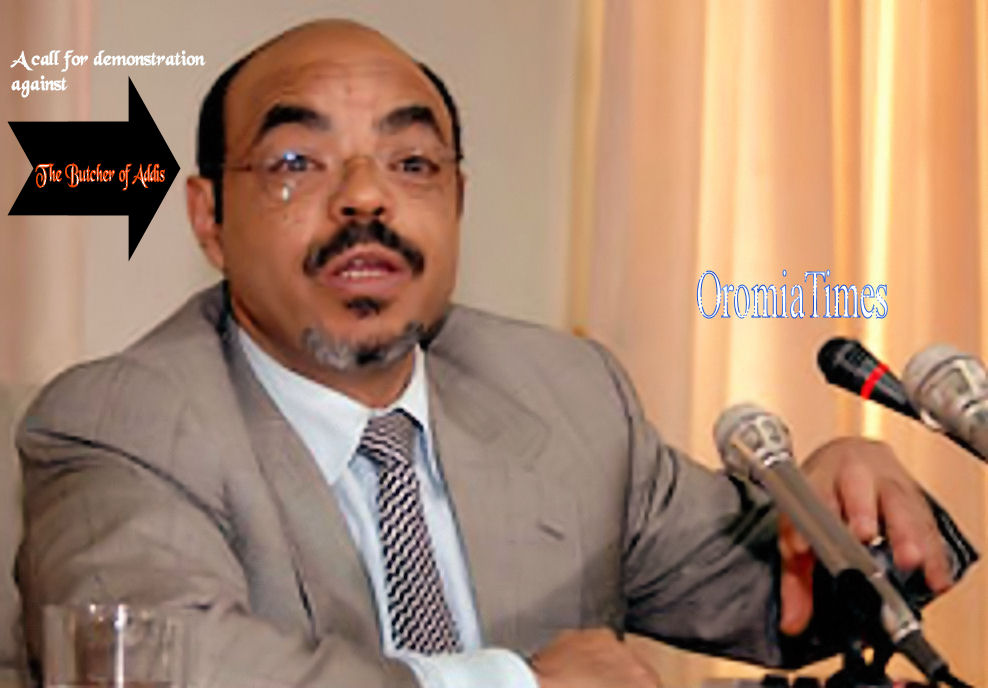
FOR IMMEDIATE RELEASE
"The Dictator of Ethiopia"
Photo: OromiaTimes Collection
Once hailed as one of Africa's new model leaders, Meles Zenawi's democratic credentials are under assault from growing ethnic and political rifts. Regardless of what the West does to sustain him in power, the people of Ethiopia are determined to overthrow him by peaceful means if they can or by force if they must. Since Meles Zenawi has committed democide as a result of his regime murdering citizens for political reasons, the Ethiopian Diaspora have  organized themselves to confront the tyrant when he appears at their turf in the United States. Ethiopians who reside in Virginia, Maryland, Washington, D.C., Massachusetts, Connecticut, New Jersey, and New York will be coming to the United Nations in New York City on September 22nd to show their solidarity with the people of Ethiopia.
A Grand Public Demonstration
Against Dictator Meles Zenawi at the UN, NY
Date: Friday, September 22, 2006
Time: 10:00 A.M.
Place: Dag Hammarskjold Plaza
(2nd Ave, 47th Street, NYC)
News Source: www.nazret.com
Car bomb attack kills 8 in Somalia
18 September 2006
MOGADISHU, Somalia (CNN) -- A car bomb targeting Somalia's transitional president, Abdullahi Yusuf Ahmed, killed eight people Monday outside Somalia's parliament in Baidoa, according to presidential and hospital sources.
Ahmed was inside the parliament building when the car bomb detonated in a nearby compound. He was not harmed.
The explosion wounded dozens and destroyed eight cars.
Baidoa is the temporary seat of the United Nations-backed transitional government, which wields little power. Somalia's last functioning government collapsed in 1991.
In early June, the Islamic Courts Union militia wrested control of Mogadishu from a U.S.-backed coalition of secular warlords.The U.S. State Department has expressed concern over reports in recent months that militias were advancing toward Baidoa.
In late July, gunmen shot and killed a minister in the interim government as he left a mosque in Baidoa. It is unclear who was behind the killing.
Journalist Mohammed Amiin contributed to this report.
Breaking News: Massive explosion outside Somali's Government
CNN and BBC Report a masive explosion outside the somali's Transitional Government's Parlament. Details coming soon.
Picture of the week

A Sudanese farmer rides his donkey in front of a U.N. vehicle near the U.N. office in Al-Fasher, the capital of north Darfur, Sudan, in this Saturday, Aug.28, 2004 file photo. The crises in Somalia and Sudan are pitting Arabs and African governments against each other, sharpening a centuries-old continental divide. That's clear from the way two regional groups _ the Arab League and the African Union _ have treated Sudan, which straddles the two. The African Union wants the U.N. in Darfur, the Arabs don't. (AP Photo/Amr Nabil)
September 17, 2006
A dignitary TPLF/EPRDF official goes shopping in luxury Paris stores
ION update
09/16/06
A dignitary goes shopping in Paris
Indian Ocean Newsletter N° 1194
An official of the governing coalition EPRDF and member of the central committee of the Tigray People’s Liberation Front (TPLF, the dominant party in Addis Ababa) went shopping in the luxury stores in Paris this week. He made a stop in Paris on his way home from the United States, spending almost 18,000 euros (over 190,000 birrs) since the beginning of this week on perfume, women’s clothes and handbags in Champs Elysée Sephora, Louis Vuitton to name but a few.
09/16/06
A dignitary goes shopping in Paris
Indian Ocean Newsletter N° 1194
An official of the governing coalition EPRDF and member of the central committee of the Tigray People’s Liberation Front (TPLF, the dominant party in Addis Ababa) went shopping in the luxury stores in Paris this week. He made a stop in Paris on his way home from the United States, spending almost 18,000 euros (over 190,000 birrs) since the beginning of this week on perfume, women’s clothes and handbags in Champs Elysée Sephora, Louis Vuitton to name but a few.
September 16, 2006
The Collapse of the die-hard TPLFRegime
Falling Down
September 16, 2006: The Ethiopian army suffered to more defections (a general and a colonel) to the Oromo Liberation Front (OLF). A similar defection took place last month.
September 15, 2006: A UN worker detained by Eritrea on August 28 still remains in custody. The UN worker was serving with the UN Mission in Ethiopia and Eritrea (UNMEE). Eritrea accused the detained UN employee of "people smuggling." Eritrea continues to "harass" UN observer forces because Eritrea believes the "international community" has sided with Ethiopia on the issue of final border demarcation.
September 14, 2006: Somali's Islamic Courts rejected the African Union's recommendation that 8000 peacekeepers be deployed to Somalia. The Islamic Courts insists that a peacekeeping force is a "cover" for Ethiopian troops operating in Somalia.
September 13, 2006: The African Union (AU) reiterated its support for a peacekeeping force in Somalia. An AU spokesman said that a force could be ready in October. At an AU meeting held on September 12 (in Addis Ababa, Ethiopia) AU members said that a peacekeeping force was needed in Somalia to keep the country from "sliding further into chaos." Seven East African countries endorsed a peacekeeping force on August 5.
September 9, 2006: Somali sources reported that the government of Libya has offered to "mediate" between the Somali Islamic Courts (Somali Islamists) and the government of Ethiopia. Ethiopian government representatives met with the president of the separatist Republic of Somaliland. The Republic of Somaliland essentially operates as a separate country from Mogadishu (which is now controlled by the Union of Islamic Courts). Somaliland claims it has been a separate country since 1991. The meeting is another indicator that Ethiopia regards the Islamic Courts as just one of several governments in Somalia.
September 8, 2006: Ethiopia claimed that its security forces arrested nine members of the Oromo Liberation Front (OLF). The Ethiopian statement claimed that the nine rebels were part of a "hit squad" that was assigned to assassinate Ethiopian government officials.
September 6, 2006: Eritrea expelled five UN UNMEE staffers. Eritrea accused the UN staff workers of spying. The UN rejected the allegations. The five expelled staff members came from five different countries: Great Britain, South Africa, Liberia, South Africa, and Trinidad-Tobago. Eritrea remains an equal opportunity expeller.
Source: www.strategypage.com (PageStrategyPage provides quick, easy access to what is going on in military affairs. We cover armed forces world wide, as well as up to date reporting on wars and hotspots wherever they may be.)
September 16, 2006: The Ethiopian army suffered to more defections (a general and a colonel) to the Oromo Liberation Front (OLF). A similar defection took place last month.
September 15, 2006: A UN worker detained by Eritrea on August 28 still remains in custody. The UN worker was serving with the UN Mission in Ethiopia and Eritrea (UNMEE). Eritrea accused the detained UN employee of "people smuggling." Eritrea continues to "harass" UN observer forces because Eritrea believes the "international community" has sided with Ethiopia on the issue of final border demarcation.
September 14, 2006: Somali's Islamic Courts rejected the African Union's recommendation that 8000 peacekeepers be deployed to Somalia. The Islamic Courts insists that a peacekeeping force is a "cover" for Ethiopian troops operating in Somalia.
September 13, 2006: The African Union (AU) reiterated its support for a peacekeeping force in Somalia. An AU spokesman said that a force could be ready in October. At an AU meeting held on September 12 (in Addis Ababa, Ethiopia) AU members said that a peacekeeping force was needed in Somalia to keep the country from "sliding further into chaos." Seven East African countries endorsed a peacekeeping force on August 5.
September 9, 2006: Somali sources reported that the government of Libya has offered to "mediate" between the Somali Islamic Courts (Somali Islamists) and the government of Ethiopia. Ethiopian government representatives met with the president of the separatist Republic of Somaliland. The Republic of Somaliland essentially operates as a separate country from Mogadishu (which is now controlled by the Union of Islamic Courts). Somaliland claims it has been a separate country since 1991. The meeting is another indicator that Ethiopia regards the Islamic Courts as just one of several governments in Somalia.
September 8, 2006: Ethiopia claimed that its security forces arrested nine members of the Oromo Liberation Front (OLF). The Ethiopian statement claimed that the nine rebels were part of a "hit squad" that was assigned to assassinate Ethiopian government officials.
September 6, 2006: Eritrea expelled five UN UNMEE staffers. Eritrea accused the UN staff workers of spying. The UN rejected the allegations. The five expelled staff members came from five different countries: Great Britain, South Africa, Liberia, South Africa, and Trinidad-Tobago. Eritrea remains an equal opportunity expeller.
Source: www.strategypage.com (PageStrategyPage provides quick, easy access to what is going on in military affairs. We cover armed forces world wide, as well as up to date reporting on wars and hotspots wherever they may be.)
September 15, 2006
Brig. General Hailu Gonfa and Col. Gemechu Ayana join OLF abandoning TPLF regime
By Staff
Sep 15, 2006
Asmara, 15 September 2006 – Brig. General Hailu Gonfa, a senior Ethiopian Army commander, and Col. Gemechu Ayana, commander of the 8th Mechanized Force, joined the Oromo Liberation Front (OLF) abandoning the TPLF regime.
In a message they conveyed to members of the Ethiopian Army after jointing the OLF, the two senior Army commanders said: “At a time when the dictatorial TPLF regime is resorting to increased suppression against the Ethiopian people by stealing the people’s voice, continuing to be at the service of such a repressive regime would only aggravate the people’s suffering. In this regard, we call on all members of the Ethiopian Army to detach themselves from the illegal regime and follow our example.”
The Eritrea media would like to announce that the interview conducted with Brig. General Hailu Gonfa and Col. Gemechu Ayana would be presented next Monday.
It is to be recalled that a month ago, Brig. General Kemal Gelchu arrived in Eritrea safely, heading tens of Ethiopian colonels and hundreds of soldiers along with their full logistics, communication equipments and military hardware, abandoning the TPLF regime.
www.shabait.com
Sep 15, 2006
 |
In a message they conveyed to members of the Ethiopian Army after jointing the OLF, the two senior Army commanders said: “At a time when the dictatorial TPLF regime is resorting to increased suppression against the Ethiopian people by stealing the people’s voice, continuing to be at the service of such a repressive regime would only aggravate the people’s suffering. In this regard, we call on all members of the Ethiopian Army to detach themselves from the illegal regime and follow our example.”
 |
It is to be recalled that a month ago, Brig. General Kemal Gelchu arrived in Eritrea safely, heading tens of Ethiopian colonels and hundreds of soldiers along with their full logistics, communication equipments and military hardware, abandoning the TPLF regime.
www.shabait.com
BBC NEWS Africa: Ethiopian officers 'join rebels'
Brig Gen Kemal Geltu defected last monthTwo senior Ethiopian army officers have defected to join the Oromo Liberation Front (OLF), the rebel group says.
The two are Brig Gen Hailu Gonfa and Col Gemechu Ayana, who commanded the Eighth Mechanized Division.
However, Ethiopian officials said they had no knowledge of the reports. Last month Brig Gen Kemal Geltu also joined the Eritrea-backed OLF.
The two men said it was time for them to take sides in the fight between tyranny and liberty, the OLF says.
Government critics say the defections are a sign of its unpopularity but the government has portrayed the defectors as malcontents.
Gen Kemal said he had crossed the border to Eritrea, along with "hundreds" of men.
The OLF, which was at first a secessionist movement, says it is fighting for more rights for the Oromo people in Ethiopia.
The Oromo are the largest ethnic group in Ethiopia, comprising about half of its 70m people.
Demonstrations after Prime Minister Meles Zenawi was re-elected in May 2005 led to a crackdown on many Oromo and other opposition organisations.
Ethiopia and Eritrea ended a border war in 2002, but Ethiopia has not withdrawn troops from the town of Badme which arbitrators awarded to Eritrea, and tensions between the two countries remain high.
http://news.bbc.co.uk/2/hi/africa/5350394.stm
The two are Brig Gen Hailu Gonfa and Col Gemechu Ayana, who commanded the Eighth Mechanized Division.
However, Ethiopian officials said they had no knowledge of the reports. Last month Brig Gen Kemal Geltu also joined the Eritrea-backed OLF.
The two men said it was time for them to take sides in the fight between tyranny and liberty, the OLF says.
Government critics say the defections are a sign of its unpopularity but the government has portrayed the defectors as malcontents.
Gen Kemal said he had crossed the border to Eritrea, along with "hundreds" of men.
The OLF, which was at first a secessionist movement, says it is fighting for more rights for the Oromo people in Ethiopia.
The Oromo are the largest ethnic group in Ethiopia, comprising about half of its 70m people.
Demonstrations after Prime Minister Meles Zenawi was re-elected in May 2005 led to a crackdown on many Oromo and other opposition organisations.
Ethiopia and Eritrea ended a border war in 2002, but Ethiopia has not withdrawn troops from the town of Badme which arbitrators awarded to Eritrea, and tensions between the two countries remain high.
http://news.bbc.co.uk/2/hi/africa/5350394.stm
Breaking News: Brigadier General Hailu Gonfa and Colonel Gammachu Ayana joined OLF
Birgadier General Hailu Gonfa, a senior officer in the Ethiopian military high command, and Colonel Gammachu Ayana, Commander of the 8th Mechanized division joined the OLF. The two defected from the Ethiopian army and joined the Oromo Liberation Front, a member of the Alliance for Freedom and Democracy, in the footsteps of Birgadier Kemal Gelchu, Commander of 18th Division and Colonel Abebe Geresu.
This is another illustration of the fact that the EPRDF's regime's hold on power is getting increasingly fragile. The military was the last institution the regime could rely on to continue to cling to power in the face of rising resistance from the population and the opposition.
This is another illustration of the fact that the EPRDF's regime's hold on power is getting increasingly fragile. The military was the last institution the regime could rely on to continue to cling to power in the face of rising resistance from the population and the opposition.
Breaking News: Statement by Brigadier General Hailu Gonfa and Colonel Gemechu Ayana
Until a few days ago, we were officers in the Ethiopian army sworn to protect the country’s laws and diverse people from any threats. To our deepest dismay, we have come to the conclusion that the greatest threat to Ethiopia and the people emanates not from elsewhere but from the regime on power.
Over the last years, the armed forces have been systematically reduced to protecting the narrow interest of a small clique determined to cling to power at all costs. Under the circumstances the choices confronting us are: Either to remain with the same oppressive machinery or wait and see hoping against hope that things would improve on their own or through a miracle. We have waited too long; we cannot wait any longer.
Despite the calls by opposition groups to peacefully deal with the dire situation, EPRDF is showing no inclination whatsoever to address the country’s mounting social, economic and political problems. Instead, it is intensifying repression. Even though this repressive machinery did not spare any people in the country, the magnitude and scale of repression, harassment and intimidation committed against Oromo people has no comparison. Moreover, it is considering new military adventures in the region that would not serve the legitimate interests of all affected—and could plunge the region into chaos.
Throughout the years we served this regime, we were hoping things would improve over time and expected the regime would also resolve political conflicts peacefully and truly democratize the country where political power emanates from the will of the people not from force. Now we have found this to be an empty promise. We are particularly elated that the Alliance for Freedom and Democracy (AFD) has offered a hope not only to eliminate the specter of more mayhem but also chart a better future through a process of dialogue involving all stakeholders in the search for comprehensive solutions.
We regret that the regime has flagrantly, and without serious consideration, rejected this offer of goodwill and continued on its path of destruction. We cannot therefore continue to defend a minority and overwhelmingly rejected regime, sadly, that is committing untold atrocities against our own people.
It is time for us to take side in the fight between tyranny and liberty. Accordingly, we have dissociated ourselves from TPLF/EPRDF and joined the liberation struggle of our people gripped by the claws of tyranny. We have therefore joined the Oromo Liberation Front that is a member of the Alliance for Freedom and Democracy (AFD) to realize the age-old dream of all peoples for freedom and democracy.
To the Ethiopian Armed Forces
The incumbent regime has been fooling us all by falsely extolling its commitment to freedom, democracy and speedy economic development. This commitment has been put to test over the last 15 years. The tyrannical behavior of the regime demonstrates that this pledge runs skin deep and does not show any sign of change, which makes all our efforts and sacrifices in vain. We believe as long as the regime continues to defy the will of the people, our problems would multiply. That is why it has to be compelled to desist from its destructive path or be removed. We therefore call on you to follow our example and join the just and popular struggle.
To the international community
The minority Ethiopian regime does not have the capacity or the legitimacy to continue to rule the country. The regime, whose dismal 15 year tenure is more than enough to gauge its goodwill, needs to be pressed rather than appeased to submit to the call for dialogue. We strongly urge you to reconsider your support for it as it does not any more serve our common strategic interests.
Brigadier General Hailu Gonfa
Colonel Gamachu Ayana
September 14, 2006
Over the last years, the armed forces have been systematically reduced to protecting the narrow interest of a small clique determined to cling to power at all costs. Under the circumstances the choices confronting us are: Either to remain with the same oppressive machinery or wait and see hoping against hope that things would improve on their own or through a miracle. We have waited too long; we cannot wait any longer.
Despite the calls by opposition groups to peacefully deal with the dire situation, EPRDF is showing no inclination whatsoever to address the country’s mounting social, economic and political problems. Instead, it is intensifying repression. Even though this repressive machinery did not spare any people in the country, the magnitude and scale of repression, harassment and intimidation committed against Oromo people has no comparison. Moreover, it is considering new military adventures in the region that would not serve the legitimate interests of all affected—and could plunge the region into chaos.
Throughout the years we served this regime, we were hoping things would improve over time and expected the regime would also resolve political conflicts peacefully and truly democratize the country where political power emanates from the will of the people not from force. Now we have found this to be an empty promise. We are particularly elated that the Alliance for Freedom and Democracy (AFD) has offered a hope not only to eliminate the specter of more mayhem but also chart a better future through a process of dialogue involving all stakeholders in the search for comprehensive solutions.
We regret that the regime has flagrantly, and without serious consideration, rejected this offer of goodwill and continued on its path of destruction. We cannot therefore continue to defend a minority and overwhelmingly rejected regime, sadly, that is committing untold atrocities against our own people.
It is time for us to take side in the fight between tyranny and liberty. Accordingly, we have dissociated ourselves from TPLF/EPRDF and joined the liberation struggle of our people gripped by the claws of tyranny. We have therefore joined the Oromo Liberation Front that is a member of the Alliance for Freedom and Democracy (AFD) to realize the age-old dream of all peoples for freedom and democracy.
To the Ethiopian Armed Forces
The incumbent regime has been fooling us all by falsely extolling its commitment to freedom, democracy and speedy economic development. This commitment has been put to test over the last 15 years. The tyrannical behavior of the regime demonstrates that this pledge runs skin deep and does not show any sign of change, which makes all our efforts and sacrifices in vain. We believe as long as the regime continues to defy the will of the people, our problems would multiply. That is why it has to be compelled to desist from its destructive path or be removed. We therefore call on you to follow our example and join the just and popular struggle.
To the international community
The minority Ethiopian regime does not have the capacity or the legitimacy to continue to rule the country. The regime, whose dismal 15 year tenure is more than enough to gauge its goodwill, needs to be pressed rather than appeased to submit to the call for dialogue. We strongly urge you to reconsider your support for it as it does not any more serve our common strategic interests.
Brigadier General Hailu Gonfa
Colonel Gamachu Ayana
September 14, 2006
 Amharic Interview with VOL (Audio)
Afaan Oromo interview with VOL (Audio)
Bitter rivalry divides Ethiopians
By Isa Omok
NAIROBI, Sept 14 (Reuters) - A increasingly bitter rivalry between Ethiopia's two top woman runners has divided public opinion in the African nation.
The conflict between world 5,000 metres champion Tirunesh Dibaba and Olympic title holder Meseret Defar reached a crescendo at the world athletics final in Berlin on Sept. 3, when Defar denied her compatriot a sixth successive Golden League win.
Four athletes, including Dibaba, had already secured five victories which enabled them to share a $500,000 purse. An additional $500,000 was on offer for those achieving a perfect series of sixth wins.
"The public here is divided into two groups. One claims that Meseret is envious and wants to stop Dibaba no matter what. The other group claims that Dibaba got what she deserved because she does not congratulate or hug Defar when the two runners finish a race," athletics writer Elshadai Negash told Reuters by telephone from Addis Ababa.
"By beating Dibaba in Berlin, Defar only did what a competitor should do, which enhanced her chances of claiming the world athlete of the year award this year."
Both runners are managed by American Mark Weltmore.
When they arrived in Berlin, Dibaba was one of the six contenders setting out for a perfect set of six victories in the $1 million Golden League Jackpot.
She had beaten Defar in Paris and Rome, but failed spectacularly to stop her in the African championships in Mauritius in August, which the world champion attributed to ill health.
One week after Mauritius, it was Dibaba's turn for revenge in the Brussels golden league meeting, where Meseret had planned to break her own world record.
"Meseret was going for the world record in Brussels. I had to destabilise her racing plans by varying the pace before kicking in the last lap," the 20-year-old said on the IAAF Web site.
Dibaba and Meseret have been entered in different races at the World Cup in Athens this weekend. Dibaba will run in the 3,000 and Meseret in the 5,000.
Source: http://sport.guardian.co.uk
NAIROBI, Sept 14 (Reuters) - A increasingly bitter rivalry between Ethiopia's two top woman runners has divided public opinion in the African nation.
The conflict between world 5,000 metres champion Tirunesh Dibaba and Olympic title holder Meseret Defar reached a crescendo at the world athletics final in Berlin on Sept. 3, when Defar denied her compatriot a sixth successive Golden League win.
Four athletes, including Dibaba, had already secured five victories which enabled them to share a $500,000 purse. An additional $500,000 was on offer for those achieving a perfect series of sixth wins.
"The public here is divided into two groups. One claims that Meseret is envious and wants to stop Dibaba no matter what. The other group claims that Dibaba got what she deserved because she does not congratulate or hug Defar when the two runners finish a race," athletics writer Elshadai Negash told Reuters by telephone from Addis Ababa.
"By beating Dibaba in Berlin, Defar only did what a competitor should do, which enhanced her chances of claiming the world athlete of the year award this year."
Both runners are managed by American Mark Weltmore.
When they arrived in Berlin, Dibaba was one of the six contenders setting out for a perfect set of six victories in the $1 million Golden League Jackpot.
She had beaten Defar in Paris and Rome, but failed spectacularly to stop her in the African championships in Mauritius in August, which the world champion attributed to ill health.
One week after Mauritius, it was Dibaba's turn for revenge in the Brussels golden league meeting, where Meseret had planned to break her own world record.
"Meseret was going for the world record in Brussels. I had to destabilise her racing plans by varying the pace before kicking in the last lap," the 20-year-old said on the IAAF Web site.
Dibaba and Meseret have been entered in different races at the World Cup in Athens this weekend. Dibaba will run in the 3,000 and Meseret in the 5,000.
Source: http://sport.guardian.co.uk
September 14, 2006
ION Update: Spate of Defections Continues
Spate of defections continues
Indian Ocean Newsletter N° 1193
09/09/2006
The Ethiopian army, judiciary and diplomatic corps are still subject to numerous defections of employees and officials who go into exile to the United States.
After the defection at the beginning of August of the Oromo General Kemal Gelchu, more departures into exile have followed among Ethiopian diplomats and other top officials in the government of Addis Ababa. A Deputy Attorney General Alemayehu Zemedkun thus fled to the United States at the beginning of August where he asked for political asylum. Zemedkun, 41, left his wife and two children in Addis Ababa and fled to the USA after the Ethiopian authorities had asked him to take over the case of the charges against the leaders of the Coalition for Unity and Democracy Party (CUDP, opposition) imprisoned in Addis Ababa. He had attempted to convince his superiors, including the Minister of Justice Shemeles Kemale, that there was no case to answer, but to no avail. He then decided to go into exile. Since then, his testimony on Internet web sites and Ethiopian opposition blogs has shed a blunt light on the actions and attitudes of the Ethiopian executives, such as the minister of justice.
Some tens of defections have taken place lately in Ethiopian diplomatic circles. Meanwhile, suspicion has gone up a notch inside the ministry for foreign affairs about diplomats not felt to be sufficiently docile with the regime in place in Addis Ababa. Matters got even worse after revelations in the international media of confidential documents written by a foreign affairs ministry high official on its propaganda strategy. Some Ethiopian opponents have been able to draw up a list of 59 names of diplomats who have defected these last few months. They include two former Ambassadors (Yohanes Genda and Fleshes Adugna Wordofa) a few ministerial counsellor and a large number of junior diplomats. Among the latest defections to date are those of a diplomat in the Ethiopian embassy to India, of Biruk Hailu plenipotentiary minister to the embassy in Paris and Gizachew Bizuayehu, counsellor. The wife of the former Ambassador Kassahun Ayele is also believed to be filing her request for political asylum in the United States.
The majority of these diplomats complain about the management methods of their hierarchical superiors, of the generalised climate of suspicion that reins in the Ethiopian embassies and the obscure role of certain Tigrayan diplomats of the Tigray People’s Liberation Front (TPLF, hard core of the EPRDF in power in Addis Ababa) operating as true political commissionaires. General Kemal Gelchu, who fled to Eritrea along with twenty other Ethiopian servicemen, is for his part expected to join the Oromo Liberation Front (OLF, armed opposition). He accuses the actions of the Tigrayan hierarchy in the Ethiopian army and has revealed the growing level of discontent among non-Tigrayan soldiers.
Indian Ocean Newsletter N° 1193
09/09/2006
The Ethiopian army, judiciary and diplomatic corps are still subject to numerous defections of employees and officials who go into exile to the United States.
After the defection at the beginning of August of the Oromo General Kemal Gelchu, more departures into exile have followed among Ethiopian diplomats and other top officials in the government of Addis Ababa. A Deputy Attorney General Alemayehu Zemedkun thus fled to the United States at the beginning of August where he asked for political asylum. Zemedkun, 41, left his wife and two children in Addis Ababa and fled to the USA after the Ethiopian authorities had asked him to take over the case of the charges against the leaders of the Coalition for Unity and Democracy Party (CUDP, opposition) imprisoned in Addis Ababa. He had attempted to convince his superiors, including the Minister of Justice Shemeles Kemale, that there was no case to answer, but to no avail. He then decided to go into exile. Since then, his testimony on Internet web sites and Ethiopian opposition blogs has shed a blunt light on the actions and attitudes of the Ethiopian executives, such as the minister of justice.
Some tens of defections have taken place lately in Ethiopian diplomatic circles. Meanwhile, suspicion has gone up a notch inside the ministry for foreign affairs about diplomats not felt to be sufficiently docile with the regime in place in Addis Ababa. Matters got even worse after revelations in the international media of confidential documents written by a foreign affairs ministry high official on its propaganda strategy. Some Ethiopian opponents have been able to draw up a list of 59 names of diplomats who have defected these last few months. They include two former Ambassadors (Yohanes Genda and Fleshes Adugna Wordofa) a few ministerial counsellor and a large number of junior diplomats. Among the latest defections to date are those of a diplomat in the Ethiopian embassy to India, of Biruk Hailu plenipotentiary minister to the embassy in Paris and Gizachew Bizuayehu, counsellor. The wife of the former Ambassador Kassahun Ayele is also believed to be filing her request for political asylum in the United States.
The majority of these diplomats complain about the management methods of their hierarchical superiors, of the generalised climate of suspicion that reins in the Ethiopian embassies and the obscure role of certain Tigrayan diplomats of the Tigray People’s Liberation Front (TPLF, hard core of the EPRDF in power in Addis Ababa) operating as true political commissionaires. General Kemal Gelchu, who fled to Eritrea along with twenty other Ethiopian servicemen, is for his part expected to join the Oromo Liberation Front (OLF, armed opposition). He accuses the actions of the Tigrayan hierarchy in the Ethiopian army and has revealed the growing level of discontent among non-Tigrayan soldiers.
Former Somali TNG president Abdikasim lashes out Ethiopia over its involvement in Somalia
Aweys Osman Yusuf
Mogadishu 14, Sep. 06
( Sh.M.Network) - In an interview with former Somali TNG government president by London seated Asharqalawsat Arabic newspaper, Abdikasim Salad Hassan stressed that if Ethiopia pulls its military personnel out of Somalia and entirely stays out of the Somali affairs, it may conduce to political progress and peaceful co-habitation in the region.
Dr. Abdikasim Salad Hassan who was among the entourage of Somalia’s Union of Islamic Courts supreme leader invited by Libya’s Kadafi said that he and the Islamic delegation went to Libya in an attempt to soothe the tense situation in the country which, as he said, is being stirred by foreign powers.
Union of Islamic Courts delegation has, on their way back to Somalia, passed by neighboring Djibouti, a country that relentlessly took major role in installing the former TNG government which was encumbered by former defeated faction warlords.
Abdikasim reiterated that no foreign intervention could resolve the situation in Somalia, adding a similar foreign military operation failed back in 1993, referring to UN-US mission that deserted Somalia in 1995 after they got humiliated and embroiled in inter-tribal war.
“Ethiopia had been entering in Somalia for the last 16 years in the country’s racial war; disintegrating Somalis, hindering every administration built for Somalia and it’s a government still determined to obstruct any Somali government that does not abide by its unlawful policies”, said former president Abdikasim.
He complimented the Islamic Courts for restoring some law and order in the capital once a volatile city.
Abdikasim said the preliminary peace accord reached by the Islamic Courts and the Somali transitional government in their second phase had a phenomenon of a good future for Somalia, inciting all neighboring countries including Ethiopia not to infringe the sovereignty of Somalia.
The President’s remarks came at a time when Iter-Governmental Authority on Development, IGAD, had come to their decision in Addis Ababa Ethiopia of deploying about 8,000 African peacekeepers in Somalia.
Somalia’s Islamic Courts pledged they would confront any foreign forces brought to Somalia.
Shabelle Media Network
Mogadishu 14, Sep. 06
( Sh.M.Network) - In an interview with former Somali TNG government president by London seated Asharqalawsat Arabic newspaper, Abdikasim Salad Hassan stressed that if Ethiopia pulls its military personnel out of Somalia and entirely stays out of the Somali affairs, it may conduce to political progress and peaceful co-habitation in the region.
Dr. Abdikasim Salad Hassan who was among the entourage of Somalia’s Union of Islamic Courts supreme leader invited by Libya’s Kadafi said that he and the Islamic delegation went to Libya in an attempt to soothe the tense situation in the country which, as he said, is being stirred by foreign powers.
Union of Islamic Courts delegation has, on their way back to Somalia, passed by neighboring Djibouti, a country that relentlessly took major role in installing the former TNG government which was encumbered by former defeated faction warlords.
Abdikasim reiterated that no foreign intervention could resolve the situation in Somalia, adding a similar foreign military operation failed back in 1993, referring to UN-US mission that deserted Somalia in 1995 after they got humiliated and embroiled in inter-tribal war.
“Ethiopia had been entering in Somalia for the last 16 years in the country’s racial war; disintegrating Somalis, hindering every administration built for Somalia and it’s a government still determined to obstruct any Somali government that does not abide by its unlawful policies”, said former president Abdikasim.
He complimented the Islamic Courts for restoring some law and order in the capital once a volatile city.
Abdikasim said the preliminary peace accord reached by the Islamic Courts and the Somali transitional government in their second phase had a phenomenon of a good future for Somalia, inciting all neighboring countries including Ethiopia not to infringe the sovereignty of Somalia.
The President’s remarks came at a time when Iter-Governmental Authority on Development, IGAD, had come to their decision in Addis Ababa Ethiopia of deploying about 8,000 African peacekeepers in Somalia.
Somalia’s Islamic Courts pledged they would confront any foreign forces brought to Somalia.
Shabelle Media Network
State media says "484th Butta Ceremony to Be Held This Year"
The Ethiopian Herald (Addis Ababa)
September 13, 2006
The 484th Butta ceremony organized among the Oromo people to evaluate Abba Gadda's would be held this Ethiopian year, the Gadda System Advancement Party said.
Party Acting Chairman Workineh Taddese told ENA yesterday that the ceremony is organized with an interval of four years while Jilla ceremony in which Abba Gadda's transfer their authority is held with an interval of eight years.
He said the current Ethiopian year is a special year among the Oromo people as it is a year that Butta ceremony is organized.
Workineh called on the Oromo people to colourfully mark the ceremony.
The Gadda System Advancement Party is making preparations to celebrate its fourth year anniversary, Workineh said.
September 13, 2006
The 484th Butta ceremony organized among the Oromo people to evaluate Abba Gadda's would be held this Ethiopian year, the Gadda System Advancement Party said.
Party Acting Chairman Workineh Taddese told ENA yesterday that the ceremony is organized with an interval of four years while Jilla ceremony in which Abba Gadda's transfer their authority is held with an interval of eight years.
He said the current Ethiopian year is a special year among the Oromo people as it is a year that Butta ceremony is organized.
Workineh called on the Oromo people to colourfully mark the ceremony.
The Gadda System Advancement Party is making preparations to celebrate its fourth year anniversary, Workineh said.
September 13, 2006
Committee on Rights of Child examines report of Ethiopia
The Committee on the Rights of the Child today reviewed the third periodic report of Ethiopia on how that country is implementing the provisions of the Convention on the Rights of the Child.
In opening remarks to the Committee, Ubah Ahmed, State Minister of the Ethiopian Ministry of Women's Affairs, said the Government of Ethiopia had taken a number of initiatives to improve the situation of children in the country. In order to enhance the implementation of policies, the Government had implemented significant budgetary resources to this field, including health care services. Despite developments, Ethiopia still had a long way to go to promote the situation of the children of the country. Various factors posed challenges, and extra efforts were required to keep the pace of progress. Ethiopia was committed to implementing fully the Convention on the Rights of the Child, and strongly believed that multilateral and bilateral support to improve the lives of children would be provided, and that the recommendations of the Committee would help in the Government's efforts to implement its plans.
Read more:
http://www.reliefweb.int/rw/RWB.NSF/db900SID/LSGZ-6TLBX2?OpenDocument
In opening remarks to the Committee, Ubah Ahmed, State Minister of the Ethiopian Ministry of Women's Affairs, said the Government of Ethiopia had taken a number of initiatives to improve the situation of children in the country. In order to enhance the implementation of policies, the Government had implemented significant budgetary resources to this field, including health care services. Despite developments, Ethiopia still had a long way to go to promote the situation of the children of the country. Various factors posed challenges, and extra efforts were required to keep the pace of progress. Ethiopia was committed to implementing fully the Convention on the Rights of the Child, and strongly believed that multilateral and bilateral support to improve the lives of children would be provided, and that the recommendations of the Committee would help in the Government's efforts to implement its plans.
Read more:
http://www.reliefweb.int/rw/RWB.NSF/db900SID/LSGZ-6TLBX2?OpenDocument
Ethiopia Grants First-Ever Amnesty
By LES NEUHAUS
The Associated Press
ADDIS ABABA, Ethiopia -- Ethiopia has granted its first-ever amnesty to 263 prisoners, commuting the death penalty for 11 of them, state media reported Tuesday.
President Girma Woldegiorgis gave clemency to 237 inmates while the rest received reduced prison terms to mark the Ethiopian New Year, which fell on Monday.
Nora Boustany 's column reporting on Washington's diplomatic community appears each Wednesday and Friday in The Post.
"The prisoners were provided with the clemency and reduction of prison terms as they have repented and shown good disciplines while they were in prison," Girma was quoted as saying. Convicted rapists and those convicted of corruption were not included in the amnesty.
Ethiopian officials were not immediately available for comment on the amnesty and it was not clear if any opposition leaders who were jailed last year were among those freed.
More than 100 independent journalists, opposition leaders and aid workers are on trial for treason and attempted genocide after violent protests following disputed 2005 elections.
London-based human rights group Amnesty International has called the defendants "prisoners of conscience who have not used or advocated violence."
In January, Britain withheld $87 million in aid to Ethiopia's government, redirecting it to humanitarian agencies or local officials because of concerns about the central government's handling of the unrest.
Source: Washington Post
The Associated Press
ADDIS ABABA, Ethiopia -- Ethiopia has granted its first-ever amnesty to 263 prisoners, commuting the death penalty for 11 of them, state media reported Tuesday.
President Girma Woldegiorgis gave clemency to 237 inmates while the rest received reduced prison terms to mark the Ethiopian New Year, which fell on Monday.
Nora Boustany 's column reporting on Washington's diplomatic community appears each Wednesday and Friday in The Post.
"The prisoners were provided with the clemency and reduction of prison terms as they have repented and shown good disciplines while they were in prison," Girma was quoted as saying. Convicted rapists and those convicted of corruption were not included in the amnesty.
Ethiopian officials were not immediately available for comment on the amnesty and it was not clear if any opposition leaders who were jailed last year were among those freed.
More than 100 independent journalists, opposition leaders and aid workers are on trial for treason and attempted genocide after violent protests following disputed 2005 elections.
London-based human rights group Amnesty International has called the defendants "prisoners of conscience who have not used or advocated violence."
In January, Britain withheld $87 million in aid to Ethiopia's government, redirecting it to humanitarian agencies or local officials because of concerns about the central government's handling of the unrest.
Source: Washington Post
September 12, 2006
OromiaTimes Album update


And many more at your www.flickr.com/photos/oromiatimes
OromiaTimes,
Serving the Nation at home and in Diaspora
Photos Elmer Kroese (Flickr Collections)


Fleeing danger to get their kicks in Grand Rapids
Sep 11, 2006
By Brad Edwards
GRAND RAPIDS-- On a no sun Sunday, at a park with a flag in the distance, there's a group at play, at practice. It's not just any group though.
There are individually and collectively special stories. They are part of the Oromo people, a group from war-torn Ethiopia often targeted by authorities there.
Targeted for detention, torture and in some cases killings, they and their families have fled here. Together the soccer team's name is Cilaalo. They number nearly 1,000 strong in Greater Grand Rapids. All have fled similar circumstances.
The team was once invited to a national amateur tournament and won. But frankly now, without a sponsor, they're too poor to play in tournaments.
But they'll practice on and most of all, they're just happy to play in a place they now think of as home.
For more information on Oromo, contact coach Abdul Mustafa at abdul321@msn.com
Source: http://www.woodtv.com/
TV Report available at www.woodtv.com/global/story.asp?s=5388581
By Brad Edwards
GRAND RAPIDS-- On a no sun Sunday, at a park with a flag in the distance, there's a group at play, at practice. It's not just any group though.
There are individually and collectively special stories. They are part of the Oromo people, a group from war-torn Ethiopia often targeted by authorities there.
Targeted for detention, torture and in some cases killings, they and their families have fled here. Together the soccer team's name is Cilaalo. They number nearly 1,000 strong in Greater Grand Rapids. All have fled similar circumstances.
The team was once invited to a national amateur tournament and won. But frankly now, without a sponsor, they're too poor to play in tournaments.
But they'll practice on and most of all, they're just happy to play in a place they now think of as home.
For more information on Oromo, contact coach Abdul Mustafa at abdul321@msn.com
Source: http://www.woodtv.com/
TV Report available at www.woodtv.com/global/story.asp?s=5388581
September 09, 2006
Falsely accusing OLF will not save TPLF from its imminent and inevitable demise
The Oromo liberation struggle is gaining momentum from day to day demonstrating greater maturity, scope, capability and sophistication. The phenomenal growth and advance of this struggle is making the minority regime in Ethiopia even more desperate. TPLF is frightened by the closing of ranks among Oromo nationals. As a result, it is resorting, as usual, to a smear campaign to falsely defame the image of the OLF. It is in the nature of desperate and tyrant regimes like the one in Ethiopia to blame all their troubles on their opponents. As observed time and again, fabricated stories have been used by the regime to falsely incriminate those whose only crime, if any, is political dissention and yearning for freedom.
Ever since coming to power, the TPLF/EPRDF regime has been busy attempting to spoil the good name of the OLF by manufacturing baseless and horrific stories to vilify the organization in the eyes of the people and most importantly the international community. It massacred innocent people in Baddanno; torched the house of people in Hararghe with their residents inside; and committed despicable crimes in Jimma, Ilu Abbabor and Arsi in an attempt to alienate the organization from the people, albeit to no avail. It mowed down peaceful Sidama protesters in Awassa with live bullets. After committing genocide on the Anyuak people of Gambella, it shamelessly attempted to blame it on OLF. After deliberately throwing explosives on schools and blowing up hotels, it had turned around and blamed the whole affair on the opposition. That is the true story behind the mysterious blasts in Addis and other towns. Last year, it mowed down peaceful demonstrators in broad day light and blamed it on CUD. What all these smear campaigns by the minority TPLF/EPRDF regime failed to achieve is hide the glaring truth from the people in Ethiopia and the international community, that the culprit has been the TPLF/EPRDF regime. The people can easily read through the thinly disguised lies.
Despite this fact, the TPLF/EPRDF regime is not abandoning this old and failed tactics. Accordingly, on September 7, 2006, its state-controlled TV scurrilously and without any grain of truth alleged that the security forces had apprehended nine individuals on a mission to take action against high-ranking OPDO officials. This is again an attempt to divert attention from a deepening crisis within the ruling party and the crumbling system.
After Brigadier General Kemal Galchu, Colonel Abebe Geresu, other senior army officers and hundreds of soldiers defected from the regime and joined up with OLF, the TPLF/EPRDF are gripped by extreme anxiety and riddled with suspicions. Since they could not find a way out of the mess they themselves created, they had to concoct groundless stories. The objective of TPLF/EPRDF in spreading this cheap propaganda is to use it as a pretext to eliminate those amongst its own military and security forces deserting it en masse and joining the popular struggle. As an Oromo saying goes, a person being washed away by cresting river tries in vain to cling to life by hanging on to the fluff. OLF categorically denies having any hand in this drama contrived by the regime and will not succumb to such cowardly action.
The Oromo liberation struggle led by the Oromo Liberation Front (OLF) is gaining momentum from day to day. As a result the TPLF/EPRDF regime is getting increasingly paralyzed from the resulting fear and unleashing a reign of terror against the Oromo and all other people in Ethiopia rather than dealing with the root cause of the problem: political repression. Detaining individuals without cause, killing them at will, expelling them from their jobs under different excuses, confiscating their property and defamation would intensify the struggle rather than dampening it. That is why the people would have no ears with which to hear and no hear to believe another futile exercise in fabrication.
At this critical time the minority TPLF/EPRDF regime is being choked by many pressing internal and external problems. Inside its own ranks, there prevails a state of internal paralysis manifested by fear and an unimaginable mistrust among its ranks. The entire edifice of the regime is decaying and is on the verge of caving in from inside and out. The people are intensifying their just struggle for freedom and democracy. TPLF/EPRDF may continue with its habit of creating all kinds of machinations, but this is not going to forestall its eventual demise, which is getting closer by the day. As the tyrannical rule of the TPLF/EPRDF is coming to an inevitable end, the days of liberation and freedom of the Oromo and all people in Ethiopia is drawing ever closer.
Victory to the Oromo people!!
Oromo Liberation Front
September 8, 2006
Ever since coming to power, the TPLF/EPRDF regime has been busy attempting to spoil the good name of the OLF by manufacturing baseless and horrific stories to vilify the organization in the eyes of the people and most importantly the international community. It massacred innocent people in Baddanno; torched the house of people in Hararghe with their residents inside; and committed despicable crimes in Jimma, Ilu Abbabor and Arsi in an attempt to alienate the organization from the people, albeit to no avail. It mowed down peaceful Sidama protesters in Awassa with live bullets. After committing genocide on the Anyuak people of Gambella, it shamelessly attempted to blame it on OLF. After deliberately throwing explosives on schools and blowing up hotels, it had turned around and blamed the whole affair on the opposition. That is the true story behind the mysterious blasts in Addis and other towns. Last year, it mowed down peaceful demonstrators in broad day light and blamed it on CUD. What all these smear campaigns by the minority TPLF/EPRDF regime failed to achieve is hide the glaring truth from the people in Ethiopia and the international community, that the culprit has been the TPLF/EPRDF regime. The people can easily read through the thinly disguised lies.
Despite this fact, the TPLF/EPRDF regime is not abandoning this old and failed tactics. Accordingly, on September 7, 2006, its state-controlled TV scurrilously and without any grain of truth alleged that the security forces had apprehended nine individuals on a mission to take action against high-ranking OPDO officials. This is again an attempt to divert attention from a deepening crisis within the ruling party and the crumbling system.
After Brigadier General Kemal Galchu, Colonel Abebe Geresu, other senior army officers and hundreds of soldiers defected from the regime and joined up with OLF, the TPLF/EPRDF are gripped by extreme anxiety and riddled with suspicions. Since they could not find a way out of the mess they themselves created, they had to concoct groundless stories. The objective of TPLF/EPRDF in spreading this cheap propaganda is to use it as a pretext to eliminate those amongst its own military and security forces deserting it en masse and joining the popular struggle. As an Oromo saying goes, a person being washed away by cresting river tries in vain to cling to life by hanging on to the fluff. OLF categorically denies having any hand in this drama contrived by the regime and will not succumb to such cowardly action.
The Oromo liberation struggle led by the Oromo Liberation Front (OLF) is gaining momentum from day to day. As a result the TPLF/EPRDF regime is getting increasingly paralyzed from the resulting fear and unleashing a reign of terror against the Oromo and all other people in Ethiopia rather than dealing with the root cause of the problem: political repression. Detaining individuals without cause, killing them at will, expelling them from their jobs under different excuses, confiscating their property and defamation would intensify the struggle rather than dampening it. That is why the people would have no ears with which to hear and no hear to believe another futile exercise in fabrication.
At this critical time the minority TPLF/EPRDF regime is being choked by many pressing internal and external problems. Inside its own ranks, there prevails a state of internal paralysis manifested by fear and an unimaginable mistrust among its ranks. The entire edifice of the regime is decaying and is on the verge of caving in from inside and out. The people are intensifying their just struggle for freedom and democracy. TPLF/EPRDF may continue with its habit of creating all kinds of machinations, but this is not going to forestall its eventual demise, which is getting closer by the day. As the tyrannical rule of the TPLF/EPRDF is coming to an inevitable end, the days of liberation and freedom of the Oromo and all people in Ethiopia is drawing ever closer.
Victory to the Oromo people!!
Oromo Liberation Front
September 8, 2006
TPLF-led Regime in Addis says "we stopped rebel hit squad"
Ethiopia: We stopped rebel hit squad
Les Neuhaus Addis Ababa, Ethiopia
Ethiopia said it has arrested nine members of a rebel hit squad that was planning to assassinate government leaders, state media reported on Friday. The suspects were working for the rebel Oromo Liberation Front, which has been fighting for greater autonomy in southern Ethiopia, the National Intelligence and Security Service said.
The Oromo make up a third of Ethiopia's 75-million people, and have been the centre of dissent against the ruling Ethiopian Peoples' Revolutionary Democratic Front.
Merera Gudina, head of the Oromo National Congress, said he was sceptical of the government's claims. On Monday, he said the Ethiopian government had detained without charge more than 250 members of the Oromo ethnic group. The latest arrests came Thursday.
"The problem is that no one has been brought into court yet, so the public has not been able to see them with their own eyes," Merera said. "If we can't see them defending themselves in a court of law, how can we know what the truth is?" In early August, an Ethiopian army officer of Oromo descent, Brigadier General Kemal Geltu, defected to traditional enemy Eritrea with more than 100 Ethiopian troops under his command. He said he was unhappy with the Ethiopian government's treatment of the Oromo.
Source: Sapa-AP
Les Neuhaus Addis Ababa, Ethiopia
Ethiopia said it has arrested nine members of a rebel hit squad that was planning to assassinate government leaders, state media reported on Friday. The suspects were working for the rebel Oromo Liberation Front, which has been fighting for greater autonomy in southern Ethiopia, the National Intelligence and Security Service said.
The Oromo make up a third of Ethiopia's 75-million people, and have been the centre of dissent against the ruling Ethiopian Peoples' Revolutionary Democratic Front.
Merera Gudina, head of the Oromo National Congress, said he was sceptical of the government's claims. On Monday, he said the Ethiopian government had detained without charge more than 250 members of the Oromo ethnic group. The latest arrests came Thursday.
"The problem is that no one has been brought into court yet, so the public has not been able to see them with their own eyes," Merera said. "If we can't see them defending themselves in a court of law, how can we know what the truth is?" In early August, an Ethiopian army officer of Oromo descent, Brigadier General Kemal Geltu, defected to traditional enemy Eritrea with more than 100 Ethiopian troops under his command. He said he was unhappy with the Ethiopian government's treatment of the Oromo.
Source: Sapa-AP
Breaking News: The Butcher of the Empire to visit New York
Breaking News: Ethiopiawinet has confirmed that Meles Zenawi the brutal tyrant is coming to New York next Tuesday and he is going to make a speech at the UN on Thursday, September 14, 2006. If there is anything that we can do collectively please let us know before we make our efforts independently. Please contact us by e-mail or by phone (202)431-2022. We are appealing to all Ethiopians, Ethiopian Americans, Political and civic organizations to work together on this matter.
Source: http://www.ethiolion.com/
Source: http://www.ethiolion.com/
Ethiopian security crackdown on Oromo Students escalating
Ethiopian security crackdown on Oromo Students escalating
Saturday 9 September 2006
By Keerransoo Biyyaa
In writing about the segregated government crackdown against Oromo students, I do not wish to rewrite the human rights violation reports in Oromia by International human rights groups such as Amnesty International, Human Rights Watch and other organisations. I would rather focus on some of the sources of the causes of segregated attacks against Oromo students on university campuses in Ethiopia. Government security agents who infiltrate students and staff protract the attacks and orchestrate conflicts. Isolated attacks against the Oromo students have been common phenomena since the coming to power of TPLF/EPRDF in 1991. These attacks and discriminations have, however, escalated since 2000 as the popular uprising against the regime started gaining momentum and expanded to all corners of the country in quest of self-determination of peoples from excessive oppressions. The phenomenon has been recurrently hitting Oromo students in all Universities in the country. Some of the universities notorious for intensively segregating Oromo students are Addis Ababa University, Mekele University, Aromaya University, Bahirdar University, and Adama University.
These causes of isolated attack against Oromo students take a number of masked forms on university campuses: verbal attacks that are provocative and denigrating to the Oromo people; textbooks that directly or indirectly insult the Oromo; T-shirts printed and worn by security agents with derogatory labels against the Oromo; and dehumanising words used in the national television and radios.
VERBAL ATTACKS, AND DEROGATORY TEXTBOOKS
These forms of assaults have been observed to be the common method the government security forces use to provoke and create an excuse to attack Oromo students in isolation. For instance, Oromo students were called derogatory names at Mekele University just for being Oromo. At the same university a pro government lecturer wrote a derogatory textbook (derogatory of the Oromo Nationals) in 2005 and stored in libraries as a main reference, following that students followed all the right procedures and have petitioned to get the book removed and the lecturer suspended legally. But the university president did not attempt to address the said problem in any way. Then students started boycotting classes, an event which was followed by the surrounding up of Oromo students by campus special forces. What makes this event an isolated attack on Oromo students is that only Oromo students were beaten, shot at, and thrown to jails. Besides denying Oromo rights to education, the degree of atrocities, as a result of excessive and indiscriminate use of force, often result in deaths of students and their being handicapped. Note that the verbal attacks, the writing of derogatory textbooks and the crackdown are exclusively formulated and implemented by government security forces. Most of the books that are derogatory of Oromo as people are history textbooks. Similarly, years back in 2000,2001 and 2002 Oromo student were segregated and attacked at Addis Ababa University for the same reason while no punishment was handed to pro government lecturer who wrote abusively. Because government is behind them, these kinds of people are encouraged to come up with more of these kinds of racist books. This can also allude to the crises in the academic integrity of poro government academic staffs who beat drums of racism and exclusion.
AROMAYA, JIMMA AND ADAMA UNIVERSITY DEROGATORY T-SHIRTS
The other causes of provocation and attack of Oromo students on University campuses that is currently being undertaken by government security agents is the wearing of T-Shirts with dehumanising labels. One label called Oromo “the greatest animals in the world”. These T-shirts are deliberately manufactured and printed with labels for the purpose of segregating Oromo as groups and individuals by the government itself. Conflicts arising from controversies over such matters have resulted in deaths and complete academic dismissal of several Oromo students without any judgement or trial. Because of “ethnic conflicts” between pro government and Oromo students at Aromaya University alone over 70 students have sustained serious injuries and have been hospitalised. Not a single colonised people in history than Oromo have ever suffered segregation of this magnitude continuously on its own fatherland in the hands of oppressors. As an attribute of any segregating regime, the government security forces cause ethnic conflict among students and support students from pro government ethnic groups to beat Oromo ones. Being beaten by other students at the gunpoint from security guards often traumatises Oromo students and makes them desperate. Instead of mediating and preventing conflicts among politically opposed groups, the regime, gives support to certain groups that goes to the extent of shelling student dormitories, beating them with buttons and gun batt. These days, it is easy to witness numerous totally irresponsible security acts and violence on campuses and school compounds.
In a similar instance, the current throwing of hand grenades by Tigrian students on the lives and properties of Oromo students on university dormitory buildings at Jimma University are condemnable instances. Unless closely observed and known from experiences, these kinds of things are done in secrete and are often difficult for Human Rights Groups to discern at a time unless follow ups are made. A few Tigrian students on campus are often discovered to be armed because whenever conflict breaks out and they (pro-government) use pistols and hand grenades against their fellow students. What country is there in the world that lets students of one tribe to be armed to attack others on university campuses? I leave that to your imagination. Given these degrees of physical and emotional instability of Oromo students, it is difficult to expect students to learn properly.
To progress from the most recent to the past events, in 2004 Oromo Students of Addis Ababa University were attacked, jailed, and dismissed in many hundreds just because of conflicts caused by security crackdown of the nature under discussion. These students did nothing except peacefully demonstrate against the unconstitutional removal of the capital city of Oromia from Finfinnee (Addis) to Adama. This group of segregated students and other civilians are suffering in jails up to date.
Similarly, in 2005 Oromo students were called derogatory names at Bahir Dar University in their residence buildings. I do not wish to specify the derogatory names because of the immense racist connotations that it bears. That actually happened when the dormitory official denied Oromo students of their usual routine of watching TV news in the evening after study. The issue is not about being denied of watching TV, it is about how it is denied which caused isolated crackdown. The security agent trivialised that Oromo students watching or not watching Oromo TV program “does not make them better humans”.
WHY INSTIGATING AND EXPANDING CONFLICTS NOW?
I am not just recounting what happened to Oromo students in and of itself. I would rather want to emphasise that in all the causes of conflicts caused and suppressed by government security, there is always a deeper political objective that the government wants to achieve. The foremost purpose of isolating and pitying Oromo students against pro government ethnic group (Tigre for instance) is to weaken the Alliance for Freedom and Democracy (AFD). Right after the formation of the AFD early 2006, there have been growing signs of unity amongst all Ethiopian political organisations to fight the fascist regime. The EPRDF/TPLF views AFD as the most dangerous enemy to be dealt with at any cost. One of such costs being shattering the lives of innocent students in unexpected conflicts very far away from their parents or guardians home-on university campuses. The method is to use security agents from students, workers, and civil society to insult the other, most of the time Oromo, to achieve a scale of conflict. Then using these opening, the government will spread propaganda that one group is a threat to the other while none is not, and promises to be on the side of anyone against Oromo or any other potential challengers to the system. It does this to spread an atmosphere of mistrust both amongst member organisations of the Alliance for Freedom and Democracy (AFD) and thereby amongst the people the organisations stand for at large. EPRDF/ TPLF wants this conflict to make sure students are divided and weakened enough when they come back to school in the new academic semester. If students stand together under the aims of AFD, then TPLF knows it is going to be a loser and that is inevitable indeed. Such is not really a sophisticated strategy, but it is a very tragic one often invoking a kind of danger that resembles the Rwanda Genocide of 1994 which Meles Zenawi camp subscribes to.
WAY FORWARD
Not cooperating with the objectives of divide and rule of the tyrant Tigrian minority rule is the only best way out from tragic consequences of such schemes. Political stakeholders, supporters, and opposition parliamentarians must stand against these TPLF draconian acts and must make sure dissent is directed against the system, and not against any people what so ever. If all can live up to this expectations, then it is possible for urging and pressurising the reluctant international communities and countries such as United States of America, the European Union, and the African Union to support the aspiration of the oppressed peoples of Ethiopia.
* Kerranso is based in Ethiopia. He can be reached at meettaa@gmail.com
(ST)
Saturday 9 September 2006
By Keerransoo Biyyaa
In writing about the segregated government crackdown against Oromo students, I do not wish to rewrite the human rights violation reports in Oromia by International human rights groups such as Amnesty International, Human Rights Watch and other organisations. I would rather focus on some of the sources of the causes of segregated attacks against Oromo students on university campuses in Ethiopia. Government security agents who infiltrate students and staff protract the attacks and orchestrate conflicts. Isolated attacks against the Oromo students have been common phenomena since the coming to power of TPLF/EPRDF in 1991. These attacks and discriminations have, however, escalated since 2000 as the popular uprising against the regime started gaining momentum and expanded to all corners of the country in quest of self-determination of peoples from excessive oppressions. The phenomenon has been recurrently hitting Oromo students in all Universities in the country. Some of the universities notorious for intensively segregating Oromo students are Addis Ababa University, Mekele University, Aromaya University, Bahirdar University, and Adama University.
These causes of isolated attack against Oromo students take a number of masked forms on university campuses: verbal attacks that are provocative and denigrating to the Oromo people; textbooks that directly or indirectly insult the Oromo; T-shirts printed and worn by security agents with derogatory labels against the Oromo; and dehumanising words used in the national television and radios.
VERBAL ATTACKS, AND DEROGATORY TEXTBOOKS
These forms of assaults have been observed to be the common method the government security forces use to provoke and create an excuse to attack Oromo students in isolation. For instance, Oromo students were called derogatory names at Mekele University just for being Oromo. At the same university a pro government lecturer wrote a derogatory textbook (derogatory of the Oromo Nationals) in 2005 and stored in libraries as a main reference, following that students followed all the right procedures and have petitioned to get the book removed and the lecturer suspended legally. But the university president did not attempt to address the said problem in any way. Then students started boycotting classes, an event which was followed by the surrounding up of Oromo students by campus special forces. What makes this event an isolated attack on Oromo students is that only Oromo students were beaten, shot at, and thrown to jails. Besides denying Oromo rights to education, the degree of atrocities, as a result of excessive and indiscriminate use of force, often result in deaths of students and their being handicapped. Note that the verbal attacks, the writing of derogatory textbooks and the crackdown are exclusively formulated and implemented by government security forces. Most of the books that are derogatory of Oromo as people are history textbooks. Similarly, years back in 2000,2001 and 2002 Oromo student were segregated and attacked at Addis Ababa University for the same reason while no punishment was handed to pro government lecturer who wrote abusively. Because government is behind them, these kinds of people are encouraged to come up with more of these kinds of racist books. This can also allude to the crises in the academic integrity of poro government academic staffs who beat drums of racism and exclusion.
AROMAYA, JIMMA AND ADAMA UNIVERSITY DEROGATORY T-SHIRTS
The other causes of provocation and attack of Oromo students on University campuses that is currently being undertaken by government security agents is the wearing of T-Shirts with dehumanising labels. One label called Oromo “the greatest animals in the world”. These T-shirts are deliberately manufactured and printed with labels for the purpose of segregating Oromo as groups and individuals by the government itself. Conflicts arising from controversies over such matters have resulted in deaths and complete academic dismissal of several Oromo students without any judgement or trial. Because of “ethnic conflicts” between pro government and Oromo students at Aromaya University alone over 70 students have sustained serious injuries and have been hospitalised. Not a single colonised people in history than Oromo have ever suffered segregation of this magnitude continuously on its own fatherland in the hands of oppressors. As an attribute of any segregating regime, the government security forces cause ethnic conflict among students and support students from pro government ethnic groups to beat Oromo ones. Being beaten by other students at the gunpoint from security guards often traumatises Oromo students and makes them desperate. Instead of mediating and preventing conflicts among politically opposed groups, the regime, gives support to certain groups that goes to the extent of shelling student dormitories, beating them with buttons and gun batt. These days, it is easy to witness numerous totally irresponsible security acts and violence on campuses and school compounds.
In a similar instance, the current throwing of hand grenades by Tigrian students on the lives and properties of Oromo students on university dormitory buildings at Jimma University are condemnable instances. Unless closely observed and known from experiences, these kinds of things are done in secrete and are often difficult for Human Rights Groups to discern at a time unless follow ups are made. A few Tigrian students on campus are often discovered to be armed because whenever conflict breaks out and they (pro-government) use pistols and hand grenades against their fellow students. What country is there in the world that lets students of one tribe to be armed to attack others on university campuses? I leave that to your imagination. Given these degrees of physical and emotional instability of Oromo students, it is difficult to expect students to learn properly.
To progress from the most recent to the past events, in 2004 Oromo Students of Addis Ababa University were attacked, jailed, and dismissed in many hundreds just because of conflicts caused by security crackdown of the nature under discussion. These students did nothing except peacefully demonstrate against the unconstitutional removal of the capital city of Oromia from Finfinnee (Addis) to Adama. This group of segregated students and other civilians are suffering in jails up to date.
Similarly, in 2005 Oromo students were called derogatory names at Bahir Dar University in their residence buildings. I do not wish to specify the derogatory names because of the immense racist connotations that it bears. That actually happened when the dormitory official denied Oromo students of their usual routine of watching TV news in the evening after study. The issue is not about being denied of watching TV, it is about how it is denied which caused isolated crackdown. The security agent trivialised that Oromo students watching or not watching Oromo TV program “does not make them better humans”.
WHY INSTIGATING AND EXPANDING CONFLICTS NOW?
I am not just recounting what happened to Oromo students in and of itself. I would rather want to emphasise that in all the causes of conflicts caused and suppressed by government security, there is always a deeper political objective that the government wants to achieve. The foremost purpose of isolating and pitying Oromo students against pro government ethnic group (Tigre for instance) is to weaken the Alliance for Freedom and Democracy (AFD). Right after the formation of the AFD early 2006, there have been growing signs of unity amongst all Ethiopian political organisations to fight the fascist regime. The EPRDF/TPLF views AFD as the most dangerous enemy to be dealt with at any cost. One of such costs being shattering the lives of innocent students in unexpected conflicts very far away from their parents or guardians home-on university campuses. The method is to use security agents from students, workers, and civil society to insult the other, most of the time Oromo, to achieve a scale of conflict. Then using these opening, the government will spread propaganda that one group is a threat to the other while none is not, and promises to be on the side of anyone against Oromo or any other potential challengers to the system. It does this to spread an atmosphere of mistrust both amongst member organisations of the Alliance for Freedom and Democracy (AFD) and thereby amongst the people the organisations stand for at large. EPRDF/ TPLF wants this conflict to make sure students are divided and weakened enough when they come back to school in the new academic semester. If students stand together under the aims of AFD, then TPLF knows it is going to be a loser and that is inevitable indeed. Such is not really a sophisticated strategy, but it is a very tragic one often invoking a kind of danger that resembles the Rwanda Genocide of 1994 which Meles Zenawi camp subscribes to.
WAY FORWARD
Not cooperating with the objectives of divide and rule of the tyrant Tigrian minority rule is the only best way out from tragic consequences of such schemes. Political stakeholders, supporters, and opposition parliamentarians must stand against these TPLF draconian acts and must make sure dissent is directed against the system, and not against any people what so ever. If all can live up to this expectations, then it is possible for urging and pressurising the reluctant international communities and countries such as United States of America, the European Union, and the African Union to support the aspiration of the oppressed peoples of Ethiopia.
* Kerranso is based in Ethiopia. He can be reached at meettaa@gmail.com
(ST)
Subscribe to:
Posts (Atom)