March 30, 2006 (OLF) - Since its ascendance to power the Ethiopian minority regime has bent on campaigns of terror on anything Oromo well across the board. Recently has it focused on expulsion of Oromo professionals from their jobs and depriving Oromo kids their rights to education. Accordingly, this month alone, 9 Oromo students were expelled from schools in West Shawa zone of Oromia for no known reasons.
The names of the expelled students are:
1. Girma Nagassa (previously imprisoned for 8 months and later released without charges ),
2. Getacho Idoosaa (also suspended from school for a year before)
3. Dagitu Tashome
4. Anbassa Tariku
5. Tadassa Tasu
6. Dajane Ababiyaa
7. Tamira Tarafa
8. Garado Asafaa
9. DajaneAduyna
Residents of the area have identified the following under cover government security officials who are behind this crime against Oromo students in the area:
1. Shanbal Nagassa (works for district administration office)
2. Baqale Banti (vice administrator of the district)
3. Sichala Dheressaa
4. Balate kumaa (member of school board)
5. Ababa Lelisa (works for rural development office)
6. Alamayo Tafaa
We would like to alert Oromos in the region to be aware of the covert operations of these individuals and take necessary precautionary measures.
Victory for the Oromo People!
OLF Infodesk
Oromo Liberation Front
March 30, 2007

March 28, 2007
A New “War on Terror” Franchise in East Africa: Oromo Americans to Rally for Adequate Media Coverage

A New “War on Terror” Franchise in East Africa: Oromo Americans to Rally for Adequate Media Coverage
Abdi Galgalo
March 28, 2007
Silently, the Horn of Africa has become the Bush Administration’s new “war on terror” franchise. This joint venture of the United States and the terrorist ethnocratic regime of Ethiopia has led many in the region to question the meaning of this “war on terror” and at what and whose cost it is being waged.
Following the horrible incident of September 11, many authoritarian regimes have jumped on the anti-terrorism bandwagon in order to quell domestic political demands and obtain support from the U.S. This includes the repressive regime of Meles Zenawi of Ethiopia, which has made incessant attempts to mischaracterize the legitimate struggle of the Oromo people for national self-determination. Despite this effort, the world is increasingly recognizing this legitimate struggle against tyranny, oppression, and marginalization.
When the unpopularity of the Zenawi regime reached its climax in 2006, which coincided with the emergence of strong Islamic militia in Somalia, the regime frantically jumped onto the “war on terror” bandwagon and effectively exploited the Islamophobia of the West in its presentation of Somalia under Islamic courts as terrorists’ heaven. Consequently, in addition to divert attention from its domestic political crises, Zenawi has managed to emerge as a principal beneficiary of the U.S.’s military and political backings.
Since the U.S. backed Ethiopia’s invasion of Somalia, the political climate at the Horn of Africa has changed for the worse--Somalia has descended into chaos, and the repression of the Oromo people is intensified and is being perpetrated in the territories of Somalia and Kenya. Oromo refugees are being hunted down in Somalia for bounty and handed over to the invading Ethiopian militia. Some are killed on the spot by Ethiopian military forces and the fates of those who are taken to Ethiopia are unknown.
The heartbreaking pleas of Oromos from Somalia and Ethiopia are heard by fellow Oromos from across the world. In their respective communities, Oromo expatriates have rallied to be voices for their oppressed compatriots. Since Ethiopia’s invasion of Somalia, the ethnic cleansing of the Oromo people has become intensified. Sadly, this act of crime against humanity has neither elicited adequate response from the international community, particularly the sponsors of Ethiopia’s invasion, nor received proper media coverage.
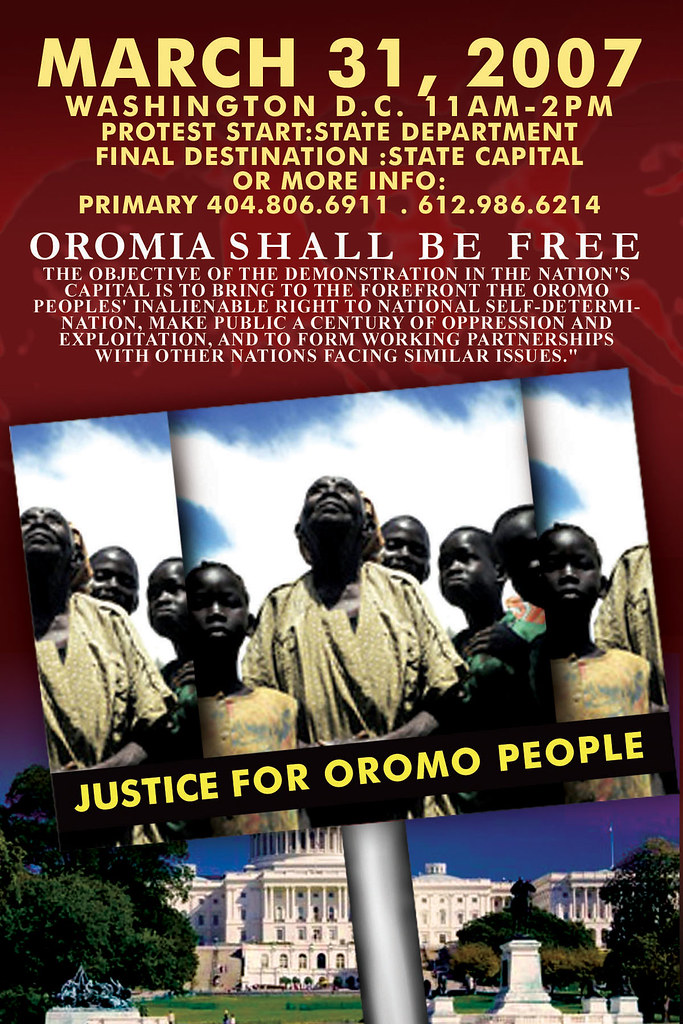
In order to address these disconcerting issues, Oromo Youth leaders are organizing a rally at the Nation’s Capital to express their dismay at the lack of response from the international community to these atrocities and the “deafening silence of the mainstream news media surrounding these atrocities”. In its press statement, the International Oromo Youth Association (I.O.Y.A) calls for an immediate cessation of the “harassment, illegal detention, kidnapping, lynching, and cold-blooded murder of Oromo refugees in Somalia” and calls on all peace-loving people to attend the rally.
The rally, which is going to take place on March 31, 2007 at 12pm starting at the State Department in Washington DC, is expected to be attended by many Oromos and non-Oromos from all across North America.
The full text of the press report from the International Oromo Youth Association follows:
Rally to Address Inadequate News Reporting in the Horn of Africa
On December 25, 2006, the government of Ethiopia launched a military campaign in neighboring Somalia, alleging that its sovereignty was threatened by the Union of Islamic Courts (UIC). The government of Ethiopia has been controlled by the Tigray People’s Liberation Front (TPLF) since 2005, a regime that has not only repressed all forms of democratic dissent, but also has persecuted ethnic groups. Having driven out the UIC from Mogadishu, the TPLF forces in collaboration with the Transitional Federal Government (TFG) of Somalia, has now shifted its mission towards fulfilling its main agenda of persecuting dissenters.
The International Oromo Youth Association (IOYA) is deeply dismayed by the incessant harassment, illegal detention, kidnapping, lynching, and cold-blooded murder of Oromo refugees in Somalia by the Ethiopian and TFG joint military forces, and by the deafening silence of the mainstream news media surrounding these atrocities. Niyata Gemechisa, an instructional technologist from Philadelphia, PA said, “Journalism is powerful, and has the ability to shape and change the world. Unfortunately, the practice of true journalism has not been evident in news reports of Ethiopia and the Horn of Africa. The American news media has failed in serving many of the voiceless citizens in one of the most potentially volatile places in the world.”
The Oromo people, the largest ethno-national group in Ethiopia, have been deprived of their basic human rights under successive Ethiopian regimes. In spite of their contribution to the country’s socio-economic development, the Oromo people have been marginalized from participating in the social, economic, and political decision-making process. Because of their continued demand for self-determination, freedom, justice and equality, Oromos have become major targets for the authoritarian Ethiopian government. Just like its predecessors, the current TPLF government led by Meles Zenawi has committed endless acts of state-sponsored terrorism against Oromo civilians, professionals, students and political dissidents.
Ethiopia and Somalia fought two border wars, in 1964 and 1977. During these two wars, Oromos were caught in the middle of the war waged by two dictators: Ziad Barre of Somalia and Mengistu Hailemariam of Ethiopia. Oromos comprised a significant proportion of Ethiopia’s conscript soldiers that fought during the Ethio-Somali wars. Due to the geographical proximity of Oromia and Somalia, the 1977 war caused a humanitarian crisis including death of civilians, internal displacement and immigration to neighboring countries. Thousands of Oromos fled to Kenya and Somalia and many lost their lives on the way and thousands never returned to their homeland.
Due to the geographical proximity of Oromia and Somalia in the border conflict of 1977, thousands of Oromos fled to Kenya and Somalia and many lost their lives on the way and thousands never returned to their homeland. Today, Somalia is home for over a quarter of million Oromo refugees who fled their country due to persecution and forced displacement by successive Ethiopian governments.
Over the last ten years, the TPLF has been meddling in Somali internal affairs to pursue Oromo refugees. Meanwhile media coverage of the affairs in the horn of Africa has not only neglecting the Oromo perspective but also native Somali Muslim perspectives. We call on the media to give voice for all sides, as well as to continue the truly investigative reporting that has emerged recently on the various stake holders in this conflict.
The IOYA is holding a demonstration to present these issues to the media on Saturday March 31, 2007 beginning at 12pm in front of the U.S. State Department located at 2201 C Street NW Washington, DC 20520. For more information contact: Gelane Gemechisa gelaneg@gmail.com OR Maya Tessema maya.tessema@gmail.com.
Justice for the Oromo People, Justice for All
International Oromo Youth Association
March 25, 2007
Africa's Horn Erupts
By John Prendergast and Colin Thomas-Jensen
Foreign Affairs
WASHINGTON'S FAILINGS IN AFRICA
The Greater Horn of Africa -- a region half the size of the United States that includes Sudan, Eritrea, Ethiopia, Djibouti, Somalia, Kenya, and Uganda -- is the hottest conflict zone in the world. Some of the most violent wars of the last half century have ripped the region apart. Today, two clusters of conflicts continue to destabilize it. The first centers on interlocking rebellions in Sudan, including those in Darfur and southern Sudan, and engulfs northern Uganda, eastern Chad, and northeastern Central African Republic. The main culprit is the Sudanese government, which is supporting rebels in these three neighboring countries -- and those states, which are supporting Sudanese groups opposing Khartoum. The second cluster links the festering dispute between Ethiopia and Eritrea with the power struggle in Somalia, which involves the fledgling secular government, antigovernment clan militias, Islamist militants, and anti-Islamist warlords. Ethiopia's flash intervention in Somalia in December temporarily secured the ineffectual transitional government's position, but that intervention, which Washington backed and supplemented with its own air strikes, has sown the seeds for an Islamist and clan-based insurgency in the future.
Recent U.S. policy has only made matters worse. The region, which has both suffered attacks by al Qaeda and hosted its agents (including Osama bin Laden himself), is a legitimate concern of U.S. officials. But stemming the spread of terrorism and extremist ideologies has become such an overwhelming strategic objective for Washington that it has overshadowed U.S. efforts to resolve conflicts and promote good governance; in everything but rhetoric, counterterrorism now consumes U.S. policy in the Greater Horn as totally as anticommunism did a generation ago. To support this critical but narrow aim, the Bush administration has too often nurtured relationships with autocratic leaders and favored covert and military action over diplomacy. Sometimes that has even included feting in Langley Sudanese officials suspected of having a hand in the massacres in Darfur or handing suitcases full of cash to warlords on the streets of Mogadishu.
The results have been disastrous. Sudan's autocrats are reverting to the extremism of their roots. In Somalia, the core of the Islamist militant movement remains intact after Ethiopia's invasion, its members' passions inflamed by the intervention. The leaders of Ethiopia, Eritrea, and Uganda have used the specter of war and the imperative of counterterrorism as excuses to crack down on political opponents and restive populations at home. The humanitarian situation throughout the region, fragile even in times of peace, is now catastrophic: nearly nine million people have been displaced, and chronic insecurity severely constrains access to humanitarian aid for the more than 16 million people who need it.
The fundamental flaw in Washington's approach is its lack of a regional diplomatic strategy to tackle the underlying causes of the two clusters of conflicts. These crises can no longer be addressed in isolation, with discrete and uncoordinated ad hoc peace initiatives. Washington must work to stabilize the Greater Horn through effective partnerships with Africa's multilateral institutions, the European Union, and the new UN secretary-general. Until it does, long-term U.S. counterterrorism objectives will suffer -- and the region will continue to burn.
DEATH ON THE NILE
Since gaining its independence in 1956, Sudan, the largest country in the region, has been engulfed in a series of civil wars pitting Arab-dominated governments in Khartoum against rebels from marginalized groups. In the face of continued unrest, the ruling National Congress Party (NCP), which took charge in a coup in 1989, has armed and trained ethnic-based militias in Sudan and throughout the region and granted them impunity for mass atrocities against civilians it suspects of supporting its opponents.
In the south, the 21-year civil war between Khartoum and the Sudan People's Liberation Army (SPLA) killed 2.2 million people -- making it the second-deadliest conflict in the world since World War II, after the civil war in Congo, which killed 3.8 million people. The NCP enlisted the Lord's Resistance Army, a millenarian rebel group based in northern Uganda, to open a second front against the SPLA. Khartoum also backed it to punish the Ugandan government for supporting the SPLA. The result there has been 1.7 million people in displaced camps and, courtesy of the Lord's Resistance Army, the highest rate of child abductions in the world.
The war in southern Sudan officially ended in January 2005 with the signing of the Comprehensive Peace Agreement. The deal granted autonomy to the area and gave the SPLA majority control of the new Government of Southern Sudan, based in Juba, and a minority role in the Government of National Unity, in Khartoum. It also provided for a referendum in 2011, in which the people of southern Sudan will decide whether to secede from the rest of the country. But two years later, the situation is not encouraging. The implementation of critical components of the arrangement -- notably the demobilization of the NCP's proxy militias in southern Sudan, the demarcation of borders in oil-producing areas, and the transparent disbursement of oil revenues -- is lagging. War clouds have been forming again since John Garang, the SPLA's charismatic leader and a leading proponent of a unified Sudan, died in a helicopter crash in July 2005. Without him, the SPLA has failed to assert itself in the Government of National Unity.
Another problem is that the negotiations leading to the agreement did not involve opposition groups from Darfur and other northern areas. That left opponents of the government in Darfur feeling that they had no other recourse but to attack military outposts, police stations, and other government interests to win a place at the negotiating table. Since the rebellion broke out there in February 2003, the NCP has supported Arab militias, known as the Janjaweed, who routinely attack the non-Arab civilians backing the rebels. Some 200,000 to 450,000 Darfurians are estimated to have died since April 2003, 2.5 million have been driven from their homes, and two-thirds of all Darfurians -- some 4.3 million people -- now need humanitarian assistance of some kind. Partly thanks to U.S. efforts, the Darfur Peace Agreement was signed in May 2006, but the negotiators secured signatures from leaders of only one rebel faction, which alienated other groups and soon resulted in more fighting. The conflict has since spilled over into Chad and the Central African Republic -- causing another two million people in those countries to require humanitarian assistance. Khartoum has been supporting an array of rebel groups and militias in both countries in the hope of overthrowing their governments and installing friendlier regimes.
In eastern Sudan, too, rebels took up arms against the regime, more than a decade ago. Although the Eritrean government mediated an agreement between the NCP and rebels there in October 2006, the deal has yet to face a serious test. In the meantime, the regime in Khartoum continues to respond ferociously to all uprisings -- a sign that it is desperate to maintain power by any means and hold on to its growing oil wealth.
ALL TANGLED UP
The second cluster of conflicts centers on Somalia and also involves Ethiopia, Eritrea, and northeastern Kenya. Somalia, the only country in the world without an operational government, has been headless since 1991, when the country's leader -- and a U.S. ally -- Muhammad Siad Barre, was overthrown. Warlords held sway in urban centers for over a decade after that, despite no fewer than 14 initiatives to create a central government. Finally, in 2004, under the impetus of the Intergovernmental Authority on Development, a regional organization, a fragile body known as the Transitional Federal Government was set up, headquartered first in Kenya and then, in mid-2005, in the Somali town of Baidoa. In the meantime, however, Somali Islamists had established in and around the capital, Mogadishu, 11 clan-based Islamic courts backed by militias, a few of which had close links to jihadists and terrorists suspected of being associated with al Qaeda.
The struggle for domination started coming to a head in mid-2006, when the Islamic courts defeated the warlords in Mogadishu and expanded their control over much of south-central Somalia. The courts managed to win over the population -- which is Muslim but of a Sufi persuasion averse to the courts' radical Salafism -- by providing security and basic services, which both the ineffectual transitional government and the predatory warlords had failed to assure. The Ethiopian government, having grown increasingly concerned about the Islamists' rising influence, sent troops across the border at the end of 2006. The fighting was over before it began. The Islamists melted into the civilian population, leaving a few militia groups to be pursued by Ethiopian forces.
The Ethiopian government had a number of reasons for taking out the Islamic courts. Ethiopia and Somalia have had a tense history, including three wars between 1960 and 1978. Somalia has hosted al-Itihaad al-Islamiya, a terrorist organization that planted several bombs in Ethiopia in the 1990s, prompting the Ethiopian government twice during that period to send troops into Somalia to destroy the group and dismantle its training camps. Last year, senior court officials made clear that they intended to incorporate Somali populations in the Somali region of southeastern Ethiopia into a greater Somalia. They were already backing Ethiopian opposition groups such as the Ogaden National Liberation Front and, in southern Oromia, the Oromo Liberation Front. This support was a direct challenge to Ethiopian Prime Minister Meles Zenawi, who, after a decade and a half of rule, faces internal political pressure from ethnic groups that feel underrepresented. Legislative elections in Ethiopia in 2005 were characterized by unprecedented openness, but after a strong showing by opposition parties, Meles' government cracked down.
These domestic troubles have also made it harder for Meles to budge on Ethiopia's border dispute with Eritrea -- another threat to regional stability. In the early 1990s, when Eritrea won its independence from Ethiopia after three decades of fighting, Ethiopia became a landlocked state. The two states' leaders, Meles and Isaias Afwerki, had good relations at first, but they soon fell out over economic and political matters, particularly the countries' ill-defined border. The tensions spiraled into an especially savage war in the late 1990s. In 2000, Eritrea and Ethiopia signed a peace deal and agreed to submit their border dispute to "final and binding" resolution by an independent international commission. The ruling, issued in 2002, awarded the disputed town of Badme to Eritrea. Meles has steadfastly refused to implement it, however, arguing that the commission's methodology was flawed. He also objects because he is sensitive to the widespread sentiment among Ethiopians that he is responsible for losing the country's access to the Red Sea at Eritrea's independence; he is careful not to appear soft on Eritrea.
The Eritrean government, for its part, is increasingly frustrated by the international community's unwillingness to pressure Ethiopia to demarcate the border. In protest, President Isaias has restricted the UN peacekeeping force charged with observing the cease-fire and expelled international aid organizations. Continually invoking the prospect of imminent war, his government has clamped down on all opposition while needling Ethiopia by supporting the Ogaden National Liberation Front and the Oromo Liberation Front. Ethiopia, meanwhile, backs the Eritrean Democratic Alliance, an umbrella organization of groups opposed to the Eritrean government.
Even more worrisome for regional stability is the fact that Ethiopia and Eritrea are playing out their differences through their neighbors. While the Ethiopian government supports the Sudanese government, the Eritrean government -- which accused Khartoum of wanting to expand its Islamist reach throughout the region and of backing a rebellion by the Eritrean Islamic Jihad Movement in the 1990s -- maintains close relations with rebels in Darfur and eastern Sudan. At the same time, it has been providing weapons and forces to the Islamic courts in Somalia, principally in opposition to the Ethiopian government, which backs the transitional government there. The Sudanese government is also involved in Somalia's affairs. Using its temporary leadership of the Arab League, for example, it convened in Khartoum a meeting between representatives of the Somali transitional government and representatives of the Islamic courts in March 2006 -- a move that raised concerns among officials of the transitional government who are wary of ties between leaders of the Islamic courts, universities in Sudan, and Islamists in the NCP.
BACKDRAFT
These proliferating threats could have been mitigated by smart U.S. policy, but Washington's approach to the Greater Horn of Africa, which centers on counterterrorism, has been erratic and shortsighted. The United States' overweening focus on stemming terrorism began early in the Clinton presidency in response to Khartoum's aggressive promotion of its ties to international terrorist organizations. Al Qaeda operatives based in Somalia blew up the U.S. embassies in Kenya and Tanzania in 1998 and, Washington suspects, attacked a hotel and an El Al plane in Kenya in 2002. Following the attacks of 9/11, Washington expanded its counterterrorism efforts in the region. It has deployed over 1,500 troops in Djibouti to carry out civil-affairs programs and help gather intelligence on suspected terrorists and has earmarked $100 million a year to support counterterrorism efforts by local authorities. More than anything, however, the United States' counterterrorism policy in the Greater Horn of Africa now hinges on three strategies: almost unconditional support for the Ethiopian government, extremely close cooperation on counterterrorism with Khartoum, and occasional but spectacular forays into Somalia in the hope of killing or capturing al Qaeda suspects.
Ethiopia has been the United States' closest ally in the Greater Horn for the last decade, partly because the fight against Islamic extremism resonates powerfully with Ethiopian officials. Although the country is half Muslim and half Christian, its political and intellectual elites have historically been Christian. Ethiopia has also suffered firsthand from Islamist terrorism: radicals based in Sudan plotted an assassination attempt on Egyptian President Hosni Mubarak in the capital, Addis Ababa, in 1995, and the Somalia-based al-Itihaad al-Islamiya has repeatedly staged attacks throughout the country. In 2001, the Bush administration declared Ethiopia the United States' principal counterterrorism ally in the region. Even the U.S. Agency for International Development -- which gave Ethiopia over $460 million in food aid and assistance in fiscal year 2005 -- touts the country as being "of strategic importance to the United States because of its geographic position" and as "the linchpin to stability in the Horn of Africa and the Global War on Terrorism."
But Washington's narrow agenda has stifled U.S. efforts to press for more democracy and greater respect for human rights in Ethiopia. And it has undermined attempts to settle the border dispute between Ethiopia and Eritrea. In 1998, with full support from the State Department, the Defense Department, and the National Security Council, former National Security Adviser Anthony Lake led the multilateral efforts that eventually ended the Eritrean-Ethiopian war in 2000. But when Ethiopia started balking at implementing the 2002 border decision, rather than pursue diplomatic efforts to pressure it, the Bush White House did little, allowing its counterterrorism objectives to override peacemaking. The two states have barely budged in the five years since, and the Eritrean government has grown deeply skeptical of the international community's intentions. From its point of view, the border issue has been settled and Ethiopia must be held to account before negotiations on other questions can begin. While the stalemate lasts, U.S.-Eritrean relations sour: Washington now sees Isaias as unreliable and worries he is becoming friendlier to rogue states such as Iran, and Isaias continues to fume at what he considers to be favoritism toward Meles.
A second focus of the Bush administration's policy in the Greater Horn has been close cooperation on counterterrorism with Sudan. Khartoum's move away from its strong support for international terrorism started during the Clinton administration. From 1991 to 1996, bin Laden resided in Sudan, and the regime allowed numerous terrorists to travel on Sudanese passports and establish training camps on Sudanese soil. But then, in 1996, in response to U.S.-led sanctions by the UN Security Council, Khartoum expelled bin Laden and dismantled al Qaeda's camps and commercial infrastructure. Relations deteriorated in the summer of 1998, when Washington retaliated for the embassy bombings in Kenya and Tanzania by blowing up a Sudanese factory that it alleged stored biological weapons. And they improved somewhat again after the attacks of 9/11, which reinforced Washington's emphasis on counterterrorism and prompted the Bush administration to engage more with Khartoum.
The Bush White House, which was eager to respond to conservative Christian constituents who were demanding an end to human rights abuses and religious persecution in southern Sudan, also intensified its support for a peace deal there. But as the SPLA and the NCP were closing in on an agreement in 2003, Darfur blew up, exposing the weakness of the narrow approach of Washington and its partners. At that point, the U.S. government had to decide whether to continue to press for peace in the south or broaden its effort to also respond aggressively to the escalating crisis in Darfur. It chose the first option for fear that choosing (and failing at) the second would jeopardize both peace between the NCP and the SPLA and Khartoum's cooperation on counterterrorism. By doing so, however, Washington unwittingly gave the Sudanese government the upper hand: Sudanese officials realized that they could delay a deal with the SPLA while underwriting brutalities in Darfur without facing serious consequences. In both October 2003 and April 2004, even as Sudanese armed forces and the Janjaweed were massacring civilians in Darfur, the White House reported to Congress that Khartoum was negotiating "in good faith" with the SPLA.
President George W. Bush and senior U.S. officials have spoken out against the crimes in Darfur (they have called them genocide), and a UN panel has blamed them in part on senior NCP officials, including the director of national intelligence, the minister of the interior, and the minister of defense. But thanks partly to increased cooperation with Washington on intelligence, Khartoum has managed to avoid punitive action, stifle diplomatic efforts to reach durable settlements with the rebels, and resist international efforts to send a robust peacekeeping force to Darfur. Last November, the Bush administration clearly stated that if Sudan did not agree by the end of the year to welcome a mixed force of UN and African Union (AU) troops to Darfur, Khartoum would face unspecified measures. But when the deadline came and went, the Bush administration issued no condemnation. Meanwhile, Khartoum has continued to cultivate its image as a counterterrorism partner -- even as hard-liners in the NCP have been reconnecting with old terrorist allies. All along, the NCP's objective in cooperating on terrorism has been to make itself indispensable to Washington in order to lessen its exposure to international pressure over its human rights record. And it has succeeded: despite a vast grass-roots movement in the United States calling for a robust response to the atrocities in Darfur, no viable plan is forthcoming yet.
U.S. policy in Somalia has also been dangerously narrow. Washington intervened there as part of a UN humanitarian mission in 1992, but it quickly got bogged down and, following the killing of 18 U.S. troops in the streets of Mogadishu, withdrew all U.S. forces in 1994. Since then, its main goal has been to apprehend the foreign al Qaeda operatives it believes are being hidden and protected by Somali Islamists. (One suspected protector is Sheik Hassan Dahir Aweys, a one-time member of al-Itihaad al-Islamiya and now the chair of the Islamic courts.) To that end, Washington has funded Somali warlords to pursue terrorists on its behalf. By 2006, the enlisted warlords were calling themselves the Alliance for the Restoration of Peace and Counterterrorism -- and getting, according to our interviews with some members, about $150,000 a month from Washington. In contrast, the United States contributed only $250,000 to the $10 million peace process that led to the formation of the Transitional Federal Government, and the United States gives far less humanitarian assistance to Somalia than to other countries in the region. The Bush administration has preferred to create a strategic partnership with warlords in the pursuit of a few terrorists rather than to address Somalia's chronic statelessness, which will continue to draw many more terrorists to the country.
Although Ethiopia's intervention this winter dislodged the potentially hostile Islamic courts -- which can be considered a short-term counterterrorism success -- it is too early for Washington to roll out the "Mission Accomplished" banners. Ethiopia's invasion has only displaced the most visible part of the Islamist movement; other elements have survived, including a network of mosques, madrasahs, and businesses, as well as a militant wing, known as the Shabaab, that has threatened to wage guerrilla war. Meanwhile, the courts' collapse has left a huge vacuum that the transitional government cannot fill. The courts had brought peace and stability, and their defeat has returned Mogadishu to the warlords who have preyed on Somalia for much of the past two decades. Two related insurgencies are likely to break out in the future, one led by the remnants of the courts, the other by disaffected clans.
This leaves the United States' interests in Somalia at risk. Having pursued the narrow objective of capturing or killing a few terrorist suspects, Washington has now become embroiled in Ethiopia's policies in Somalia, which may diverge significantly from its own in the long run. Focusing on hunting down suspects without also investing in state building is a strategy that could not have worked, and the decision to support Ethiopia's military invasion without devising a broader political strategy was a stunning mistake, especially considering the U.S. experience in Iraq. Predictably, resentment over foreign intervention has been building among Somalis. And U.S. air strikes against Islamist holdouts in the far south of the country have turned Somalia into a much more interesting target for al Qaeda than it once was; they could boost recruiting for the Islamists for a long time.
A THREE-PART PLAN
A new framework for engagement in the Greater Horn is urgently needed to reverse these trends. The United States' counterterrorism objectives would be best served by a new comprehensive diplomatic initiative focused on resolving conflict and promoting good governance throughout the region. Any new strategy must be wide-ranging and multilateral. It must focus all at once on resolving conflicts, keeping the peace, and punishing spoilers, and it will require working with the UN Security Council and the AU.
First, the United States should launch a Greater Horn peace initiative with the AU and the new UN secretary-general to devise a comprehensive approach to the two main clusters of conflicts surrounding Sudan and Somalia. This should entail coordinated efforts to resolve the related crises in Darfur, Chad, and the Central African Republic; secure a deal between the Lord's Resistance Army and the Ugandan government; broker a power-sharing arrangement in Somalia; and settle the ongoing disputes in southern Sudan and between Ethiopia and Eritrea, in order to see the two existing peace deals concerning them fully implemented. These efforts would require the creation of a conflict resolution cell in the region, staffed by senior diplomats reporting to the State Department and assigned for at least one year, who would coordinate peace talks and support their realization. This initiative could follow the models provided by the partnership between the United States, the United Kingdom, Norway, and the Intergovernmental Authority on Development that ended the war in southern Sudan and the partnership between the United States, the European Union, and the Organization of African Unity (the AU's predecessor) that ended the war between Ethiopia and Eritrea. Unfortunately, so far, in both Somalia and Darfur, the international community has put the cart before the horse, working furiously to send peacekeeping forces before having secured viable peace agreements.
Second, a concerted effort must be made to boost the peacekeeping capacity that would be needed to implement any peace deals. The United States and the European Union have spent hundreds of millions of dollars in the past decade to prepare African armies to participate more effectively in peacekeeping operations. But judging by the limitations of the AU operations in Darfur, peacekeeping objectives need to be refocused. Lacking an explicit mandate to protect civilians, the AU troops in Darfur have often been either irrelevant or counterproductive, serving as a lightning rod for local hostility and as an excuse for the inaction of the international community. The AU does not have enough forces to deploy in multiple theaters; it could barely scrape together the 7,500 troops it sent to Darfur. And with Western donors failing to fully fund the mission, the troops were ill equipped and remained unpaid for months. The inescapable conclusion from the AU's experience in Darfur is that the UN should lead peacekeeping operations in Africa (as it does elsewhere in the world), with substantial AU participation and a mandate to protect civilians.
Third, Washington must do a better job of garnering international support for using, or at least threatening to use, multilateral penalties of some type. In Sudan, Somalia, and Ethiopia, the U.S. government and some Western states have offered much and gained little in return, partly because they have failed to apply instruments of pressure; they are like barking dogs with no bite. Real leverage comes from the early use of multilateral punitive measures -- such as prosecutions by the International Criminal Court, targeted sanctions against senior officials and rebels, and oil embargoes and other instruments of economic pressure -- and from their suspension when compliance is achieved. How can the regime in Khartoum be expected to act any differently in Darfur if its activities bear no cost?
WALKING THE WALK
Boosting conflict resolution, peacekeeping, and punitive measures will unquestionably be difficult, but it can be done if the United States builds multilateral partnerships to share the diplomatic and financial burdens. In Sudan, this will require preventing the NCP from continuing to channel U.S. policies into separate streams -- one on southern Sudan, another on Darfur, another still on counterterrorism. Washington needs a cohesive Sudan policy that addresses all U.S. goals simultaneously and uses multilateral punitive actions to achieve them. Until the power-sharing agreement is fully implemented in the south and wealth and power devolve from the ruling elites in Khartoum to marginalized areas in Darfur and the east, the tensions that have fueled 50 years of civil war in Sudan will not subside.
Despite its flaws, the Comprehensive Peace Agreement in southern Sudan remains a key building block for altering the distribution of power and reestablishing democracy throughout the country -- but only if it is fully implemented. Enforcement means overcoming several major obstacles: the NCP's failure to demobilize its proxy militia forces in southern Sudan, its refusal to accept a border commission's ruling regarding the oil-producing region of Abyei, and the lack of transparency in the division of oil revenues between the Government of National Unity in Khartoum and the Government of Southern Sudan in Juba. NCP hard-liners simply will not implement key elements of the agreement -- or abandon their militaristic policies in Darfur -- unless Western governments subject them to the coordinated pressure of UN sanctions, asset freezes, and criminal indictments.
At the same time, the United States and other donors must live up to their commitment to help build the capacity of the nascent Government of Southern Sudan. International donors pledged $4.5 billion for Sudan at a conference following the Comprehensive Peace Agreement in Oslo in May 2005, but they did not fulfill their obligations fully because of mounting concern over Khartoum's role in the atrocities in Darfur. They must now refocus on the south to prevent a return to conflict. And they must prepare for the increasing likelihood that the region will vote to secede in the 2011 referendum. Southern Sudanese participating in focus groups convened by the National Democratic Institute in April 2006 expressed near-total support for independence. With little progress in their relations with Khartoum, it is unlikely that southerners will change their minds in the next four years. But Khartoum will probably return to war rather than allow the referendum to occur and risk losing access to 80 percent of its oil resources. More focused international support for the Government of Southern Sudan, especially for helping the SPLA become a regular army, would not only decrease insecurity in the south in the run-up to the referendum but also help deter the NCP from resuming the conflict (or at least give southerners the means to defend themselves if it did).
With Sudan's oil revenues up to $4 billion a year, Khartoum is now driven more by greed than by Islamist ideology. This presents an opportunity for the United States to increase economic pressure on Khartoum. But Washington cannot make the most of this without engaging more deeply with China and Arab League countries, which have strong economic interests in Sudan and regularly run interference for the regime. In response to U.S. economic sanctions in the 1990s, the Sudanese oil sector established close ties with China and, to a lesser extent, with Malaysia and India; as a result, Beijing is now reluctant to lean on Khartoum. But the growing perception that Beijing is turning a blind eye to continuing atrocities in Darfur could mar its international image as it prepares to host the 2008 Olympics. Recent efforts to build consensus among China, Russia, and the Arab League for enhancing peacekeeping forces in Darfur are a good start. But it is also necessary to build multilateral support for a comprehensive peace strategy that would force Khartoum to stop supporting rebel groups in Chad and the Central African Republic, negotiate amendments to the flawed Darfur Peace Agreement, and accept a properly mandated international peacekeeping force -- with UN troops under UN command and control -- to protect civilians and dismantle the Janjaweed. The United States should work through the UN Security Council to freeze the assets of senior NCP officials and their businesses and impose travel bans on them, as well as facilitate the flow of information about suspected war criminals to the International Criminal Court. In case the situation deteriorates and Khartoum continues to obstruct peace efforts, the international community should urgently plan for deploying ground and air forces to protect civilians without Khartoum's consent.
In Somalia, too, a multilateral approach to peace building is necessary to prevent protracted insurgencies from engulfing the region. There has been little history of sectarian violence in Ethiopia, but many Ethiopians now worry that an extended war with Somali Islamists could create religious divisions at home, pitting, in particular, Muslims against the government. Rather than relying primarily on military force, regular intelligence from and occasional intervention by Ethiopia, anti-Islamist warlords, and a weak transitional government, as it has done, Washington must adopt a more nuanced approach to Somalia. It should work with the European Union, the AU, the Arab League, and the Intergovernmental Authority on Development to pressure all parties into negotiating a power-sharing deal between the transitional government, clan leaders in Mogadishu, and the Islamic courts. The Somali transitional government will negotiate only if pressed by Ethiopia, and the United States has more clout with Ethiopia than does any other external actor. By contrast, Washington lacks direct leverage with the Islamic courts and excluded clan elders, and so U.S. diplomacy on that front should focus on getting governments in the region and in the Arab League to persuade them to accept a government of national unity.
None of this will be easy. Washington must appoint full-time envoys to press for a power-sharing deal in Somalia and to nudge Ethiopia and Eritrea toward accommodation. Letting these disputes fester would ensure the advent of Islamist and clan-based insurgencies in Somalia and increase the possibility of another war between Ethiopia and Eritrea. Both developments would be disastrous for the people of the Greater Horn and for long-term U.S. counterterrorism objectives.
The essential lesson of U.S. counterterrorism policy over the last five years -- apparently unheeded by the Bush administration -- is that in order for local Muslim populations to take the United States' counterterrorism agenda seriously, the United States must take their state-building and power-sharing agendas seriously, too. Ironically, the strategy is already there on paper. In its 2002 National Security Strategy and elsewhere, the Bush administration has argued that failing states foster terrorism and has laid out a comprehensive approach to counterterrorism that involves promoting peace building, state reconstruction, and good governance. When it comes to the Greater Horn, however, the Bush administration has simply not implemented its own policies. By relying on sporadic military strikes and continued support for autocrats without broader political planning, it has combined the worst elements of its current strategy in Iraq with the Cold War-era policy of cronyism. Conflict resolution and good governance are, in fact, the keys to countering terrorism in the Greater Horn over the long term. Failing to recognize this will likely result in hundreds of thousands more deaths, billions of dollars more spent on emergency humanitarian aid -- and the increased prospect of another terrorist attack against U.S. interests in the region. With a few more dollars spent on preventive diplomacy, these outcomes could be avoided altogether.
John Prendergast, who worked at the National Security Council and the State Department in the Clinton administration, is a Senior Adviser at the International Crisis Group and a co-author of the forthcoming "Not on Our Watch". Colin Thomas-Jensen is Africa Advocacy and Research Manager at the International Crisis Group.Foreign Affairs
March 22, 2007
March 20, 2007
Aman Kamsare lambastes Abyssinian tyrant Meles Zenawi
Dr. Muhammad Shamsaddin Megalommatis
March 18, 2007

As the Horn of Africa situation deteriorates and is about to become an Islamic Terror avalanche from Somalia to Mauritania, we find necessary to offer space to Oromo political leaders, who are the only guarantee for the West in the explosive volcano Abyssinia.
The paranoid dictator Meles Zenawi launched a supposedly anti-Islamist expedition to Somalia last December and January, and the result has been so far detrimental to all the African peoples who aspire to Democracy, Freedom and Progress, as well as to all those concerned with the Islamic Terror expansion. The deeply hated dictator proved to be good enough to generate a situation in which every oppressed people of the Horn of Africa is by now pushed to the hands of Islamist terrorists who - unhindered and calm - position themselves as ‘fighters’ for Africa’s Independence and for the end of the Western Colonialism.
To avoid an equation of the type “Islamists = African liberators”, America and Europe have to cooperate with the forbearers of African Democracy, the Gada system practicing Oromos, who make more than 40% of Abyssinia’s population and fight for independence. As the Oromo culture reflects the values of the traditional African spiritual wisdom and monotheistic religious system Waaqa, Oromos are the only sizeable African nation that has not yet been caught by the winds of religious fanaticism.
The rise of Oromos in supremacy at Finfinne (Addis Ababa) would bring forth the most effective break wave, as traditional African tolerance permeates also Christian and Muslim Oromos. Eliminating the reasons of dissatisfaction, oppression, stagnancy and misery remains the key to success in averting the East African Islamic Terror volcano that was created not by the Islamic Courts of Justice but by the Abyssinian tyranny and involvement in Somalia.
Mr. Aman Kedir Kamsare and the Front for Independence of Oromia will be among the Western World’s best interlocutors in tomorrow’s free Ethiopia that under Oromo leadership will generate great progress for the entire continent. We will publish Mr. Kamsare’s interview in two parts, the first focusing on aspects of the Abyssinian tyranny and the second referring to the present situation.
An Interview with Mr. Aman Kedir Kamsare, Vice Chairman of the Front for Independence of Oromia
- Aman, you belong to the leadership of the Front for Independence of Oromia, one of the most influential Oromo political fronts. What pushed you to get involved with politics? When did you start your political activities, and what are the aspects of your commitment to Oromia’s independence and national self-determination?
- A tremendous and shocking experience record consists in the main reason that pushed me to political involvement and activism relatively early in my life, at the age of 18.
Since my adolescence I lived in a very marked way the fact that my motherland, Oromia, and my people had fallen under the inhuman and barbaric Abyssinian colonialism. This life experience formed me and ultimately led me to the world of politics. In the beginning, it was not politics in the strict sense of the term, involving party activism; it was a real matter of survival, the ultimate choice between Life and Death.
To your surprise, my vision of an independent and prosperous Nation of Oromia does not emanate from academic analyses and university discourses. My parents were the first to instigate in my heart a real political vision; they were tragic victims of the Abyssinian colonial slavery. As a matter of fact, my mother and father played a great role in the formation of my independent political thinking. During my childhood, I experienced – immensely, strikingly and painfully - the burden of the abominable Abyssinian colonial yoke in all its ramifications: psychological, cultural, political, linguistic, and economic.
My parents were obliged to pay land rents in kind, hard labour and money, to the Abyssinian colonial nafxaynaas, who had enslaved the Oromians and our motherland by monopolizing the power of modern firearms.
When in the Primary School, I was called ‘Gallaa’ by the children of Abyssinian colonial settlers, and this term is definitely derogatory, tantamount to slave. I was looked down upon by the children of a foreign people that had invaded my country. I was despised by them because I was an Oromo, belonging particularly to the Arsi Oromo populace.
My identity as Arsi Oromo was the reason for humiliating treatment and flagrant discrimination against me during my early school life. “Shirrixaam Gaallaa” and “Shirrixaam Arusii” are the dehumanizing, insulting words that still echo in my ears. They bear witness to the unforgettable stigma and the absolute alienation that have been cast upon the Oromo people by the Abyssinian invaders, and they make me recall all the horrors of the Abyssinian colonial oppression that I experienced since those days.
Due mainly to these extreme experiences, I was left with no other choice than to choose between slavery and freedom, and to opt for either colonial domination and eternal humiliation or national dignity. It was only normal that I decided to be a free and independent person rather than a slave in the hands of Abyssinian masters. I decided to die a noble death rather than living a meaningless and humiliated life. That is why I joined the Oromo National Movement for Independence 30 years ago.
As it could be expected, my active participation in the Oromo Movement for Independence ended up with my imprisonment. I was detained for no less than 12 years without facing a trial.
In addition, I spent most of this space of time in maximum security cells. In a summarizing way, I should say that I experienced a lengthy and tortuous journey in the abyss of the Abyssinian colonial empire. It would take me months and years to narrate what the gangsters of the Abyssinian tyranny attempted in order to deprive me from my personal integrity and Oromo national pride.
- Would you introduce yourself to our readers? What is your connection to the Oromo national movements? Where have you been born? In what part of Abyssinia have you spent your childhood and adolescence? To what extent has your formation been influenced by your family background?
- I was born in Oromia, in the Arsi administrative region, in Arba Gugu province, in the Ciniinaa-Waragu village. To be honest, I do not know the exact date of my birth; this sounds strange in the Western world but it is a common story in obscurantist, backward Abyssinia. My parents were illiterate; they could not read and write; even today, Abyssinia’s miserable record of illiteracy is one of the highest in the world. I never got any written public document specifying the exact date of my birth. I personally decided on this for the first time, when I came to Norway as a bona fide political refugee with the help of Norwegian immigration office.
During my preliminary interview at the premises of the Norwegian Directorate of Immigration (UDI), I was asked when I was born, and I answered ”I do not know”. The constable went on, asking me when I would like to be born. I said that I would like to be born on the day I first stepped on the soil of Norway which is January 9, 1999. It was then that real life of free human being started for me.
As a matter of fact, I was born to a destitute family who could not make ends meet. My parents were an average Oromo family of cattle-breeders. We owned a small lot of land that could not cover our life needs, and as a consequence my father was obliged to work. He was the tenant farmer of one of the fiefdoms established by Abyssinian feudal lords in the Colle district of our colonized country, Oromia.
- What are your educational background and your cultural preferences and hobbies?
- I attended the Primary School of a Catholic mission, located at the village Waragu Daka Diima, in Arba Gugu province, Gololcha district. I then continued in the Secondary School of Cholle Qulullicha, another town in the Arba Gugu province.
I then enrolled in the Finfinne University (falsely called by the Abyssinian invaders as ‘Addis Ababa University’), Bahar Dar annex. There I took Pedagogical Science and English Language and Literature. Eager to advance, I pursued my studies at a later stage, and I got a B.A. degree in Socio-linguistics from York University, Great Britain. Last year, I completed my Masters’ degree studies in African English Literature in Tromsø University, Norway. Willing to continue, I have applied for Ph.D. level studies, and I am currently seeking ways to finance my studies (grants, scholarships, etc.). For the time being, I am working as English teacher in a High School supervised by Tromsø University, Norway.
Studying, reading and writing have become my inalienable parts of myself. Books and dictionaries are my closest companions and most intimate friends. I enjoy reading books on Oromo History; I also read much about various national liberation struggles. If I happen to disappear from my buddies for some time, they all know that I must be somewhere in a library buried among books! Yet, I do not see myself as a bookish person! I need all these data, and all the detailed information I get because I want to use them as a compass to direct myself, through the correct road map, to the Independence of Oro-biyyaa (Oromo Country).
When it comes to hobbies, I like sports and gymnastics. I do exercise myself every morning. Physical exercise has therefore become part of my daily life.
- Would you give our readers an outline of your professional experience?
- I am English language teacher, and an author focused on Oromo related subjects. As I settled in Norway and learnt Norwegian, I felt obliged to break ground, to make my language known to more people, and to compile a trilingual, English-Norwegian-Oromo dictionary. I believe this helped a lot in raising global awareness and in diffusing Oromo culture at a global level. In addition, I have composed an Oromo Grammar, a book that is the first of its kind so far.
- Today how do you evaluate the presentation of the Oromos and the Oromo Ethiopian culture within the Primary and Secondary Education in Abyssinia?
- The Abyssinian rulers have been working indefatigably to eradicate the Oromo national existence and identity since the early days of the colonization of Oromia. First, they occupied our country with the help of European military might, intelligence, and financial and logistical assistance. The completion of Oromia’s occupation was followed by subsequent extensive massacres, a real genocide that still remains quasi-totally unknown by the rest of the world. It was an intentional act bearing all basic aspects of Genocide. To give you an example, during the Amhara Abyssinian invasion of Oromia (1880 - 1890), the Abyssinian army, accompanied by gangs of thugs and pillagers, perpetrated horrible acts as following: they amputated hands and breasts of Arsi-Oromos who gallantly and heroically resisted the colonial invasion, besieged in a Aanole, a great historical place.
Facing barbaric occupation forces led by Menelik II of Abyssinia, the Arsii-Oromo martyrs paid with their blood their national Oromo pride and their willingness to preserve their freedom and independence. Thus, was written at Aanole one of the bleakest moments of African History. During a single battle, around 12000 Arsii-Oromo fighters, men and women, were mercilessly murdered.
Unique mass grave of such size throughout Africa, Aanole Cenotaph is the place where 12000 people were buried collectively by the Abyssinian criminals; the act consists in one of the most abominable deeds ever carried out in Africa.
The Aanole act of ethnic cleansing is a pale competitor of many other murderous acts perpetrated by the all-committed Amhara Abyssinian invaders of Ethiopia. The Gullalle and Abbichuu Oromos in the central Oromia were met with the same anti-human attitude of the Amhara Abyssinians, who have always been an alien element in Oromia. Aged and adolescent Gullalle and Abbichuu Oromos were burned alive, locked in their homes, by the rejoicing Abyssinian invaders who wished to clear Ethiopia from its indigenous population, when trying to complete the master plan of the Abyssinian invasion.. Great Oromian Heroes like Tufa Muna and Birraatuu Gole fell in that battle, becoming the best personification of Diachronic African Soul.
The African Genocide has its own Geography; following the battle of Calii Calanqoo, in the eastern part of Oromia, extensive massacres of defenceless Oromians generated rivers of blood that testify to the real nature of the intentional murders perpetrated by the alien Abyssinian invaders.
The perpetration of Abyssinian genocide of Oromo Cushites was complimented by further acts and policies targeting the total extinction of the Oromo Cushitic Nation; these criminal deeds were cultural and linguistic of character.
Immediately after the Abyssinian invasion of Oromia, the invaders launched the Amharization project, which was part of the plan to eradicate the Oromo Cushitic National Identity. In doing so, the illiterate generals of the barbaric and obscurantist Kingdom of Abyssinia tried to destroy the Oromo Gada socio-political system, which bears witness to authentically African concepts and practices of Democracy, having nothing to envy from Pericles’ Athens.
The Amharization / Abyssinianization plan advanced in parallel with another project, namely the diffusion of the heretic, monophysitic version of Christianity among the Cushitic Oromians. This heresy has nothing in common with Western Christian denominations, and many Catholic missionaries and explorers found unmerited death in the hands of the Amhara Abyssinian heretics. Read the Catholic Encyclopaedia in www.advent.org, entry Abyssinia, and you will get an introductory picture….
As a matter of fact, they dictatorially imposed changes of thousands of toponymics, and attempted to enforce change of personal names of Oromo Cushites. To give you an idea, Biqilaa became Bekkele and Marga was turned to Eshetu.
In addition, the Abyssinian invaders and their barbaric Debteras attempted to amharize Oromo national names, names of important historical places, names of Oromo religious places and holy shrines; at the same time, they desecrated these places and sanctuaries.
Then, Finfinnee, the historical capital of Oromia, was renamed as Addis Ababa, and Bushooftu was turned to Debra Zeit; Hadaama was disfigured to Narerth, Abboomsa was transvested to Tinsae Berihan, and so on and so on.…
This is not the end of the story. The analphabetic Amhara invaders imposed tyrannically the so-called Abyssinian educational system, which is a form of perpetuating barbarism and analphabetism, Hatred for the ‘Other’, and ignorance. They try to do their best to prevent foreign scholars from reaching Gueze manuscripts, because they cannot read and understand them anymore, their tradition being mostly oral! This barbarism and targeted illiteracy they attempted to diffuse among the occupied Oromos, preaching the dictatorial concept of the supremacy of one religion, one language, and one ethnic group under the rule of the Abyssinian absolute monarchy ‘by the grace of god’.
Subsequently, they forbade the exercise of Oromiffa, the Oromo language, the Gada, the Oromo socially established system of Democracy, Waaqaa, the historical Oromo religion, an absolutely monotheistic and aniconic system of religion, and in general the Oromo culture, the Oromo way of life as a whole.
Speaking Afaan Oromo (as Oromiffa is also called), exercising Oromo ritual ceremonies, and practicing the Gada system as national institution became capital crime. They tried to physically exterminate the Oromo nation and to spiritually enslave all the survivors. In a nutshell, the Abyssinian predators and their analphabetic and barbaric bogus-Christian clergy left no stone unturned to annihilate our human essence and destroy our national identity once and for all.
They called us as they keep calling us ‘Gaallaas’, a derogatory term which means slave or cruel. This criminal project of dehumanizing, stigmatizing and obliterating our human and national existence – this ongoing African Genocide – has been intensified and carried out in a far more sophisticated way down to the present day.
The present Abyssinian educational institutions are the authentic continuation of all the tyrannical practices of the Abyssinian monarchy or Communist tyranny. From Menelik to Haile Selassie, and from Mengistu to Meles Zenawi nothing changed, except the product wrapping has been updated. Every system changes to adjust itself to a new environment; Abyssinia can hardly carry out this sort of change, and this does not pertain to the antihuman, barbaric and criminal nature of the invaders’ regime that remains untouched..
In today’s Oromia, the educational system is the regime’s key tool in promoting the ideological, cultural, social, political and economic and ideological dominance of another variant of the Abyssinian ruling elites (i.e. the Tigray ethnic groups’ ruling elite led by the anachronistic, quasi-monarch Meles Zenawi). Never forget that the Tigrays do not represent more than 12% of the country’s population! The present day educational curricula in Oromia’s primary and secondary schools are a mere photocopy of the traditional, century-long Abyssinian colonial policy.
The Abyssinian educational system is genuinely totalitarian of nature, as it inculcates in the minds of the schoolchildren a forced concept of unity that is not accepted by all the oppressed peoples of Abyssinia, and a fake idea of ‘democracy’ that involves undisputed acceptance of the regime’s bogus-historical dogma. The creators and the beneficiaries of the current educational system are the newly settled Tigray colonial class and their surrogate organizations, the PEDOs. The people at the head of educational pyramid are exclusively Amhara-Tigray debteras and their puppets. The system does not accept genuine Oromos instructors and native teachers belonging to other non-Abyssinian, oppressed peoples who would challenge the officially imposed dogma.
American Chronicle
+++++++++++++++++++++++++++++
Part II
Oromo Leader Kamsare to UN: Ostracize Abyssinia’s Rogue Thug Zenawi
Dr. Muhammad Shamsaddin Megalommatis
March 26, 2007

Following the publication of Oromo Leader Aman Kamsare’s interview before a week, a great mobilization has taken place, and the case of the oppressed peoples of fake ’Ethiopia’ was given wide attention.
As more people allover the world realize that the murderous African dictator Meles Zenawi and his daeth squads cannot be further allowed to perpetuate their antihuman, totalitarian policies, this second part of Mr. Aman Kamsare’s interview sheds more light on the Abyssinian regime’s discriminatory policies, and on the ways Mr. Kamsare and the Front for Independence of Oromia (FIO)
challenge today’s most repellant African tyranny.
Having spent many long years in the inhuman Abyssinian prisons, the Oromo leader calls for Free Oromia, Humanism, Democracy, Freedom, and Human Rights’ Respect in one of the world’s most sensitive, strategic areas; this is the only way to avert the explosion of the African Islamic Terror Volcano that has been generated because of the inhuman policies practiced by the bogus-‘Ethiopian’ gangster state. The note at the end of the interview reveals the personality of the Visionary Oromo Leader Aman Kamsare.
Interview with Mr. Aman Kedir Kamsare, Vice Chairman of the Front for Independence of Oromia – Second Part
- What aspects of Amhara / Tigray Abyssinian oppression are unbearable and inhuman?
- What the Amhara / Tigray Abyssinian ruling classes have been and are currently doing against me personally, and against my nation as a whole, is totally inhuman, unbearable and barbaric. They destroyed our national existence in its entirety. They occupied our country by force and dismantled Gadaa, our centuries old, genuinely democratic socio-political system, replacing it by the Abyssinian feudal – monarchical administration that – exported to another country – took immediately a clearly colonial character.
More precisely, they divided our country into tiny provinces, and attempted to play colonial tricks by turning a group of Oromos against another. They arbitrarily imprisoned, killed, dislocated, and tortured an extraordinarily high number of our fellow country men and women. Furthermore, they robbed our natural resources, depriving us from our national wealth; Oromia was rich in gold and coffee, which became a monopoly of the Abyssinian colonial invaders.
On many occasions, Abyssinian soldiers and gendarmerie raped Oromo women and girls; they systematically burned our houses and our forests, causing therefore a dramatic transfiguration at the social level, and an environmental depletion as regards the ecosystem. In brief, they destroyed our national and natural environment.
Oromia, as African homeland without extensive contacts with other parts of the world, was relatively immune from a great number of diseases before the arrival of the Abyssinian invaders. They brought in various contaminations and diseases, such as syphilis and gonorrhoea. Generally, they did to us what English colonialism did to Kenya, what apartheid did to South Africa, and they did what all colonial powers did to the rest of Africa at the times of the colonization of this continent.
In the case of the Abyssinian invasion of Oromia, the difference lies only in the skin colour of the colonizer, our colonials’ skin is black whereas the other African peoples’ colonizers’ skin was white.
Sometimes it is even difficult to compare the Abyssinian brutality and inhumanity with that of the European colonizers. The Abyssinian attitude of the colonizers has been more crude, more barbaric and more intolerable than that of the Europeans. Saying this, I want merely to emphasize on the bitterness of Abyssinian oppression; it would never be my intention to opt for a colonial master instead of another, as I do reject colonialism in its entirety.
Personally, I fell victim of their inhuman treatment in very young age. As I mentioned already, without a trial, I was imprisoned, and I spent no less than 12 years of agonizing, traumatising and anguishing prison life in Amhara-Tigray colonial custody. During my long stay in prison, they violated my physical integrity as a person. They denied my inalienable right to peaceful life. They subjected me to extremely brutal physical tortures. Many times, they whipped me while they were drunk. They kept me alone in solitary confinements in the Alambakany, Ma’ikalawi, and Assallaa Karchalle jails, and in the Korea and Dhedheessaa concentration camps. In all these prisons, I was not only brutally tortured by the Abyssinian sadist soldiers but I was also afflicted by urine and forced defecation. They did not allow me to go to toilet on time. I had to manage to get to the toilet once every 48 hours, lest I be noticed by someone. I was not only tortured by various sadomasochistic methods, but also bred parasites, such as lice, fleas and rats.
By far, the most terrible kind of torture I experienced in the Abyssinian prison cells was mental torture. They used to threaten me with death. They let me believe that I was condemned – in absentia – to death. They repeatedly tried to force me to confess crimes that I had not committed barely for my belongingness to the Oromo people. They ceaselessly told me that they would execute me on the next day if I refused to confess what they demanded.
Along with my fellow inmates, I was forced to observe other prisoners digging their own graves. Is there anything more inhuman, unbearable and horrible than this?
- Would you describe the political situation in Abyssinia during the current Tigray-led regime?
- The political situation in Abyssinia during the current Tigray-TPLF led regime turns from bad to worse. It would not an exaggeration to characterize the current Abyssinian regime led by Meles Zenawi as neo-colonialist and crypto-fascist of nature. In order to hide its tyrannical and brutal nature, the Zenawi regime camouflaged itself behind a mask of democracy.
Democracy is a shield of mendacity due to which the Meles Zenawi regime confuses the international community, and gets assistance for its war project. There is a vast difference between words and deeds. Chanting the slogan of democracy and self-determination, the Zenawi regime imprisons, tortures and executes those struggling for genuine democracy and self-determination.
Throughout History, experience teaches that Abyssinian regimes and ruling elites cannot be democratic or manage to have a human face. Chauvinism, dictatorship, and totalitarian social traits are their common denominator. What we witnessed during the last two successive regimes is precisely the unfolding of these typified Abyssinian characteristics.
The defunct Communist military junta led by Mengistu Hailemariam revealed its true nature through a painful process that lasted almost two decades. The same thing holds true for the current Tigray Abyssinian regime led by Meles Zenawi. The typical features of all the Abyssinian regimes, including the recent TPLF regime, are chauvinism, inhumanity, and tyranny.
As it happened with its predecessors, the main strategic objective of the Tigray-led regime is to create an artificial Ethiopia that is dominated and controlled by the Tigray ruling elites. The tactics and the coverage they employ may vary, but the hidden agenda is always the same. And this is what we are attesting today, in front of our eyes…
I want therefore to underscore the fact that the TPLF oppressive regime led by Meles Zenawi proved to be the bitterest enemy of the people of Oromia. It waged an undeclared war against the Oromo people since its grip on power. Over the past fifteen years, it has conducted a selective extermination of the Oromians, who all desire fervently to become an independent nation. A great number of Oromians have been kidnapped by the regime’s assassination squads, and we have no information concerning their whereabouts and fate.
The TPLF regime did not only reveal its racist anti-Oromo face in the most hideous way, but it also did its best to make others hate the Oromo people. As soon as it seized the totalitarian state power, it devised a three-faceted anti-Oromo strategy:
a)dividing and ruling the Oromo people,
b)reorganizing and using the classical Amhara settler colonial class against the Oromians, and
c)pitting other oppressed peoples and ethnic groups of Abyssinia against the Oromo people, thus refuelling territorial conflicts.
The target behind all this was to finally crush the Oromo struggle for independence through all possible biases, involving of course extensive use of military force.
What few people understand is that the main objective of the recent aggressive attitude and war against the Republic of Somalia is the completion of the long-standing Abyssinian colonial project of destroying Oromia. By preventing Oromian fighters of independence from having a hinterland for their struggle, the Zenawi regime thinks ‘Oromia’ while talking ‘Somalia’.
- Would you describe the main fields of Human Rights' violations in Abyssinia?
- Human rights are violated in Abyssinia at all levels, from economic, to social, cultural, and political. To start with, the right of the Oromo people to self-determination is absolutely denied. The present Abyssinian colonialist regime recognizes the right of Oromo people for self-determination only in words. The theoretical acceptance of this right Is actually presented it as apologetics geared only for governmental propaganda; practically speaking it is meaningless. If there is a real right for self-determination in Abyssinia, it applies only to the ruling colonial Amhara and Tigray elites, and eventually to their satellite organizations.
The current Abyssinian regime does not only grossly violate peoples’ right to self-determination but it also severely abuses individual human rights. Abyssinia is a country in which the most elementary Human Rights are being constantly violated. In today’s Abyssinia, breaking the physical integrity of a person is not an exception but the prevailing rule and norm.
Above all, there is no law to guarantee the right to life. Arbitrary arrest, extra-judicial killing, and extensive torture are rampant under Meles Zenawi regime of Abyssinia. The right to one’s own property is totally abrogated. The land is massively owned by the ruling Tigray elite. It possesses absolute and unlimited power to evict the Oromo peasantry from their lands; the same applies to other non Abyssinian peoples.
- What are your relations and your differences with the OLF?
- My organization, Front for Independence of Oromia (FIO), has similarities and differences with the OLF and other Oromo liberation forces. We believe that our differences are reconcilable and can be bridged through constructive dialogue. Our basic concern is with the pro-Abyssinian elements that have infiltrated the leadership recently, and contributed to a revision of the original political program. We tolerated the internal weaknesses that permeated the OLF for decades. We tolerated the lack of experience and the incompetence of its leadership for we hoped it could be overcome through time. However, we could not accept that among the OLF leadership prevailed pro-Abyssinian and defeatist elements that promote policies of capitulation, therefore becoming sort of advocates of the Abyssinian pseudo-democracy and the globalization rhetoric. That is why we took some distance, dissociating ourselves from this group. We launched FIO without being antagonists with OLF in its entirety; we simply underscored our difference with the pro-Abyssinian elements among the OLF leadership, as this is crucial and fundamental. We categorically repudiate the recent political marriage consummated between the old Amhara-Abyssinian neo-colonial elites and the pro-Abyssinian faction of the OLF under the hypocritical pretext of alliance and tactics. This is totally unacceptable for us, and absolutely incompatible with our political position. However, we are currently focused on our own activities without comparing and/or contrasting with OLF.
We have a clear vision and a definite ideological outlook. Using the term ‘ideology’, I do not refer to the old polarization between the socialist and the capitalist worlds. I mostly mean the ideas that are the driving force in our struggle for independence, and the advocacy for the liberation of the people of Oromia.
We at FIO believe that a qualitative transformation can be brought about in our society chiefly through the development of the inner, behavioural, spiritual and cultural dynamics of our Oromo Nation.
Any external conditioning depends mainly on our internal characteristics; we should not forget this. In addition, we are fully aware that, however fine and attractive the help, the influence, and the impact of others may be, we can only genuinely transform our own reality, on the basis of a detailed, multifaceted and multi-dimensional knowledge of Oromia, of our Culture, of our People, and thanks to our own efforts and sacrifices. We strongly believe that national liberation and fundamental social change are not exportable commodities. They are mainly local, national phenomena and situations, no matter to what extent they may/might be influenced by favourable and unfavourable external factors. This means our destiny is in our hands.
We firmly believe that our fate is essentially determined and conditioned by the historical reality of our people. We do not dream to free ourselves by relying on external forces. We do not suffer from any ideological deficiency syndrome, and our minds are free of any self-deception strategy, unlike the pro-Abyssinian globalist elements.
For us independence is not given.
It is something that we can make.
We have clear political principles and program. Our guiding principle is the right of the people of Oromia for self-determination. I understand that the term self-determination can at times be illusive and very ambiguous. By self-determination we do not mean a form of state organization included within the Abyssinian totalitarian state. We do not consider self-determination as compatible with any sort of federation within, let alone union with, Abyssinia.
According to our definition, self-determination has nothing in common with the principle of joint-determination. Neither is it depending on electoral circumstances or constitutional machinations.
By self-determination we mean the formation of an Independent, Democratic, Republic of Oromia.
Nothing more and nothing less.
To achieve this goal we believe in, and work for, the complete eradication of Abyssinian colonialism. This signifies for us, Oromians, the ultimate the obliteration of slavery in Abyssinia and Oromia. However bitter our situation may be, this is a bitter truth, and we must acknowledge it. We tell this truth, without disguising it, to both our enemies and our friends. We just do not accept slavery. We actually never did.
This artificial fabrication, the Abyssinian or ‘Ethiopian’ Empire, was never a nation; it never became a nation. Even worse for its ruling classes, it was never accepted as the realm of a nation by the oppressed nations and masses. Under its various metamorphoses, it has always been an alien, imposed empire. Because of this, it has always been a moribund construction, a gradually decaying state liable only to natural death.
We have our clear strategic objectives. The formation of an Independent, Democratic, Republic of Oromia has three dimensions, which are complimentary and indivisible:
1. Territorial Integrity of Oromia. This means we stand for the restoration of the historical Orom-biyyaa. Sticking to our Principles and Ideals, we do not intend to inherit the artificial colonial boundaries that are irrelevant, a simple historical monument of undeserved experience. The international borders of Oromia will be the borders that pre-existed to the Abyssinian colonial invasion.
2. Popular Sovereignty in Oromia. This signifies that the supreme power in Oromia emanates from the People of Oromia. No other authority can be placed higher than our People in our country.
3. The rise of the Democratic Society of Oromia. By democratic social system, we refer to Gada, the historical, genuinely African system of Democratic Society that has for centuries reflected the Kushitic Values of Humanity, Fraternity, Justice, Equity and Freedom. In tomorrow’s Oromia, Gada will be the source of our Political and Constitutional Philosophy. As it can be easily deduced, Gada is diametrically opposed to the bogus-concept of the so-called “Abyssinian democracy”.
As I pointed out earlier, our mission is not to democratizing a colonial empire which is an obsolete system, but to definitely dismantle it. Our objective is not to replace colonialist rulers with new, this time Oromo native, oppressors and tyrants. We aspire to put an end to slavery and injustice in all their forms, be they internal or external. This clear position alleviates the eventual ‘threat’ of an Oromo elite rising to replace within the same state’s frame the Amhara – Tigray ruling class. This would change only the name of the tyranny, and is of purely anti-Oromo, anti-Kushitic character.
We have a realistic, national strategy. We do not indulge ourselves in a daydream of passivism. We are for peace and we are against defeatism. We shall not allow any further harm to be made to the Oromo Nation. We have the right to continue to exist and to prosper as a Great African Nation. Abyssinians have deployed their greatest effort to destroy us as a Nation. They never understood the language of Peace. The only language they understand is that of the gun. Consequently, a liberation war is not our choice. It is a reality - imposed on us. We are left with no alternative.
We die and bleed in our invaded country because we are still being Oromos. Anguished, we have been languished in the hell of the Abyssinian prisons because of our national identity. Our choice is either to perish or to accept slavery.
To survive from the long lasting Oromo Holocaust and live in National Dignity, we must defend ourselves. As we are devoured by the Abyssinian political and military hyenas, we are forced to oppose them by all means and make them harmless to our wives, children and the elders..
As a matter of fact, we have a realistic plan of action. We believe in action rather than empty words. We want to be judged not only on the basis of political discourses but mainly on account of our deeds.
- Are you happy with the international awareness and outreach work performed so far by Oromo intellectuals and political activists allover the world?
- No, I am not satisfied with the international awareness of our situation. Unfortunately, we are victims of a certain misunderstanding. To assess correctly, the international community seems not to have properly understood us. This is due to certain reasons.
One of them is the Abyssinian state’s monopoly of information. The international community is denied access to authentic information from original sources. They seem to be ‘forced’ to accept what the Abyssinian state’s representatives, the diplomats, ministers, and high administrators, narrate to them about Abyssinia, named ‘Ethiopia’. The international community has not yet shaped a perspicacious view into the realities of the Abyssinian tyranny. Their idea about the so-called ‘Ethiopia’ is a fiction.
Another reason is the fact that the European colonial powers have the interest to maintain the Abyssinian colonial empire, preserving the Amhara and Tigray elites in power. As a matter of fact, the artificial ‘Ethiopian’ empire was originally created by the European colonial powers themselves. One should not forget this historically reality. They used the small, anachronistic, medieval monarchy of Abyssinia, turning it to the cornerstone of the entire colonization of the Horn of Africa.
History teaches that Abyssinia was the only black kingdom – tiny at those days – that participated in the disreputable 1884 Berlin Conference that left bleak memories throughout the Black Continent where we call it “the Scramble for Africa”. Only after that day, the Abyssinian monarchy started expanding as a buffer colonial state geared to bring balance among the British, French, Italian and German zones of colonial division of Africa. All this happened to the prejudice of the Oromos, the Sidamas, the Ogadenis and the Afars, who have been gradually colonized by the Abyssinian monarchical tyranny.
I appeal to the democratic, freedom-loving international community. We are victims of injustice. We are being killed, imprisoned, tortured, and dislocated without the dictatorial state of Abyssinia being held responsible for any crime. We do not demand privileges.
We request that the fundamental Human Right, the Right to Self-Determination, the right to live in our own homeland, should be respected for the Great Historical Nation of the Oromos as well.
The international community should put themselves in our shoes so that they get an idea of how dramatic and inhuman our situation is.
- Would you explain to our readers the meaning and the identity of the 'Debteras'?
- Both Amhara and Tigray Debteras (the ruling Abyssinian elites) are of the same nature. They are fanatically religious and fervently chauvinists. Sticking to their heretic version of Monophysitism, they never accept that they are by nature equal with those they – shamelessly – consider as their subjects.
The medieval and totalitarian Debteras prefer to die rather than to accept that the Amhara and Tigray ethnic groups are equal with the oppressed by them non-Abyssinian peoples. Do not even mention the independence of these peoples!
The massively analphabetic Debteras are perilous indeed for the entire African continent; they have been accustomed with the idea of declaring wars after wars. They believe they have a kind of messianic right to rule and dominate others. Having a dangerous, racist and bogus-messianic vision about Abyssinia, they are genuine messengers of historical falsification, obscurantism, violence, hatred, and ignorance. They murdered many European explorers who intended to study their own, Abyssinian, past, and publish Cueze manuscripts. They are absurd, paranoid, and Oromo-phobic; they are characterized by suspicion against, and rejection of, the ‘Other’, whoever and whatever the ‘Other’ may be.
I have never come across an Abyssinian Debtera who would face the truth, and courageously and boldly accept the crimes committed against the Oromo people and other nations; let alone apologize!
In vain, and in striking contrast with today’s miserably low economic and technological level of underdeveloped Abyssinia, they keep preaching the glory of the past Abyssinian kingdom, eulogizing in racist terms the Abyssinian nation, language, and heretic religion.
Among themselves, they miserably compete with one another about who will kill more, who will imprison more, and who will plunder more; the concept of Crime against Humanity does not exist for them.
As it can be understood, in their mind they do not offer any space for the oppressed nations; and in their imperial tyranny, the only free space they offer to the oppressed peoples is at gunpoint.
- The Oromos are a sizeable Kushitic people of Africa; what are your connections and relations with other African Kushitic peoples, the Berbers of Atlas, the Haussa, and others?
- For me the national names Oromians, Kushites, Berbers, Hausas, Sudanese, and Egyptians are synonyms. They are variants denoting the same people under various linguistic designations. To commit a conscious mistake, I would name myself Kushite or Berber, Haussa, Sudanese and Egyptian rather than calling myself an Ethiopian. The Abyssinian Debteras have stolen the historically Kushitic name ‘Ethiopia’, falsely attributing it to their colonial empire, which was created with the help of the European colonial military machine.
- Mr. Kamsare, thank you for this interview.
NOTE
In the picture, behind Mr. Aman Kamsare, we can distinguish two red paintings; the one at the left was drawn by Ms. Inger Sitter, one of the most famous Norwegian painters, an impressionist. The painting’s title is ‘Red’ and it symbolizes power, life, and temperament. The painting to the right was illustrated by the world known Norwegian painter, Ms. Gunvar Advocat, Norway’s leading impressionist. Entitled ‘Red Diamond’, the painting expresses power and silence. Mr. Kamsare’s predilection for colour combinations involving black, red and white is only normal; these are the three colours of the National Oromo flag, which features three equal horizontal bands of black (top), red and white.
American Chronicle
March 18, 2007
As the Horn of Africa situation deteriorates and is about to become an Islamic Terror avalanche from Somalia to Mauritania, we find necessary to offer space to Oromo political leaders, who are the only guarantee for the West in the explosive volcano Abyssinia.
The paranoid dictator Meles Zenawi launched a supposedly anti-Islamist expedition to Somalia last December and January, and the result has been so far detrimental to all the African peoples who aspire to Democracy, Freedom and Progress, as well as to all those concerned with the Islamic Terror expansion. The deeply hated dictator proved to be good enough to generate a situation in which every oppressed people of the Horn of Africa is by now pushed to the hands of Islamist terrorists who - unhindered and calm - position themselves as ‘fighters’ for Africa’s Independence and for the end of the Western Colonialism.
To avoid an equation of the type “Islamists = African liberators”, America and Europe have to cooperate with the forbearers of African Democracy, the Gada system practicing Oromos, who make more than 40% of Abyssinia’s population and fight for independence. As the Oromo culture reflects the values of the traditional African spiritual wisdom and monotheistic religious system Waaqa, Oromos are the only sizeable African nation that has not yet been caught by the winds of religious fanaticism.
The rise of Oromos in supremacy at Finfinne (Addis Ababa) would bring forth the most effective break wave, as traditional African tolerance permeates also Christian and Muslim Oromos. Eliminating the reasons of dissatisfaction, oppression, stagnancy and misery remains the key to success in averting the East African Islamic Terror volcano that was created not by the Islamic Courts of Justice but by the Abyssinian tyranny and involvement in Somalia.
Mr. Aman Kedir Kamsare and the Front for Independence of Oromia will be among the Western World’s best interlocutors in tomorrow’s free Ethiopia that under Oromo leadership will generate great progress for the entire continent. We will publish Mr. Kamsare’s interview in two parts, the first focusing on aspects of the Abyssinian tyranny and the second referring to the present situation.
An Interview with Mr. Aman Kedir Kamsare, Vice Chairman of the Front for Independence of Oromia
- Aman, you belong to the leadership of the Front for Independence of Oromia, one of the most influential Oromo political fronts. What pushed you to get involved with politics? When did you start your political activities, and what are the aspects of your commitment to Oromia’s independence and national self-determination?
- A tremendous and shocking experience record consists in the main reason that pushed me to political involvement and activism relatively early in my life, at the age of 18.
Since my adolescence I lived in a very marked way the fact that my motherland, Oromia, and my people had fallen under the inhuman and barbaric Abyssinian colonialism. This life experience formed me and ultimately led me to the world of politics. In the beginning, it was not politics in the strict sense of the term, involving party activism; it was a real matter of survival, the ultimate choice between Life and Death.
To your surprise, my vision of an independent and prosperous Nation of Oromia does not emanate from academic analyses and university discourses. My parents were the first to instigate in my heart a real political vision; they were tragic victims of the Abyssinian colonial slavery. As a matter of fact, my mother and father played a great role in the formation of my independent political thinking. During my childhood, I experienced – immensely, strikingly and painfully - the burden of the abominable Abyssinian colonial yoke in all its ramifications: psychological, cultural, political, linguistic, and economic.
My parents were obliged to pay land rents in kind, hard labour and money, to the Abyssinian colonial nafxaynaas, who had enslaved the Oromians and our motherland by monopolizing the power of modern firearms.
When in the Primary School, I was called ‘Gallaa’ by the children of Abyssinian colonial settlers, and this term is definitely derogatory, tantamount to slave. I was looked down upon by the children of a foreign people that had invaded my country. I was despised by them because I was an Oromo, belonging particularly to the Arsi Oromo populace.
My identity as Arsi Oromo was the reason for humiliating treatment and flagrant discrimination against me during my early school life. “Shirrixaam Gaallaa” and “Shirrixaam Arusii” are the dehumanizing, insulting words that still echo in my ears. They bear witness to the unforgettable stigma and the absolute alienation that have been cast upon the Oromo people by the Abyssinian invaders, and they make me recall all the horrors of the Abyssinian colonial oppression that I experienced since those days.
Due mainly to these extreme experiences, I was left with no other choice than to choose between slavery and freedom, and to opt for either colonial domination and eternal humiliation or national dignity. It was only normal that I decided to be a free and independent person rather than a slave in the hands of Abyssinian masters. I decided to die a noble death rather than living a meaningless and humiliated life. That is why I joined the Oromo National Movement for Independence 30 years ago.
As it could be expected, my active participation in the Oromo Movement for Independence ended up with my imprisonment. I was detained for no less than 12 years without facing a trial.
In addition, I spent most of this space of time in maximum security cells. In a summarizing way, I should say that I experienced a lengthy and tortuous journey in the abyss of the Abyssinian colonial empire. It would take me months and years to narrate what the gangsters of the Abyssinian tyranny attempted in order to deprive me from my personal integrity and Oromo national pride.
- Would you introduce yourself to our readers? What is your connection to the Oromo national movements? Where have you been born? In what part of Abyssinia have you spent your childhood and adolescence? To what extent has your formation been influenced by your family background?
- I was born in Oromia, in the Arsi administrative region, in Arba Gugu province, in the Ciniinaa-Waragu village. To be honest, I do not know the exact date of my birth; this sounds strange in the Western world but it is a common story in obscurantist, backward Abyssinia. My parents were illiterate; they could not read and write; even today, Abyssinia’s miserable record of illiteracy is one of the highest in the world. I never got any written public document specifying the exact date of my birth. I personally decided on this for the first time, when I came to Norway as a bona fide political refugee with the help of Norwegian immigration office.
During my preliminary interview at the premises of the Norwegian Directorate of Immigration (UDI), I was asked when I was born, and I answered ”I do not know”. The constable went on, asking me when I would like to be born. I said that I would like to be born on the day I first stepped on the soil of Norway which is January 9, 1999. It was then that real life of free human being started for me.
As a matter of fact, I was born to a destitute family who could not make ends meet. My parents were an average Oromo family of cattle-breeders. We owned a small lot of land that could not cover our life needs, and as a consequence my father was obliged to work. He was the tenant farmer of one of the fiefdoms established by Abyssinian feudal lords in the Colle district of our colonized country, Oromia.
- What are your educational background and your cultural preferences and hobbies?
- I attended the Primary School of a Catholic mission, located at the village Waragu Daka Diima, in Arba Gugu province, Gololcha district. I then continued in the Secondary School of Cholle Qulullicha, another town in the Arba Gugu province.
I then enrolled in the Finfinne University (falsely called by the Abyssinian invaders as ‘Addis Ababa University’), Bahar Dar annex. There I took Pedagogical Science and English Language and Literature. Eager to advance, I pursued my studies at a later stage, and I got a B.A. degree in Socio-linguistics from York University, Great Britain. Last year, I completed my Masters’ degree studies in African English Literature in Tromsø University, Norway. Willing to continue, I have applied for Ph.D. level studies, and I am currently seeking ways to finance my studies (grants, scholarships, etc.). For the time being, I am working as English teacher in a High School supervised by Tromsø University, Norway.
Studying, reading and writing have become my inalienable parts of myself. Books and dictionaries are my closest companions and most intimate friends. I enjoy reading books on Oromo History; I also read much about various national liberation struggles. If I happen to disappear from my buddies for some time, they all know that I must be somewhere in a library buried among books! Yet, I do not see myself as a bookish person! I need all these data, and all the detailed information I get because I want to use them as a compass to direct myself, through the correct road map, to the Independence of Oro-biyyaa (Oromo Country).
When it comes to hobbies, I like sports and gymnastics. I do exercise myself every morning. Physical exercise has therefore become part of my daily life.
- Would you give our readers an outline of your professional experience?
- I am English language teacher, and an author focused on Oromo related subjects. As I settled in Norway and learnt Norwegian, I felt obliged to break ground, to make my language known to more people, and to compile a trilingual, English-Norwegian-Oromo dictionary. I believe this helped a lot in raising global awareness and in diffusing Oromo culture at a global level. In addition, I have composed an Oromo Grammar, a book that is the first of its kind so far.
- Today how do you evaluate the presentation of the Oromos and the Oromo Ethiopian culture within the Primary and Secondary Education in Abyssinia?
- The Abyssinian rulers have been working indefatigably to eradicate the Oromo national existence and identity since the early days of the colonization of Oromia. First, they occupied our country with the help of European military might, intelligence, and financial and logistical assistance. The completion of Oromia’s occupation was followed by subsequent extensive massacres, a real genocide that still remains quasi-totally unknown by the rest of the world. It was an intentional act bearing all basic aspects of Genocide. To give you an example, during the Amhara Abyssinian invasion of Oromia (1880 - 1890), the Abyssinian army, accompanied by gangs of thugs and pillagers, perpetrated horrible acts as following: they amputated hands and breasts of Arsi-Oromos who gallantly and heroically resisted the colonial invasion, besieged in a Aanole, a great historical place.
Facing barbaric occupation forces led by Menelik II of Abyssinia, the Arsii-Oromo martyrs paid with their blood their national Oromo pride and their willingness to preserve their freedom and independence. Thus, was written at Aanole one of the bleakest moments of African History. During a single battle, around 12000 Arsii-Oromo fighters, men and women, were mercilessly murdered.
Unique mass grave of such size throughout Africa, Aanole Cenotaph is the place where 12000 people were buried collectively by the Abyssinian criminals; the act consists in one of the most abominable deeds ever carried out in Africa.
The Aanole act of ethnic cleansing is a pale competitor of many other murderous acts perpetrated by the all-committed Amhara Abyssinian invaders of Ethiopia. The Gullalle and Abbichuu Oromos in the central Oromia were met with the same anti-human attitude of the Amhara Abyssinians, who have always been an alien element in Oromia. Aged and adolescent Gullalle and Abbichuu Oromos were burned alive, locked in their homes, by the rejoicing Abyssinian invaders who wished to clear Ethiopia from its indigenous population, when trying to complete the master plan of the Abyssinian invasion.. Great Oromian Heroes like Tufa Muna and Birraatuu Gole fell in that battle, becoming the best personification of Diachronic African Soul.
The African Genocide has its own Geography; following the battle of Calii Calanqoo, in the eastern part of Oromia, extensive massacres of defenceless Oromians generated rivers of blood that testify to the real nature of the intentional murders perpetrated by the alien Abyssinian invaders.
The perpetration of Abyssinian genocide of Oromo Cushites was complimented by further acts and policies targeting the total extinction of the Oromo Cushitic Nation; these criminal deeds were cultural and linguistic of character.
Immediately after the Abyssinian invasion of Oromia, the invaders launched the Amharization project, which was part of the plan to eradicate the Oromo Cushitic National Identity. In doing so, the illiterate generals of the barbaric and obscurantist Kingdom of Abyssinia tried to destroy the Oromo Gada socio-political system, which bears witness to authentically African concepts and practices of Democracy, having nothing to envy from Pericles’ Athens.
The Amharization / Abyssinianization plan advanced in parallel with another project, namely the diffusion of the heretic, monophysitic version of Christianity among the Cushitic Oromians. This heresy has nothing in common with Western Christian denominations, and many Catholic missionaries and explorers found unmerited death in the hands of the Amhara Abyssinian heretics. Read the Catholic Encyclopaedia in www.advent.org, entry Abyssinia, and you will get an introductory picture….
As a matter of fact, they dictatorially imposed changes of thousands of toponymics, and attempted to enforce change of personal names of Oromo Cushites. To give you an idea, Biqilaa became Bekkele and Marga was turned to Eshetu.
In addition, the Abyssinian invaders and their barbaric Debteras attempted to amharize Oromo national names, names of important historical places, names of Oromo religious places and holy shrines; at the same time, they desecrated these places and sanctuaries.
Then, Finfinnee, the historical capital of Oromia, was renamed as Addis Ababa, and Bushooftu was turned to Debra Zeit; Hadaama was disfigured to Narerth, Abboomsa was transvested to Tinsae Berihan, and so on and so on.…
This is not the end of the story. The analphabetic Amhara invaders imposed tyrannically the so-called Abyssinian educational system, which is a form of perpetuating barbarism and analphabetism, Hatred for the ‘Other’, and ignorance. They try to do their best to prevent foreign scholars from reaching Gueze manuscripts, because they cannot read and understand them anymore, their tradition being mostly oral! This barbarism and targeted illiteracy they attempted to diffuse among the occupied Oromos, preaching the dictatorial concept of the supremacy of one religion, one language, and one ethnic group under the rule of the Abyssinian absolute monarchy ‘by the grace of god’.
Subsequently, they forbade the exercise of Oromiffa, the Oromo language, the Gada, the Oromo socially established system of Democracy, Waaqaa, the historical Oromo religion, an absolutely monotheistic and aniconic system of religion, and in general the Oromo culture, the Oromo way of life as a whole.
Speaking Afaan Oromo (as Oromiffa is also called), exercising Oromo ritual ceremonies, and practicing the Gada system as national institution became capital crime. They tried to physically exterminate the Oromo nation and to spiritually enslave all the survivors. In a nutshell, the Abyssinian predators and their analphabetic and barbaric bogus-Christian clergy left no stone unturned to annihilate our human essence and destroy our national identity once and for all.
They called us as they keep calling us ‘Gaallaas’, a derogatory term which means slave or cruel. This criminal project of dehumanizing, stigmatizing and obliterating our human and national existence – this ongoing African Genocide – has been intensified and carried out in a far more sophisticated way down to the present day.
The present Abyssinian educational institutions are the authentic continuation of all the tyrannical practices of the Abyssinian monarchy or Communist tyranny. From Menelik to Haile Selassie, and from Mengistu to Meles Zenawi nothing changed, except the product wrapping has been updated. Every system changes to adjust itself to a new environment; Abyssinia can hardly carry out this sort of change, and this does not pertain to the antihuman, barbaric and criminal nature of the invaders’ regime that remains untouched..
In today’s Oromia, the educational system is the regime’s key tool in promoting the ideological, cultural, social, political and economic and ideological dominance of another variant of the Abyssinian ruling elites (i.e. the Tigray ethnic groups’ ruling elite led by the anachronistic, quasi-monarch Meles Zenawi). Never forget that the Tigrays do not represent more than 12% of the country’s population! The present day educational curricula in Oromia’s primary and secondary schools are a mere photocopy of the traditional, century-long Abyssinian colonial policy.
The Abyssinian educational system is genuinely totalitarian of nature, as it inculcates in the minds of the schoolchildren a forced concept of unity that is not accepted by all the oppressed peoples of Abyssinia, and a fake idea of ‘democracy’ that involves undisputed acceptance of the regime’s bogus-historical dogma. The creators and the beneficiaries of the current educational system are the newly settled Tigray colonial class and their surrogate organizations, the PEDOs. The people at the head of educational pyramid are exclusively Amhara-Tigray debteras and their puppets. The system does not accept genuine Oromos instructors and native teachers belonging to other non-Abyssinian, oppressed peoples who would challenge the officially imposed dogma.
American Chronicle
+++++++++++++++++++++++++++++
Part II
Oromo Leader Kamsare to UN: Ostracize Abyssinia’s Rogue Thug Zenawi
Dr. Muhammad Shamsaddin Megalommatis
March 26, 2007
Following the publication of Oromo Leader Aman Kamsare’s interview before a week, a great mobilization has taken place, and the case of the oppressed peoples of fake ’Ethiopia’ was given wide attention.
As more people allover the world realize that the murderous African dictator Meles Zenawi and his daeth squads cannot be further allowed to perpetuate their antihuman, totalitarian policies, this second part of Mr. Aman Kamsare’s interview sheds more light on the Abyssinian regime’s discriminatory policies, and on the ways Mr. Kamsare and the Front for Independence of Oromia (FIO)
challenge today’s most repellant African tyranny.
Having spent many long years in the inhuman Abyssinian prisons, the Oromo leader calls for Free Oromia, Humanism, Democracy, Freedom, and Human Rights’ Respect in one of the world’s most sensitive, strategic areas; this is the only way to avert the explosion of the African Islamic Terror Volcano that has been generated because of the inhuman policies practiced by the bogus-‘Ethiopian’ gangster state. The note at the end of the interview reveals the personality of the Visionary Oromo Leader Aman Kamsare.
Interview with Mr. Aman Kedir Kamsare, Vice Chairman of the Front for Independence of Oromia – Second Part
- What aspects of Amhara / Tigray Abyssinian oppression are unbearable and inhuman?
- What the Amhara / Tigray Abyssinian ruling classes have been and are currently doing against me personally, and against my nation as a whole, is totally inhuman, unbearable and barbaric. They destroyed our national existence in its entirety. They occupied our country by force and dismantled Gadaa, our centuries old, genuinely democratic socio-political system, replacing it by the Abyssinian feudal – monarchical administration that – exported to another country – took immediately a clearly colonial character.
More precisely, they divided our country into tiny provinces, and attempted to play colonial tricks by turning a group of Oromos against another. They arbitrarily imprisoned, killed, dislocated, and tortured an extraordinarily high number of our fellow country men and women. Furthermore, they robbed our natural resources, depriving us from our national wealth; Oromia was rich in gold and coffee, which became a monopoly of the Abyssinian colonial invaders.
On many occasions, Abyssinian soldiers and gendarmerie raped Oromo women and girls; they systematically burned our houses and our forests, causing therefore a dramatic transfiguration at the social level, and an environmental depletion as regards the ecosystem. In brief, they destroyed our national and natural environment.
Oromia, as African homeland without extensive contacts with other parts of the world, was relatively immune from a great number of diseases before the arrival of the Abyssinian invaders. They brought in various contaminations and diseases, such as syphilis and gonorrhoea. Generally, they did to us what English colonialism did to Kenya, what apartheid did to South Africa, and they did what all colonial powers did to the rest of Africa at the times of the colonization of this continent.
In the case of the Abyssinian invasion of Oromia, the difference lies only in the skin colour of the colonizer, our colonials’ skin is black whereas the other African peoples’ colonizers’ skin was white.
Sometimes it is even difficult to compare the Abyssinian brutality and inhumanity with that of the European colonizers. The Abyssinian attitude of the colonizers has been more crude, more barbaric and more intolerable than that of the Europeans. Saying this, I want merely to emphasize on the bitterness of Abyssinian oppression; it would never be my intention to opt for a colonial master instead of another, as I do reject colonialism in its entirety.
Personally, I fell victim of their inhuman treatment in very young age. As I mentioned already, without a trial, I was imprisoned, and I spent no less than 12 years of agonizing, traumatising and anguishing prison life in Amhara-Tigray colonial custody. During my long stay in prison, they violated my physical integrity as a person. They denied my inalienable right to peaceful life. They subjected me to extremely brutal physical tortures. Many times, they whipped me while they were drunk. They kept me alone in solitary confinements in the Alambakany, Ma’ikalawi, and Assallaa Karchalle jails, and in the Korea and Dhedheessaa concentration camps. In all these prisons, I was not only brutally tortured by the Abyssinian sadist soldiers but I was also afflicted by urine and forced defecation. They did not allow me to go to toilet on time. I had to manage to get to the toilet once every 48 hours, lest I be noticed by someone. I was not only tortured by various sadomasochistic methods, but also bred parasites, such as lice, fleas and rats.
By far, the most terrible kind of torture I experienced in the Abyssinian prison cells was mental torture. They used to threaten me with death. They let me believe that I was condemned – in absentia – to death. They repeatedly tried to force me to confess crimes that I had not committed barely for my belongingness to the Oromo people. They ceaselessly told me that they would execute me on the next day if I refused to confess what they demanded.
Along with my fellow inmates, I was forced to observe other prisoners digging their own graves. Is there anything more inhuman, unbearable and horrible than this?
- Would you describe the political situation in Abyssinia during the current Tigray-led regime?
- The political situation in Abyssinia during the current Tigray-TPLF led regime turns from bad to worse. It would not an exaggeration to characterize the current Abyssinian regime led by Meles Zenawi as neo-colonialist and crypto-fascist of nature. In order to hide its tyrannical and brutal nature, the Zenawi regime camouflaged itself behind a mask of democracy.
Democracy is a shield of mendacity due to which the Meles Zenawi regime confuses the international community, and gets assistance for its war project. There is a vast difference between words and deeds. Chanting the slogan of democracy and self-determination, the Zenawi regime imprisons, tortures and executes those struggling for genuine democracy and self-determination.
Throughout History, experience teaches that Abyssinian regimes and ruling elites cannot be democratic or manage to have a human face. Chauvinism, dictatorship, and totalitarian social traits are their common denominator. What we witnessed during the last two successive regimes is precisely the unfolding of these typified Abyssinian characteristics.
The defunct Communist military junta led by Mengistu Hailemariam revealed its true nature through a painful process that lasted almost two decades. The same thing holds true for the current Tigray Abyssinian regime led by Meles Zenawi. The typical features of all the Abyssinian regimes, including the recent TPLF regime, are chauvinism, inhumanity, and tyranny.
As it happened with its predecessors, the main strategic objective of the Tigray-led regime is to create an artificial Ethiopia that is dominated and controlled by the Tigray ruling elites. The tactics and the coverage they employ may vary, but the hidden agenda is always the same. And this is what we are attesting today, in front of our eyes…
I want therefore to underscore the fact that the TPLF oppressive regime led by Meles Zenawi proved to be the bitterest enemy of the people of Oromia. It waged an undeclared war against the Oromo people since its grip on power. Over the past fifteen years, it has conducted a selective extermination of the Oromians, who all desire fervently to become an independent nation. A great number of Oromians have been kidnapped by the regime’s assassination squads, and we have no information concerning their whereabouts and fate.
The TPLF regime did not only reveal its racist anti-Oromo face in the most hideous way, but it also did its best to make others hate the Oromo people. As soon as it seized the totalitarian state power, it devised a three-faceted anti-Oromo strategy:
a)dividing and ruling the Oromo people,
b)reorganizing and using the classical Amhara settler colonial class against the Oromians, and
c)pitting other oppressed peoples and ethnic groups of Abyssinia against the Oromo people, thus refuelling territorial conflicts.
The target behind all this was to finally crush the Oromo struggle for independence through all possible biases, involving of course extensive use of military force.
What few people understand is that the main objective of the recent aggressive attitude and war against the Republic of Somalia is the completion of the long-standing Abyssinian colonial project of destroying Oromia. By preventing Oromian fighters of independence from having a hinterland for their struggle, the Zenawi regime thinks ‘Oromia’ while talking ‘Somalia’.
- Would you describe the main fields of Human Rights' violations in Abyssinia?
- Human rights are violated in Abyssinia at all levels, from economic, to social, cultural, and political. To start with, the right of the Oromo people to self-determination is absolutely denied. The present Abyssinian colonialist regime recognizes the right of Oromo people for self-determination only in words. The theoretical acceptance of this right Is actually presented it as apologetics geared only for governmental propaganda; practically speaking it is meaningless. If there is a real right for self-determination in Abyssinia, it applies only to the ruling colonial Amhara and Tigray elites, and eventually to their satellite organizations.
The current Abyssinian regime does not only grossly violate peoples’ right to self-determination but it also severely abuses individual human rights. Abyssinia is a country in which the most elementary Human Rights are being constantly violated. In today’s Abyssinia, breaking the physical integrity of a person is not an exception but the prevailing rule and norm.
Above all, there is no law to guarantee the right to life. Arbitrary arrest, extra-judicial killing, and extensive torture are rampant under Meles Zenawi regime of Abyssinia. The right to one’s own property is totally abrogated. The land is massively owned by the ruling Tigray elite. It possesses absolute and unlimited power to evict the Oromo peasantry from their lands; the same applies to other non Abyssinian peoples.
- What are your relations and your differences with the OLF?
- My organization, Front for Independence of Oromia (FIO), has similarities and differences with the OLF and other Oromo liberation forces. We believe that our differences are reconcilable and can be bridged through constructive dialogue. Our basic concern is with the pro-Abyssinian elements that have infiltrated the leadership recently, and contributed to a revision of the original political program. We tolerated the internal weaknesses that permeated the OLF for decades. We tolerated the lack of experience and the incompetence of its leadership for we hoped it could be overcome through time. However, we could not accept that among the OLF leadership prevailed pro-Abyssinian and defeatist elements that promote policies of capitulation, therefore becoming sort of advocates of the Abyssinian pseudo-democracy and the globalization rhetoric. That is why we took some distance, dissociating ourselves from this group. We launched FIO without being antagonists with OLF in its entirety; we simply underscored our difference with the pro-Abyssinian elements among the OLF leadership, as this is crucial and fundamental. We categorically repudiate the recent political marriage consummated between the old Amhara-Abyssinian neo-colonial elites and the pro-Abyssinian faction of the OLF under the hypocritical pretext of alliance and tactics. This is totally unacceptable for us, and absolutely incompatible with our political position. However, we are currently focused on our own activities without comparing and/or contrasting with OLF.
We have a clear vision and a definite ideological outlook. Using the term ‘ideology’, I do not refer to the old polarization between the socialist and the capitalist worlds. I mostly mean the ideas that are the driving force in our struggle for independence, and the advocacy for the liberation of the people of Oromia.
We at FIO believe that a qualitative transformation can be brought about in our society chiefly through the development of the inner, behavioural, spiritual and cultural dynamics of our Oromo Nation.
Any external conditioning depends mainly on our internal characteristics; we should not forget this. In addition, we are fully aware that, however fine and attractive the help, the influence, and the impact of others may be, we can only genuinely transform our own reality, on the basis of a detailed, multifaceted and multi-dimensional knowledge of Oromia, of our Culture, of our People, and thanks to our own efforts and sacrifices. We strongly believe that national liberation and fundamental social change are not exportable commodities. They are mainly local, national phenomena and situations, no matter to what extent they may/might be influenced by favourable and unfavourable external factors. This means our destiny is in our hands.
We firmly believe that our fate is essentially determined and conditioned by the historical reality of our people. We do not dream to free ourselves by relying on external forces. We do not suffer from any ideological deficiency syndrome, and our minds are free of any self-deception strategy, unlike the pro-Abyssinian globalist elements.
For us independence is not given.
It is something that we can make.
We have clear political principles and program. Our guiding principle is the right of the people of Oromia for self-determination. I understand that the term self-determination can at times be illusive and very ambiguous. By self-determination we do not mean a form of state organization included within the Abyssinian totalitarian state. We do not consider self-determination as compatible with any sort of federation within, let alone union with, Abyssinia.
According to our definition, self-determination has nothing in common with the principle of joint-determination. Neither is it depending on electoral circumstances or constitutional machinations.
By self-determination we mean the formation of an Independent, Democratic, Republic of Oromia.
Nothing more and nothing less.
To achieve this goal we believe in, and work for, the complete eradication of Abyssinian colonialism. This signifies for us, Oromians, the ultimate the obliteration of slavery in Abyssinia and Oromia. However bitter our situation may be, this is a bitter truth, and we must acknowledge it. We tell this truth, without disguising it, to both our enemies and our friends. We just do not accept slavery. We actually never did.
This artificial fabrication, the Abyssinian or ‘Ethiopian’ Empire, was never a nation; it never became a nation. Even worse for its ruling classes, it was never accepted as the realm of a nation by the oppressed nations and masses. Under its various metamorphoses, it has always been an alien, imposed empire. Because of this, it has always been a moribund construction, a gradually decaying state liable only to natural death.
We have our clear strategic objectives. The formation of an Independent, Democratic, Republic of Oromia has three dimensions, which are complimentary and indivisible:
1. Territorial Integrity of Oromia. This means we stand for the restoration of the historical Orom-biyyaa. Sticking to our Principles and Ideals, we do not intend to inherit the artificial colonial boundaries that are irrelevant, a simple historical monument of undeserved experience. The international borders of Oromia will be the borders that pre-existed to the Abyssinian colonial invasion.
2. Popular Sovereignty in Oromia. This signifies that the supreme power in Oromia emanates from the People of Oromia. No other authority can be placed higher than our People in our country.
3. The rise of the Democratic Society of Oromia. By democratic social system, we refer to Gada, the historical, genuinely African system of Democratic Society that has for centuries reflected the Kushitic Values of Humanity, Fraternity, Justice, Equity and Freedom. In tomorrow’s Oromia, Gada will be the source of our Political and Constitutional Philosophy. As it can be easily deduced, Gada is diametrically opposed to the bogus-concept of the so-called “Abyssinian democracy”.
As I pointed out earlier, our mission is not to democratizing a colonial empire which is an obsolete system, but to definitely dismantle it. Our objective is not to replace colonialist rulers with new, this time Oromo native, oppressors and tyrants. We aspire to put an end to slavery and injustice in all their forms, be they internal or external. This clear position alleviates the eventual ‘threat’ of an Oromo elite rising to replace within the same state’s frame the Amhara – Tigray ruling class. This would change only the name of the tyranny, and is of purely anti-Oromo, anti-Kushitic character.
We have a realistic, national strategy. We do not indulge ourselves in a daydream of passivism. We are for peace and we are against defeatism. We shall not allow any further harm to be made to the Oromo Nation. We have the right to continue to exist and to prosper as a Great African Nation. Abyssinians have deployed their greatest effort to destroy us as a Nation. They never understood the language of Peace. The only language they understand is that of the gun. Consequently, a liberation war is not our choice. It is a reality - imposed on us. We are left with no alternative.
We die and bleed in our invaded country because we are still being Oromos. Anguished, we have been languished in the hell of the Abyssinian prisons because of our national identity. Our choice is either to perish or to accept slavery.
To survive from the long lasting Oromo Holocaust and live in National Dignity, we must defend ourselves. As we are devoured by the Abyssinian political and military hyenas, we are forced to oppose them by all means and make them harmless to our wives, children and the elders..
As a matter of fact, we have a realistic plan of action. We believe in action rather than empty words. We want to be judged not only on the basis of political discourses but mainly on account of our deeds.
- Are you happy with the international awareness and outreach work performed so far by Oromo intellectuals and political activists allover the world?
- No, I am not satisfied with the international awareness of our situation. Unfortunately, we are victims of a certain misunderstanding. To assess correctly, the international community seems not to have properly understood us. This is due to certain reasons.
One of them is the Abyssinian state’s monopoly of information. The international community is denied access to authentic information from original sources. They seem to be ‘forced’ to accept what the Abyssinian state’s representatives, the diplomats, ministers, and high administrators, narrate to them about Abyssinia, named ‘Ethiopia’. The international community has not yet shaped a perspicacious view into the realities of the Abyssinian tyranny. Their idea about the so-called ‘Ethiopia’ is a fiction.
Another reason is the fact that the European colonial powers have the interest to maintain the Abyssinian colonial empire, preserving the Amhara and Tigray elites in power. As a matter of fact, the artificial ‘Ethiopian’ empire was originally created by the European colonial powers themselves. One should not forget this historically reality. They used the small, anachronistic, medieval monarchy of Abyssinia, turning it to the cornerstone of the entire colonization of the Horn of Africa.
History teaches that Abyssinia was the only black kingdom – tiny at those days – that participated in the disreputable 1884 Berlin Conference that left bleak memories throughout the Black Continent where we call it “the Scramble for Africa”. Only after that day, the Abyssinian monarchy started expanding as a buffer colonial state geared to bring balance among the British, French, Italian and German zones of colonial division of Africa. All this happened to the prejudice of the Oromos, the Sidamas, the Ogadenis and the Afars, who have been gradually colonized by the Abyssinian monarchical tyranny.
I appeal to the democratic, freedom-loving international community. We are victims of injustice. We are being killed, imprisoned, tortured, and dislocated without the dictatorial state of Abyssinia being held responsible for any crime. We do not demand privileges.
We request that the fundamental Human Right, the Right to Self-Determination, the right to live in our own homeland, should be respected for the Great Historical Nation of the Oromos as well.
The international community should put themselves in our shoes so that they get an idea of how dramatic and inhuman our situation is.
- Would you explain to our readers the meaning and the identity of the 'Debteras'?
- Both Amhara and Tigray Debteras (the ruling Abyssinian elites) are of the same nature. They are fanatically religious and fervently chauvinists. Sticking to their heretic version of Monophysitism, they never accept that they are by nature equal with those they – shamelessly – consider as their subjects.
The medieval and totalitarian Debteras prefer to die rather than to accept that the Amhara and Tigray ethnic groups are equal with the oppressed by them non-Abyssinian peoples. Do not even mention the independence of these peoples!
The massively analphabetic Debteras are perilous indeed for the entire African continent; they have been accustomed with the idea of declaring wars after wars. They believe they have a kind of messianic right to rule and dominate others. Having a dangerous, racist and bogus-messianic vision about Abyssinia, they are genuine messengers of historical falsification, obscurantism, violence, hatred, and ignorance. They murdered many European explorers who intended to study their own, Abyssinian, past, and publish Cueze manuscripts. They are absurd, paranoid, and Oromo-phobic; they are characterized by suspicion against, and rejection of, the ‘Other’, whoever and whatever the ‘Other’ may be.
I have never come across an Abyssinian Debtera who would face the truth, and courageously and boldly accept the crimes committed against the Oromo people and other nations; let alone apologize!
In vain, and in striking contrast with today’s miserably low economic and technological level of underdeveloped Abyssinia, they keep preaching the glory of the past Abyssinian kingdom, eulogizing in racist terms the Abyssinian nation, language, and heretic religion.
Among themselves, they miserably compete with one another about who will kill more, who will imprison more, and who will plunder more; the concept of Crime against Humanity does not exist for them.
As it can be understood, in their mind they do not offer any space for the oppressed nations; and in their imperial tyranny, the only free space they offer to the oppressed peoples is at gunpoint.
- The Oromos are a sizeable Kushitic people of Africa; what are your connections and relations with other African Kushitic peoples, the Berbers of Atlas, the Haussa, and others?
- For me the national names Oromians, Kushites, Berbers, Hausas, Sudanese, and Egyptians are synonyms. They are variants denoting the same people under various linguistic designations. To commit a conscious mistake, I would name myself Kushite or Berber, Haussa, Sudanese and Egyptian rather than calling myself an Ethiopian. The Abyssinian Debteras have stolen the historically Kushitic name ‘Ethiopia’, falsely attributing it to their colonial empire, which was created with the help of the European colonial military machine.
- Mr. Kamsare, thank you for this interview.
NOTE
In the picture, behind Mr. Aman Kamsare, we can distinguish two red paintings; the one at the left was drawn by Ms. Inger Sitter, one of the most famous Norwegian painters, an impressionist. The painting’s title is ‘Red’ and it symbolizes power, life, and temperament. The painting to the right was illustrated by the world known Norwegian painter, Ms. Gunvar Advocat, Norway’s leading impressionist. Entitled ‘Red Diamond’, the painting expresses power and silence. Mr. Kamsare’s predilection for colour combinations involving black, red and white is only normal; these are the three colours of the National Oromo flag, which features three equal horizontal bands of black (top), red and white.
American Chronicle
March 14, 2007
Oromos are fed to wild beasts in their own homeland
OROMO LIBERATION FRONT
Press Statement
Oromos are fed to wild beasts in their own homeland
March 11, 2007 — The ongoing atrocities perpetuated by the Ethiopian minority regime against the Oromo people took a new turn recently when 19 Oromos (age ranging from 14yrs teen to 70yrs old elderly man) were murdered and their corpses were intentionally disposed in beast-infested jungle for hyena consumption. The corpses of 19 Oromos were fully eaten up by hyenas and their relatives were left with no remains for burial.
In any civilized human culture dead bodies are dignified and human remains deserve dignified burial. In stark contrast with such universal humane standards, our people are being hunted in their own homes, massacred in mass and their remains are fed to wild beasts by a regime devoid of any human dignity. This inhumane act of cruelty is in accordance with the recent declaration by Prime Minister Melles Zenawi in which he criminalized any association with the Oromo Liberation Front, legalizing mass murder as a result of political views. The first phase of the mass killing mission has been executed in Eastern Oromia zone under the banner of "eliminating opposition supports". We have earlier reported the murders taken place around the hills known as Suufii and Daalacha, in Mi’essoo district, in which more than 20 innocent people were killed.
The names of people fed to wild animals, those tortured beyond recovery and those languishing in concentration camps are compiled as follows:
a) Those fed to hyena
b) Those fed to hyena
1; Ayihsaa Aliyyii; 14; Female, Mi’eesso
2; Ahmad Mahammad Kurree; 70; Male, Mi’eesso
3; Adam Abdukariim; 32; M, Mi’eesso
4; Adam Ammee Yaasuuf; 35; M, Mi’eesso
5; Ahamad Abrahim (boruu); 30; M, Mi’eesso
6; Mahamad Eeliyaas Guutoo; 28; M; Mi’eesso
7; Yaasuf Ibroo; 34; M; Asabooti; Mi’eesso;
8; Ahmad Abduraman; 37; M; Asabooti; Mi’eesso
9; Abdallaa Mahamad Beruu; 25; M; Faayoo; Mi’eesso; Grade 10
10; Mahamad Aliyyii Turee; 30; M; ‘Ciro; Ciro;
11; Adinaan Mahammad; 22; ‘M; Galamso; Habroo; Grade 12
12; Ahmad Mahamad; ‘36; M; Gubbaa Qorichaa; Gubbaa qoricha;
13; ‘Ahmad Korreaa; -; M; ; Doobbaa;
14; Ahmad Aliyyii; 14; M; Doobbaa; Doobbaa; Grade 8
15; Ahmad shankoor; 18; M; ; Tuullo; Grade 10
16; Ahmad Eeliyaas; -; M; ; Mi’eesso;
17; Ibrahim Badhaasoo; -; M; ; Habroo;
18; Mohammad Saanii; ‘-; M; ; Doobbaa;
19; Ahamad Abraahim; -; M; ; Mi’eesso; Grade 9
b) Those tortured beyond recovery
1) Ahmad Abdullee
2) Mahamad Habroo
3) Abdujaliil Abdallaa
4) Mahamad Sofiyaan
5) Abdallaa Dawid
6) Ibsaa Aadam
7) Mahdii Aliyyii
8) Gadaa Mahamad
9) Kalid Aliyyii
10) Kimiyaa Aadam
11) Faatumaa Mahamad
12) Muntahaa
13) Faatumaa Zaaraa
c) Those languishing in concentration camps in Mi’eesso
1; Usmaan Tuqoo;
2; Bokkuu Burtaa; Student at Haramaya University
3; Abdallaa Mahamadee;
4; Husseen Ahmad;
5; Kaarruu Bishee;
6; Badhaasoo Mahamad;
7; Abdallaa Abraahim;
8; Aadam Abdullaa;
9; Yaassin Ibraoo;
We would to renew our call on to the international community to break the silence about the massacre of the Oromo people and exert their outmost effort to stop this human tragedy.
Oromo Liberation Front -Infodesk
March 11, 2007
Subscribe to:
Posts (Atom)